What Caused the Recent Earthquakes in the SW Pacific Region?

  • Thread starter Thread starter davenn
  • Start date Start date
  • Tags Tags
    Seismology
Click For Summary

Discussion Overview

The discussion revolves around the recent occurrence of significant earthquakes in the SW Pacific region, specifically focusing on the seismic events near the Solomon Islands, Kermadec Islands, and Loyalty Islands. Participants explore the challenges of analyzing seismic data, particularly in distinguishing between overlapping seismic events.

Discussion Character

  • Exploratory
  • Technical explanation
  • Conceptual clarification

Main Points Raised

  • One participant reports three large earthquakes in the SW Pacific region, providing specific magnitudes and locations.
  • Another participant seeks clarification on how to differentiate between two unrelated seismic events that occur concurrently, particularly when they overlap in time.
  • A participant shares personal experience with difficulty in identifying aftershocks buried within the signal of a larger mainshock, citing a specific historical example.
  • It is noted that experts may be able to distinguish overlapping events, although the participant is unsure of the exact methods used.
  • Discussion includes the use of seismograph networks to differentiate events based on the timing of P wave arrivals at various sensors.
  • One participant mentions using high-pass filtering techniques to enhance the visibility of P wave arrivals from multiple events.

Areas of Agreement / Disagreement

Participants express varying levels of understanding regarding the differentiation of seismic events, with some sharing personal experiences and techniques while others seek clarification. No consensus is reached on the methods used by experts or the effectiveness of filtering techniques.

Contextual Notes

Participants acknowledge the complexity of analyzing seismic data, particularly when events occur closely in time or are separated by distance. Limitations in personal experience and knowledge about expert techniques are noted.
davenn
Science Advisor
Gold Member
Messages
9,715
Reaction score
11,761
Hi guys

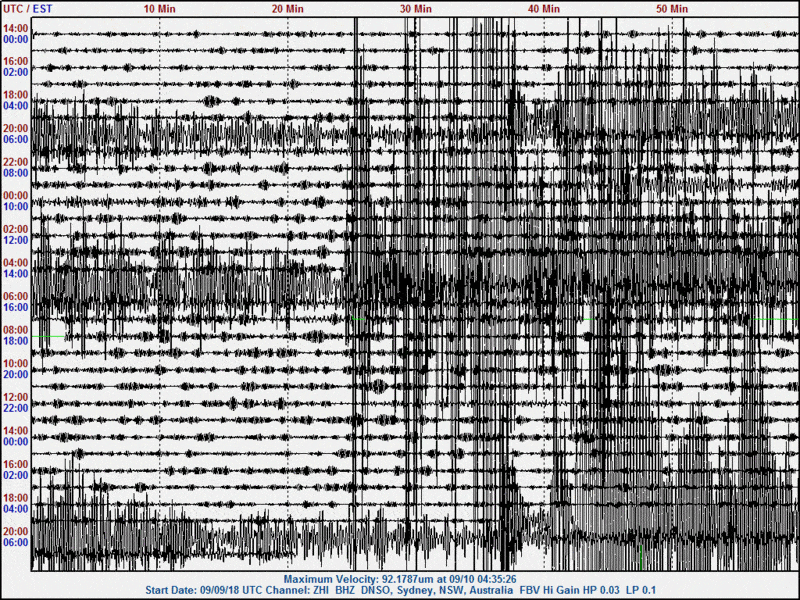
the last 24 hours has seen 3 large quakes in the SW Pacific area

6.5 central Solomon Isl. not far from Kirakira
M 6.5 - 65km NW of Kirakira, Solomon Islands

6.9 southern Kermadec Isl. area
M 6.9 - 61km SW of L'Esperance Rock, New Zealand

6.3 Loyalty Isl area E of New Caledonia
M 6.3 - 202km WNW of Ile Hunter, New Caledonia

the recording from my seismo system
http://www.sydneystormcity.com/seismograms.htm

180909-10  UT M 6.5 Solomons, 6.9 Kermadecs, 6.3 Loyalty Isl zhi.gif
cheers
Dave
 

Attachments

  • 180909-10  UT M 6.5 Solomons, 6.9 Kermadecs, 6.3 Loyalty Isl zhi.gif
    180909-10 UT M 6.5 Solomons, 6.9 Kermadecs, 6.3 Loyalty Isl zhi.gif
    205.2 KB · Views: 1,179
  • Like
Likes   Reactions: jim mcnamara, Charles Link, Wrichik Basu and 3 others
Earth sciences news on Phys.org
@davenn Just a point of clarification for us ignorant types, please. Suppose two unrelated seismic events are concurrent, i.e., overlapping in time. Using the seismic graph, how can you differentiate them?
 
  • Like
Likes   Reactions: BillTre
jim mcnamara said:
Suppose two unrelated seismic events are concurrent, i.e., overlapping in time. Using the seismic graph, how can you differentiate them?

OK this does happen from time to time, actually reasonably regularly.
Mainly with a large event with one or more aftershocks buried in the larger events' signal. I personally haven't been able to see,
say a, M5.5 aftershock that is buried in the M7.2 mainshock if they have occurred within a minute of each other.

here's a recent example ….
Main shock
M 8.2 - 286km NNE of Ndoi Island, Fiji
2018-08-19 00:19:40 (UTC)

Aftershock
M 6.3 - 268km NNE of Ndoi Island, Fiji
2018-08-19 00:23:06 (UTC)

On my recording, I couldn't tell that there were 2 events separated by ~ 4 minutes. But the experts could :smile:

upload_2018-9-12_13-18-4.png
How they do it, I am not sure. Maybe I need to send some emails and see if they will tell me. :biggrin:

Now for the same or closely times events that are separated by some distance, then it becomes easy to differentiate the events using a seismograph network.
as there will always be one or more sensors in the network that are closer to one of those 2 events that what the other sensors are.
It then just becomes a matter of the timing of the P wave arrivals at the various network sensors from which they can then produce locations for the events.hope that helps

Dave
 

Attachments

  • upload_2018-9-12_13-18-4.png
    upload_2018-9-12_13-18-4.png
    138.3 KB · Views: 1,082
Last edited:
  • Like
Likes   Reactions: jim mcnamara and BillTre
OK with a bit of playing around with filtering. Mainly doing high pass filtering so I could cut out a large portion of the
lower frequency signals. This helps the P wave arrivals from both events to stand out clearer.
I did a 6 pole hi-pass filtered from 1Hz

P arrivals.JPG
 

Attachments

  • P arrivals.JPG
    P arrivals.JPG
    43.2 KB · Views: 1,055
  • Like
Likes   Reactions: Drakkith, jim mcnamara and BillTre

Similar threads

  • · Replies 2 ·
Replies
2
Views
3K