A couple basic conceptual questions

  • Thread starter Thread starter haydn
  • Start date Start date
  • Tags Tags
    Conceptual Couple
haydn
Messages
26
Reaction score
0
Question 1:
labdiagram1.jpg


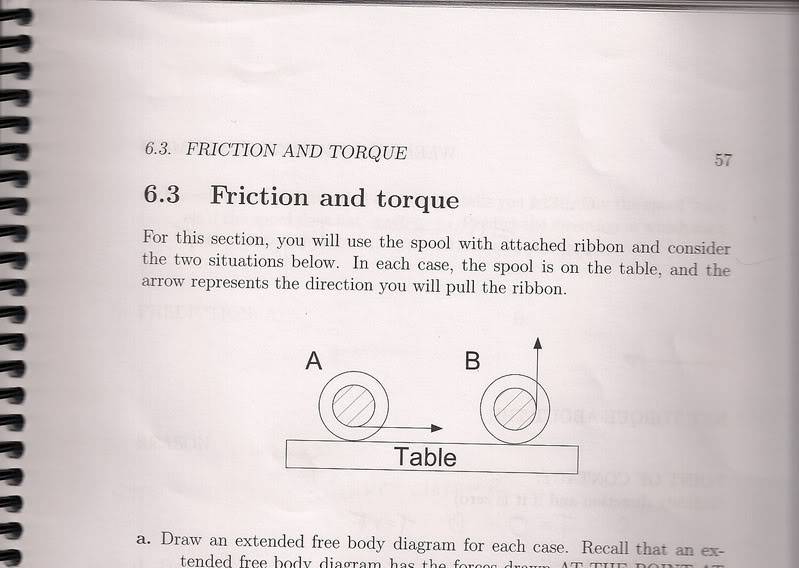
I was told here that in Case A, the torque is equal to zero. I'm not really seeing that. I know torque is equal to rFsin\theta. If I draw a vector from the rotation point (the very center of the spool) to the point where the force is being applied, I get that the force and r are perpendicular, so sin\theta=1. Where am I going wrong? I was told that the torque in case B is rF, which I can clearly see by the same reasoning.

Question 2:
labdiagram2.jpg


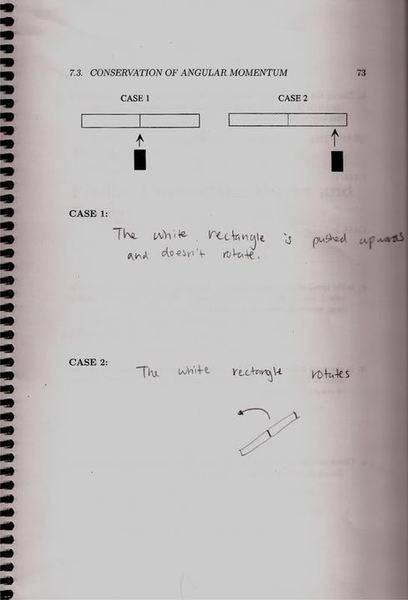
For both cases, I was told the net force and net torque on the system is 0. The system is considered to be both of the objects. If someone could explain this I'd appreciate it.


Thanks.
 
Physics news on Phys.org
"net"

haydn said:
I was told here that in Case A, the torque is equal to zero. I'm not really seeing that.

For both cases, I was told the net force and net torque on the system is 0. The system is considered to be both of the objects. If someone could explain this I'd appreciate it.

Hi haydn! :smile:

(i'm assuming that the friction is preventing the spool from moving)

If the spool isn't moving, then yes the net torque is zero.

The net torque is the sum of the torque from the ribbon and the torque (or moment … same thing :biggrin:) from the friction force (and, technically the torque of the weight also, though if you take torque about the centre, then that will be zero :wink:)

Question 2 is similar … you use the net force or torque, which means adding all the forces or torques. :smile:
 
Thanks for the reply. I'm not sure I'm understanding your explanation completely. Please tell me if I'm right or wrong here.

For my first question, in case A, the net torque is 0 because the friction force and the force applied via the ribbon cancel each other out. So incorporating the equation t=rFsin\theta, you would plug the net force, 0 into the equation?

Then for case B on the second question though, there are two force components, friction and the force applied via the ribbon... wouldn't this result in a net force at some angle other than 90 degrees? I was told thought that for case B, torque is just equal to rF.

Thanks for the help.
 
I'm really not following what you're doing.

The question quite clearly tells you to start by drawing "an extended free body diagram for each case".

Have you done this? What does it show? What equations can you get from it?
 
Yes I drew free body diagrams. For case A I have a force going to the right via the ribbon and a friction force going to the left. I believe these cancel out for a net force of 0.

For case B I have a force going straight up via the ribbon and a friction force perpendicular to that, going to the left along the table. I don't get how the net torque in this case is equal to rF.
 
haydn said:
Yes I drew free body diagrams.

No you didn't …

what about the other forces?​
 

Similar threads

  • · Replies 30 ·
2
Replies
30
Views
4K
  • · Replies 8 ·
Replies
8
Views
2K
  • · Replies 5 ·
Replies
5
Views
3K
  • · Replies 6 ·
Replies
6
Views
3K
  • · Replies 25 ·
Replies
25
Views
2K
  • · Replies 32 ·
2
Replies
32
Views
2K
  • · Replies 4 ·
Replies
4
Views
2K
  • · Replies 7 ·
Replies
7
Views
2K
Replies
6
Views
2K