A couple of questions about photons and superposition..

Click For Summary
SUMMARY

This discussion centers on the behavior of photons passing through polarization filters A and B, with A at 0° and B at 30°. After passing through filter A, the photon is not in a superposition of polarization states but is represented as a superposition of states along different axes, specifically as ##\frac{\sqrt{3}}{2}|30\rangle+\frac{1}{2}|120\rangle##. The probability P of the photon passing through filter B is calculated using the Born rule, yielding P = cos²(30°) = 0.75. The conversation emphasizes that while the photon has a 100% chance of passing through a horizontally oriented filter, it does not possess a definite polarization in any direction.

PREREQUISITES
  • Understanding of quantum mechanics principles, particularly superposition.
  • Familiarity with polarization filters and their angles.
  • Knowledge of the Born rule in quantum mechanics.
  • Basic mathematical skills to interpret quantum state representations.
NEXT STEPS
  • Study the mathematical formalism of quantum mechanics, focusing on state representations.
  • Learn about the implications of superposition in different basis states.
  • Research the Born rule and its applications in quantum probability calculations.
  • Explore advanced topics in quantum optics, particularly the behavior of photons through multiple filters.
USEFUL FOR

Students and professionals in physics, particularly those specializing in quantum mechanics and optics, as well as anyone interested in the foundational concepts of photon behavior and polarization.

Karagoz
Messages
51
Reaction score
5
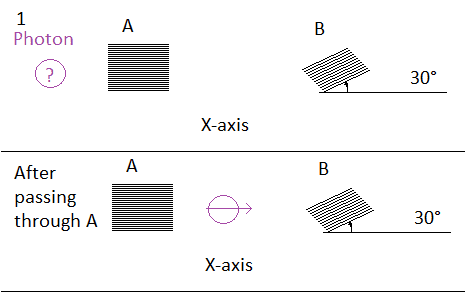
There are two polarization filters, A and B.
Photon.png


Polarization filter A has angle of 0° and B has an angle of 30°.

A photon is in superposition, so it doesn't have a definite polarization axis. The likelihood it's passing through a filter is depend on the difference between angle of the polarization filter A and angle of the polarization axis of photon.

But let's say the photon did pass through the filter A, and the photon's axis is now parallell with the filter A's axis (and X axis).

After passing through filter A, is that photon still in a superposition, or does this photon now have a definite polarization axis, or is it still in superposition?

The likelihood P of that photon passing through polarization filter B, is it P = cos^2(30°) = 0.75 ?
 

Attachments

  • Photon.png
    Photon.png
    2.8 KB · Views: 1,159
  • Like
Likes   Reactions: Fraser MacDonald
Physics news on Phys.org
Karagoz said:
After passing through filter A, is that photon still in a superposition, or does this photon now have a definite polarization axis, or is it still in superposition?
After it passes through the first filter, it is in the state "100% chance of passing through a horizontally oriented filter". That state is not a superposition of horizontally polarized and vertically polarized. However, it is a superposition of polarization along other axes. In particular, it is equal to ##\frac{\sqrt{3}}{2}|30\rangle+\frac{1}{2}|120\rangle## where ##|30\rangle## is the state "100% chance of passing through a filter at 30 degrees from horizontal" and ##|120\rangle## is the state "100% chance of passing through a filter perpendicular to 30 degrees". Apply the Born rule to that superposition and you will see that the photon does in fact have a .75 probability of passing the 30-degree filter.

(Note that I have carefully avoided saying that the photon has a definite polarization in any direction. It never does - "100% chance of passing through a horizontally oriented filter" is not the same thing as "definitely polarized on a horizontal axis")
 
  • Like
Likes   Reactions: bhobba, DrChinese and Lord Jestocost
Nugatory said:
(Note that I have carefully avoided saying that the photon has a definite polarization in any direction. It never does - "100% chance of passing through a horizontally oriented filter" is not the same thing as "definitely polarized on a horizontal axis")
Unless that's what you define "definite polarisation" as... Just sayin'.
 
Whether something is in superposition depends on your choice of basis states. A state could be in superposition in one set of basis states and not in another.
 
Derek P said:
Unless that's what you define "definite polarisation" as... Just sayin'.
Fair enough, but do you want to take a B-level thread into that swamp? :)
The mathematical formalism says what I said and no more, so that's as much as I'm going to say in this thread.
 
  • Like
Likes   Reactions: bhobba, Derek P and DrChinese
Nugatory said:
Fair enough, but do you want to take a B-level thread into that swamp? :)

Nooooo... We need to drain that swamp. :smile:

PS As I go to "like" your post, I realize you are at 3500 likes already. Impressive.
 
DrChinese said:
3500 likes
3,502 actually :biggrin:
 

Similar threads

Replies
11
Views
2K
  • · Replies 27 ·
Replies
27
Views
2K
  • · Replies 5 ·
Replies
5
Views
2K
  • · Replies 40 ·
2
Replies
40
Views
5K
  • · Replies 80 ·
3
Replies
80
Views
8K
  • · Replies 11 ·
Replies
11
Views
2K
  • · Replies 3 ·
Replies
3
Views
1K
  • · Replies 8 ·
Replies
8
Views
2K
  • · Replies 19 ·
Replies
19
Views
2K
  • · Replies 7 ·
Replies
7
Views
2K