A discrete-time queue Markov Chain problem

Click For Summary
SUMMARY

The discussion centers on solving a discrete-time queue Markov Chain problem involving a transition probability matrix with five states. The participants confirm that the transition probabilities for states a0, a1, a2, and a3 are all equal to 1/4, while b1 and b2 are determined to be 1/4 and 1/2, respectively. The conversation also addresses the calculation of expected time until the buffer reaches capacity and how to handle waste when arrivals exceed buffer capacity. Participants emphasize the importance of ensuring the transition matrix is a right stochastic matrix.

PREREQUISITES
  • Understanding of Markov Chains and transition probability matrices
  • Familiarity with stochastic processes and their properties
  • Knowledge of calculating expected values in probability theory
  • Proficiency in using LaTeX for mathematical formatting
NEXT STEPS
  • Study the properties of right stochastic matrices in Markov Chains
  • Learn about calculating expected time in discrete-time Markov Chains
  • Explore the concept of waste in queuing theory and its mathematical representation
  • Practice formatting mathematical expressions using LaTeX for clarity in communication
USEFUL FOR

Students and professionals in operations research, queuing theory, and stochastic processes, particularly those working with Markov Chains and discrete-time systems.

Joe1998
Messages
36
Reaction score
4
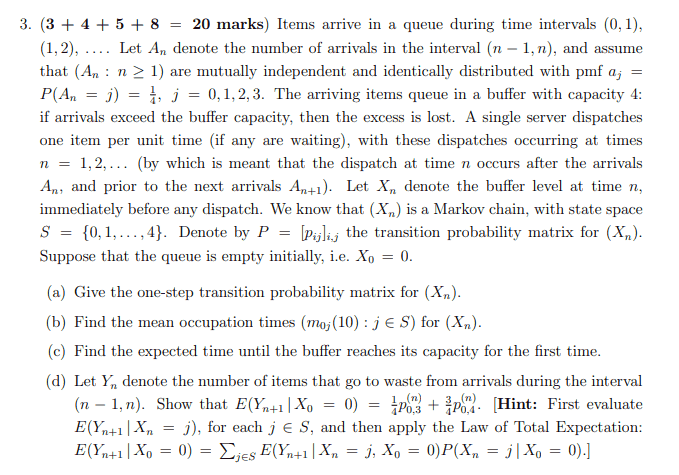
The following problem is seriously tricky and I urgently need help with it, thanks.
phpCahCVW.png


For part a: we have the following transition probability matrix

P = a0 a1 a2 a3

a0 a1 a2 a3

0 a0 a1 b2

0 0 a0 b1

Now, is a0 = a1 = a2 = a3 = 1/4? And is b1 = 1/4 whereas b2 = 1/4 + 1/4 = 1/2?

Note that bk = P(An ≥ 4) = ∑ aj (Where the sum is over all j≥ K) ; and aj = P(An = j) , j = 0,1,2,3.


For part b: is it just (m0j(10) / 11) = (m0j(10) / 11) and (m1j(10) / 11), etc.? Of course we calculate P10, right?


For part c: Does that mean we are dealing with Xn = 4? And to calculate the expected time until the buffer reaches its capacity for the first time, then do we just use the formula (mij(n) / n+1)? If yes, then at what values of i,j and n do we look at? E.g., is it m04(10) / 10+1, or...?


For part d: Since in the question it says that "if arrivals exceed the buffer capacity, then the excess is lost", then I understand that Yn is representing that waste. Now, do we calculate the transition matrix for Yn or what? Because I seriously have no idea how to even solve this question, so any quick help would be really appreciate it because I have very limited time left.

Thanks for your help, I really appreciate it.
Kind regards
 
  • Wow
Likes   Reactions: nuuskur
Physics news on Phys.org
It's virtually unreadable. You have five states, therefore the transition matrix is ##5\times 5##. When you have a candidate for the transition matrix, check it's a right stochastic matrix, otherwise your result would be wrong.

I do not have the mental capacity required to decipher the rest of this :nb) My condolences to your grader. Please, format it with TeX, it's not implemented without reason.

Your being in a hurry is irrelevant. It is your responsibility to get things done on time.
 
Last edited:
nuuskur said:
It's virtually unreadable. You have five states, therefore the transition matrix is ##5\times 5##. When you have a candidate for the transition matrix, check it's a right stochastic matrix, otherwise your result would be wrong.

I do not have the mental capacity required to decipher the rest of this :nb) My condolences to your grader. Please, format it with TeX, it's not implemented without reason.

Your being in a hurry is irrelevant. It is your responsibility to get things done on time.
Do you have any idea how to approach part c or d?
 
Last edited:
Joe1998 said:
Do you have any idea how to approach part c or d?
Yes, start by showing your answer for (a): I'll help by giving you a template to amend:
$$
\begin{bmatrix}
\frac{1}{4} & \frac{1}{4} & \frac{1}{4} & \frac{1}{4} & \frac{1}{4} \\
\end{bmatrix}
$$
 
  • Like
Likes   Reactions: nuuskur and PeroK
Yeah I know how to do parts a and b, I have already done them.

Part a:
1/4 1/4 1/4 1/4 0

0 1/4 1/4 1/4 1/4

0 0 1/4 1/4 1/2

0 0 0 1/4 3/4

0 0 0 0 1

Part b:
I just calculate the sum of P^m for m = 0,1,2,3,4,5,6,7,8,9,10 and then add up the first row.

Now, I am stuck at parts c and d, so any help would ne appreciate it.
 
  • Sad
  • Wow
Likes   Reactions: nuuskur and pbuk
pbuk said:
Yes, start by showing your answer for (a): I'll help by giving you a template to amend:
$$
\begin{bmatrix}
\frac{1}{4} & \frac{1}{4} & \frac{1}{4} & \frac{1}{4} & \frac{1}{4} \\
\end{bmatrix}
$$
If you can't work out how to copy and amend that template, copy the code below into your message.
Code:
$$
\begin{bmatrix}
\frac{1}{4} & \frac{1}{4} & \frac{1}{4} & \frac{1}{4} & 0 \\
\frac{1}{4} & \frac{1}{4} & \frac{1}{4} & \frac{1}{4} & \frac{1}{4} \\
\end{bmatrix}
$$

Only the first row of your answer to (a) is correct.
 
pbuk said:
If you can't work out how to copy and amend that template, copy the code below into your message.
Code:
$$
\begin{bmatrix}
\frac{1}{4} & \frac{1}{4} & \frac{1}{4} & \frac{1}{4} & 0 \\
\frac{1}{4} & \frac{1}{4} & \frac{1}{4} & \frac{1}{4} & \frac{1}{4} \\
\end{bmatrix}
$$

Only the first row of your answer to (a) is correct.
Wait, why only my first row is correct? I got it checked by my professor and he confirmed that it is correct! So why do you think it is not correct?
 
Take for instance your last row representing the transitions from the state where the buffer contains 4 items immediately before dispatch (i.e. it is full) at time ## n ## . The next thing that happens is that an item is dispatched, so the buffer contains 3 items, and then {0..3} items arrive with equal probability. If 0 items arrive between times ## n ## and ## n + 1 ## (with probability ## \frac 1 4 ##) then there will still be only 3 items at time ## n + 1 ##.
 
pbuk said:
Take for instance your last row representing the transitions from the state where the buffer contains 4 items immediately before dispatch (i.e. it is full) at time ## n ## . The next thing that happens is that an item is dispatched, so the buffer contains 3 items, and then {0..3} items arrive with equal probability. If 0 items arrive between times ## n ## and ## n + 1 ## (with probability ## \frac 1 4 ##) then there will still be only 3 items at time ## n + 1 ##.
Ok so let's not waste time on parts a and b, because I have checked with my professor and said they are correct, so all what I am asking is if you could give me some help, tips and guidance regarding how to do parts c and d, thanks.
 
  • Haha
Likes   Reactions: nuuskur
  • #10
Joe1998 said:
Ok so let's not waste time on parts a and b, because I have checked with my professor and said they are correct, so all what I am asking is if you could give me some help, tips and guidance regarding how to do parts c and d, thanks.
For part c), in general, if something happens for the first time in phase ##n##, then it didn't happen in phases ##1## to ##n -1## and then did happen. That suggests an interative or inductive approach here.

I think this is now too advanced to avoid Latex. I have a particular inability to read unformatted mathematics.
 
  • Like
Likes   Reactions: pbuk
  • #11
PeroK said:
For part c), in general, if something happens for the first time in phase ##n##, then it didn't happen in phases ##1## to ##n -1## and then did happen. That suggests an interative or inductive approach here.

I think this is now too advanced to avoid Latex. I have a particular inability to read unformatted mathematics.
Ok, what about part d, how to go about it?
Thanks
 
  • #12
Joe1998 said:
Ok, what about part d, how to go about it?
What about following the expansive hint in the question?
 
  • Like
Likes   Reactions: pbuk
  • #13
PeroK said:
What about following the expansive hint in the question?
Yeah cool, thanks.
 

Similar threads

  • · Replies 1 ·
Replies
1
Views
1K
  • · Replies 3 ·
Replies
3
Views
2K
  • · Replies 8 ·
Replies
8
Views
2K
Replies
9
Views
2K
Replies
1
Views
2K
Replies
24
Views
4K
  • · Replies 3 ·
Replies
3
Views
3K
  • · Replies 9 ·
Replies
9
Views
7K
Replies
1
Views
4K
Replies
3
Views
2K