A Fact I Observed While Looking at the Proof of the Pythagorean Theorem.

Click For Summary
SUMMARY

The discussion centers around a conjecture regarding the relationship between segments in a right-angled triangle, specifically that segment AP is parallel to segment BD. The proof involves coordinate geometry, where points are defined based on angle ABC, leading to the conclusion that AP is perpendicular to BC, thus confirming its parallelism to BD. The participants also express a desire for a Euclidean proof that utilizes the right angle at A, while referencing Ceva's Theorem as a potential tool for further exploration.

PREREQUISITES
  • Understanding of right-angled triangles and their properties
  • Familiarity with coordinate geometry and the use of coordinates in proofs
  • Knowledge of cyclic quadrilaterals and their properties
  • Basic understanding of Ceva's Theorem and its applications in geometry
NEXT STEPS
  • Explore the applications of Ceva's Theorem in triangle geometry
  • Study the properties of cyclic quadrilaterals in detail
  • Learn about Euclidean proofs and their significance in geometry
  • Investigate advanced coordinate geometry techniques for triangle proofs
USEFUL FOR

Mathematics students, geometry enthusiasts, educators looking to teach Euclidean geometry, and anyone interested in advanced triangle properties and proofs.

caffeinemachine
Gold Member
MHB
Messages
799
Reaction score
15
Let $ABC$ be a right angled triangle, where the right angle is at $A$.
Construct squares on $AC$, $AB$ and $BC$ as shown. Let $P$ be the point of intersection of $BK$ and $FC$ (Note that $P$ is not marked in the figure).

Then I conjecture that $AP$ is parallel to $BD$.View attachment 4630What I tried:By obsercing that $\Delta FBC\cong \Delta ABD$, we see that $\angle BAC=\angle BFC$.
Therefore, if $X$ is the point of intersection of $FC$ and $AD$, we see that $BFAX$ is a cyclic quadrilateral.This gives us that $AD\perp FC$, and similarly $BK\perp AE$. But I couldn't go any further.
 

Attachments

  • Screenshot from 2015-08-11 13:46:12.png
    Screenshot from 2015-08-11 13:46:12.png
    6 KB · Views: 157
Mathematics news on Phys.org
Your conjecture is correct (but this is not the sort of proof that you wanted).

I took coordinates with $B$ as the origin, and $C = (1,0)$. If $\theta$ is the angle $ABC$ then $A = (\cos^2\theta, \sin\theta\cos\theta)$, $F = (-\sin\theta\cos\theta, \cos^2\theta)$ and $K = (1+\sin\theta\cos\theta, \sin^2\theta).$ The equation of the line $CF$ is $y(1+\sin\theta\cos\theta) = (1-x)\cos^2\theta$, and the equation of $BK$ is $y(1+\sin\theta\cos\theta) = x\sin^2\theta.$ The $x$-coordinate of the point $P$ where these lines intersect is $\cos^2\theta$, which is the same as the $x$-coordinate of $A$. This shows that $AP$ is perpendicular to $BC$ and therefore parallel to $BD$.

I don't know if there is anything about that proof that might help in finding a Euclidean proof of the result. The proof must somehow exploit the fact that there is a right angle at $A$, and I don't see how to bring that in.
 
Opalg said:
Your conjecture is correct (but this is not the sort of proof that you wanted).

I took coordinates with $B$ as the origin, and $C = (1,0)$. If $\theta$ is the angle $ABC$ then $A = (\cos^2\theta, \sin\theta\cos\theta)$, $F = (-\sin\theta\cos\theta, \cos^2\theta)$ and $K = (1+\sin\theta\cos\theta, \sin^2\theta).$ The equation of the line $CF$ is $y(1+\sin\theta\cos\theta) = (1-x)\cos^2\theta$, and the equation of $BK$ is $y(1+\sin\theta\cos\theta) = x\sin^2\theta.$ The $x$-coordinate of the point $P$ where these lines intersect is $\cos^2\theta$, which is the same as the $x$-coordinate of $A$. This shows that $AP$ is perpendicular to $BC$ and therefore parallel to $BD$.

I don't know if there is anything about that proof that might help in finding a Euclidean proof of the result. The proof must somehow exploit the fact that there is a right angle at $A$, and I don't see how to bring that in.
Hey Opalg. Take a look at this. geometry - A Fact I Observed While Looking at the Proof of Pythagorean Theorem. - Mathematics Stack Exchange
 
caffeinemachine said:
Very neat! When I see a really clever proof like that, it reminds me of how much Euclidean geometry appealed to me in high school sixty years ago. In Britain, this sort of geometry does not feature in school mathematics at all any more. I think that is a great pity, because it is such a good way to attract (some) students to mathematics and to teach them the concept of proof.
 
Opalg said:
Very neat! When I see a really clever proof like that, it reminds me of how much Euclidean geometry appealed to me in high school sixty years ago. In Britain, this sort of geometry does not feature in school mathematics at all any more. I think that is a great pity, because it is such a good way to attract (some) students to mathematics and to teach them the concept of proof.
I share the sentiment Opalg. In the wake of modern mathematics, Euclidean geometry is now not important in terms of research. Thus even some of the people good at math tend to ignore the subject.
 
CaffeineMachine, when I read your question it almost immediately occurred to me that Ceva's theorem,
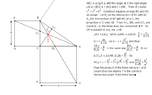
Ceva's Theorem might be applicable. The following attachment shows that indeed this theorem implies the result. My apologies for changing notation, but for me a right triangle should satisfy $a^2+b^2=c^2$.

Classical geometry is a beautiful subject, and I really enjoy it. However, many people, even those like me with a mathematical bent, find the subject to be quite challenging. For beginning students even "simple" ideas like similar triangles can be confusing. It's bad enough to identify corresponding sides, but after that there are just too many equations involving the sides. So I think maybe it's a good idea to bypass geometry as a first course. I'm afraid too many beginning students in geometry say: if this is math, it's too hard for me.

View attachment 4642
 

Attachments

  • johng005.png
    johng005.png
    14.1 KB · Views: 123
Last edited by a moderator:
johng said:
CaffeineMachine, when I read your question it almost immediately occurred to me that Ceva's theorem,
Ceva's Theorem might be applicable. The following attachment shows that indeed this theorem implies the result. My apologies for changing notation, but for me a right triangle should satisfy $a^2+b^2=c^2$.

Classical geometry is a beautiful subject, and I really enjoy it. However, many people, even those like me with a mathematical bent, find the subject to be quite challenging. For beginning students even "simple" ideas like similar triangles can be confusing. It's bad enough to identify corresponding sides, but after that there are just too many equations involving the sides. So I think maybe it's a good idea to bypass geometry as a first course. I'm afraid too many beginning students in geometry say: if this is math, it's too hard for me.
That's just super nice and a bit more easy to come up with than the one I had given a link to.
 

Similar threads

Replies
4
Views
4K
  • · Replies 8 ·
Replies
8
Views
5K
  • · Replies 40 ·
2
Replies
40
Views
5K
  • · Replies 62 ·
3
Replies
62
Views
12K