A geometric proof (minimizing the length of two lines in a rectangle)

Click For Summary
SUMMARY

The discussion focuses on a geometric proof aimed at minimizing the length of two lines within a rectangle, specifically addressing the relationship between angles and line segments. The user explores the equality of angles (^c=^d) and their implications on line lengths, leading to the expression AP'+BP'=2AP' and the challenge of proving the inequality 1/sin(a+b)+1/sin(a-b)>2/sin(a) for the range 0 PREREQUISITES

  • Understanding of basic geometric principles and properties of triangles
  • Familiarity with trigonometric functions, particularly sine
  • Knowledge of calculus concepts, particularly in relation to geometric proofs
  • Ability to manipulate and transform geometric figures
NEXT STEPS
  • Study the properties of triangles and their angles in geometric proofs
  • Research trigonometric identities and their applications in inequalities
  • Explore geometric transformations, specifically reflections and their effects on line segments
  • Learn about calculus-based approaches to optimization problems in geometry
USEFUL FOR

Mathematicians, geometry enthusiasts, students studying advanced mathematics, and anyone interested in geometric proofs and optimization techniques.

ali PMPAINT
Messages
44
Reaction score
8
Homework Statement
Show that in a rectrangular ABCD, with a point P on CD, Show that AP+BP is smallest when CP=DP
Relevant Equations
Maybe sin(a+b)=sin(a)cos(b)+cos(a)sin(b) and sin(a-b)=sin(a)cos(b)-cos(a)sin(b)
So, I know it can be proven using calculus, but I need the geometric one.
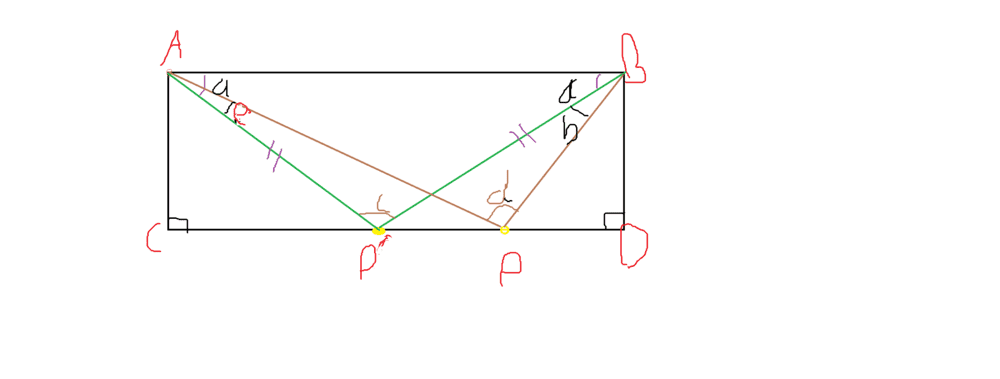
244525

So, I got that ^c=^d and therefor, the amount of increment in one of a, is equal to the other(^e=^b). (Also 0<a+b<Pi/2)
And AP'=BP'=BD/sin(a) and BP=BD/sin(a+b) and AP=BD/sin(a-b).
AP'+BP'=2AP'=2BD/sin(a) and AP+BP=BD(1/sin(a+b)+1/sin(a-b))
Know I'm trying to show 1/sin(a+b)+1/sin(a-b)>2/sin(a) for 0<a+b<Pi/2 , But no result.
Any suggestion please?
 

Attachments

  • Untitled.png
    Untitled.png
    6.9 KB · Views: 321
Last edited by a moderator:
Physics news on Phys.org
Flip over the line CD to get A' and B' as corners of rectangle A'B'B A
What's the shortest line from A'to B ?
 
  • Like
Likes ali PMPAINT
BvU said:
Flip over the line CD to get A' and B' as corners of rectangle A'B'B A
What's the shortest line from A'to B ?
Thanks for the hint!
244544

On triangle BP'A', we have BP'+A'P'>BA' and beacuase BA'=2BO=AO+BO , and BP'+A'P'=BP'+AP' , we get BP'+AP'>AO+BO
 
  • Like
Likes epenguin

Similar threads

  • · Replies 4 ·
Replies
4
Views
2K
  • · Replies 5 ·
Replies
5
Views
2K
Replies
2
Views
2K
  • · Replies 8 ·
Replies
8
Views
2K
Replies
4
Views
2K
Replies
2
Views
2K
  • · Replies 5 ·
Replies
5
Views
3K
  • · Replies 11 ·
Replies
11
Views
3K
  • · Replies 3 ·
Replies
3
Views
2K
  • · Replies 2 ·
Replies
2
Views
2K