ali PMPAINT
- 44
- 8
- Homework Statement
- Show that in a rectrangular ABCD, with a point P on CD, Show that AP+BP is smallest when CP=DP
- Relevant Equations
- Maybe sin(a+b)=sin(a)cos(b)+cos(a)sin(b) and sin(a-b)=sin(a)cos(b)-cos(a)sin(b)
So, I know it can be proven using calculus, but I need the geometric one.
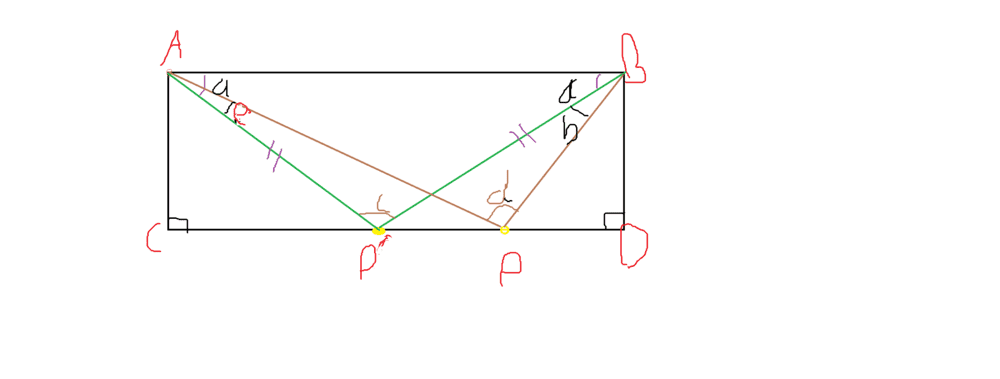
So, I got that ^c=^d and therefor, the amount of increment in one of a, is equal to the other(^e=^b). (Also 0<a+b<Pi/2)
And AP'=BP'=BD/sin(a) and BP=BD/sin(a+b) and AP=BD/sin(a-b).
AP'+BP'=2AP'=2BD/sin(a) and AP+BP=BD(1/sin(a+b)+1/sin(a-b))
Know I'm trying to show 1/sin(a+b)+1/sin(a-b)>2/sin(a) for 0<a+b<Pi/2 , But no result.
Any suggestion please?
So, I got that ^c=^d and therefor, the amount of increment in one of a, is equal to the other(^e=^b). (Also 0<a+b<Pi/2)
And AP'=BP'=BD/sin(a) and BP=BD/sin(a+b) and AP=BD/sin(a-b).
AP'+BP'=2AP'=2BD/sin(a) and AP+BP=BD(1/sin(a+b)+1/sin(a-b))
Know I'm trying to show 1/sin(a+b)+1/sin(a-b)>2/sin(a) for 0<a+b<Pi/2 , But no result.
Any suggestion please?
Attachments

Last edited by a moderator: