A Guide to Growing Vegetables in Containers

  • Context:
  • Thread starter Thread starter Albert1
  • Start date Start date
Join the discussion
Registration is free. Ask a follow-up in this thread, or start your own.
7 replies · 2K views
Albert1
Messages
1,221
Reaction score
0

Attachments

  • Angle AED.jpg
    Angle AED.jpg
    8.4 KB · Views: 137
Mathematics news on Phys.org
I'm thinking perhaps you have another elegant solution at hand but I'm going to post my "weak" solution here nevertheless:o:
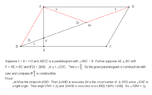
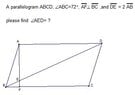
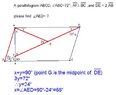
First we let $\angle AED=\alpha$, and $DE=2k,\,AB=k$.

Applying the Sine Rule on both the triangles $AED$ and $ABE$ we see that

$\dfrac{2k}{\sin 90^{\circ}}=\dfrac{AE}{\sin (90-\alpha)^{\circ}}$ and $\dfrac{k}{\sin \alpha}=\dfrac{AE}{\sin (\alpha-18)^{\circ}}$

Dividing the first by the second equation yields

$\begin{align*}\sin (\alpha-18)^{\circ}&=2\sin \alpha \sin (90-\alpha)^{\circ}\\&=2\sin \alpha \cos \alpha\\&=\sin 2\alpha\end{align*}$

Since $0<2\alpha<180^{\circ}$, we must alter the expression inside the sine function of $\sin (\alpha-18)^{\circ}$ such that we have

$\sin (180-(\alpha-18))^{\circ}=\sin 2\alpha$

Solving it for $\alpha$ we obtain $\alpha=66^{\circ}$.
 
Last edited:
anemone said:
I'm thinking perhaps you have another elegant solution at hand but I'm going to post my "weak" solution here nevertheless:o:
First we let $\angle AED=\alpha$, and $DE=2k,\,AB=k$.

Applying the Sine Rule on both the triangles $AED$ and $ABE$ we see that

$\dfrac{2k}{\sin 90^{\circ}}=\dfrac{AE}{\sin (90-\alpha)^{\circ}}$ and $\dfrac{k}{\sin \alpha}=\dfrac{AE}{\sin (\alpha-18)^{\circ}}$

Dividing the first by the second equation yields

$\begin{align*}\sin (\alpha-18)^{\circ}&=2\sin \alpha \sin (90-\alpha)^{\circ}\\&=2\sin \alpha \cos \alpha\\&=\sin 2\alpha\end{align*}$

Since $0<2\alpha<180^{\circ}$, we must alter the expression inside the sine function of $\sin (\alpha-18)^{\circ}$ such that we have

$\sin (180-(\alpha-18))^{\circ}=\sin 2\alpha$

Solving it for $\alpha$ we obtain $\alpha=66^{\circ}$.
your solution is also very nice!
 
Albert.
I found your parallelogram very interesting. You may well have observed this, but here is something. If angle ABC in the parallelogram is "arbitrary" $$\theta$$, the parallelogram is constructible with ruler and compass iff $${\theta\over 3}$$ is constructible. Shown is an angle of 60 degrees. Of course, a 20 degree angle is not constructible.View attachment 3336
 

Attachments

  • MHBgeometry13.png
    MHBgeometry13.png
    10.2 KB · Views: 123
johng said:
Albert.
I found your parallelogram very interesting. You may well have observed this, but here is something. If angle ABC in the parallelogram is "arbitrary" $$\theta$$, the parallelogram is constructible with ruler and compass iff $${\theta\over 3}$$ is constructible. Shown is an angle of 60 degrees. Of course, a 20 degree angle is not constructible.https://www.physicsforums.com/attachments/3336
yes it is very interesting
given $\angle ABC=72^o$
using compass and ruler only ,
Can we construct an angle=$24^o ?$
 
Albert,
Years ago I taught constructibility of numbers from an algebraic standpoint (degree of an extension field). So I remembered cos(20 degree) is not constructible. For 24 degrees:
First, the regular pentagon is constructible and hence an angle of 72. So 3=(72-(45+30)) is constructible. Thus 24 degrees is constructible by constructing 3 degree angles 8 times.

I surfed a little and found the 2500 year old trisection method (due to Hippocrates?) -- Angle Trisection by Hippocrates This is really just a variation of your parallelogram.
 
johng said:
Albert,
Years ago I taught constructibility of numbers from an algebraic standpoint (degree of an extension field). So I remembered cos(20 degree) is not constructible. For 24 degrees:
First, the regular pentagon is constructible and hence an angle of 72. So 3=(72-(45+30)) is constructible. Thus 24 degrees is constructible by constructing 3 degree angles 8 times.

I surfed a little and found the 2500 year old trisection method (due to Hippocrates?) -- Angle Trisection by Hippocrates This is really just a variation of your parallelogram.
johng
well done!