Understanding the Equivalence of Two Mechanical Systems

Click For Summary
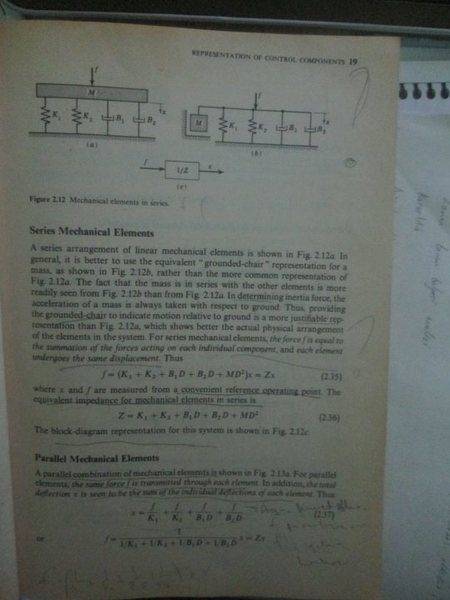
The discussion centers on understanding the equivalence of two mechanical systems depicted in a picture, specifically how force f is distributed among components M, K1, K2, B1, and B2. Clarification is provided that the total force can be expressed through equations linking these elements, particularly emphasizing the relationship in simpler cases, such as two springs in series. The mass M should be conceptualized as a block supported by springs and dashpots, with the external force acting on it. Additionally, it is highlighted that Newton's Second Law states the sum of forces equals M multiplied by acceleration, not that any single force equals that product. This understanding is crucial for grasping the mechanical system's dynamics.
mech-eng
Messages
825
Reaction score
13
I cannot understand the mechanical systems in the picture. In the picture a) how can f is scattered equally to M, K1, K2, B1 and B2 ? Where do you know this? How can two systems be equivalent of each other?

In the picture (b) if f is applied, how can the force on M is Ma, a is acceleration.
IMG_1461.JPG


< Mentor Note -- Improved contrast version of UPLOAD >
View attachment 111153

Source: Automatic Control Engineering by Francis H.Raven

Thank you.
 
Last edited by a moderator:
Engineering news on Phys.org
Text is perfectly clear. But I concede it's a bit weird at first: after all the various elements seem to be in parallel.

Perhaps it becomes clearer to you if you write the equations for a simpler case.

E.g. just the two springs: ##\ f = (K_1 + K_2) x\ .\ ## And you see that ##\ Z_{\rm tot} = Z_1 + Z_2 \ ## -- that's why they call it series.

Now add the mass and write the equation linking ##\ f, \ M, \ K_1, \ K_2 \ ## in a similar form.

Once you get that, the ##C_1p## and ##C_2p## are a piece of cake.
 
Ah, Berk has a copy too ! Or did he just pimp yours :smile:? Mine is a first student edition ( 1961 :rolleyes: ) where it's page 15 with exactly the same text .
 
  • Like
Likes berkeman
I suspect that the beam-like appearance of the mass M is part of what is throwing you off. Instead, think of M as more of a block with two springs and two dashpots supporting it. The external force F acts on the block, as well as forces from each spring and dashpot. All that is of interest here is vertical motion, so ignore the horizontal distribution of elements.

Your question about (b) is not grammatically correct English. Remember what Newton's Second Law says: The SUM of forces on the mass is M*a, not that any single force is M*a.
 
What mathematics software should engineering students use? Is it correct that much of the engineering industry relies on MATLAB, making it the tool many graduates will encounter in professional settings? How does SageMath compare? It is a free package that supports both numerical and symbolic computation and can be installed on various platforms. Could it become more widely used because it is freely available? I am an academic who has taught engineering mathematics, and taught the...

Similar threads

Replies
3
Views
2K
  • · Replies 5 ·
Replies
5
Views
1K
  • · Replies 4 ·
Replies
4
Views
848
  • · Replies 1 ·
Replies
1
Views
987
Replies
6
Views
1K
  • · Replies 4 ·
Replies
4
Views
2K
  • · Replies 2 ·
Replies
2
Views
2K
  • · Replies 5 ·
Replies
5
Views
1K
  • · Replies 17 ·
Replies
17
Views
2K
  • · Replies 5 ·
Replies
5
Views
3K