Understanding Bending Moment Calculations in Mechanical Systems

Click For Summary

Homework Help Overview

The discussion revolves around bending moment calculations in mechanical systems, specifically related to a crankshaft segment under load. Participants are examining the correct formulation of the bending moment and its implications for stress analysis at a specific point on the shaft.

Discussion Character

  • Conceptual clarification, Assumption checking, Problem interpretation

Approaches and Questions Raised

  • Participants are exploring the correct expression for the bending moment, questioning the relevance of the dimensions provided, and discussing the implications of different axes of rotation on the torque and bending moments. There are inquiries about the ambiguity in the problem statement and the potential misquoting of the book answer.

Discussion Status

The discussion is active, with participants providing insights and clarifications regarding the torque and bending moment calculations. Some have suggested that the book answer may contain errors, while others are seeking further explanation on specific aspects of the problem setup.

Contextual Notes

Participants note that the problem statement may have been misquoted, and there is a focus on the specific location of point A on the z-axis, which is critical for the analysis of stresses. The original poster emphasizes the need to clarify the bending moment expression as it relates to the dimensions provided.

Setareh7796
Messages
9
Reaction score
0
Homework Statement
Finding the bending moment caused by force P at point A
Relevant Equations
My incorrect solution: P multiplied by perpendicular distance from point A so the equation becomes=M=P*b2
But the correct solution is M= P* (b2+b1). I don't understand how b2+b1 is the perpendicular distance.
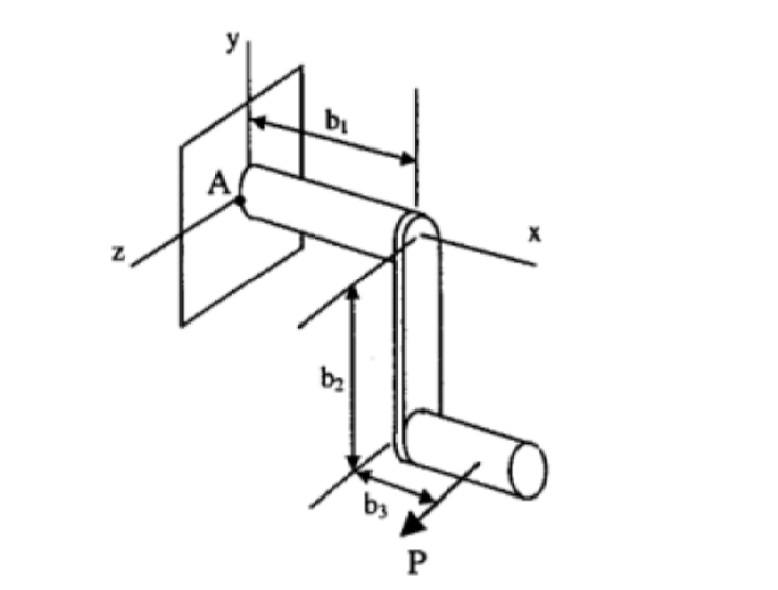
bending moment.jpg
 
Physics news on Phys.org
Setareh7796 said:
But the correct solution is M= P* (b2+b1).
The question is ambiguous. Strictly speaking, it is given by the vector equation, ##\vec M=(\vec b_1+\vec b_2+\vec b_3)\times \vec P##. To see this, blank out everything in the diagram except point A and the force P.
But if they mean the net torque at A after including the reaction from the sleeve enclosing the crankshaft then your answer is correct.
 
haruspex said:
But if they mean the net torque at A after including the reaction from the sleeve enclosing the crankshaft then your answer is correct.

@haruspex I wondered if you could explain this last part? I did look at this question but couldn't see how the torque of P about A could be anything other than ##(\vec{b}_1 + \vec{b}_2 + \vec{b}_3) \times \vec{P}##. Thanks!
 
etotheipi said:
@haruspex I wondered if you could explain this last part? I did look at this question but couldn't see how the torque of P about A could be anything other than ##(\vec{b}_1 + \vec{b}_2 + \vec{b}_3) \times \vec{P}##. Thanks!
It is not shown, but in any sensible arrangement the shaft at A would be enclosed in a supporting sleeve so that it can only rotate about the X axis.
For the purposes of analysing the effectiveness of the mechanism, the only torque of interest is the torque about that axis. Any other torques produced by P would be balanced by reaction from the sleeve.

The book answer, if quoted correctly, is bizarre, so has it or the problem statement been misquoted? Maybe the original said "about the X axis". Or maybe it did use vector notation. But neither makes the book answer correct.
 
  • Informative
Likes   Reactions: etotheipi
haruspex said:
It is not shown, but in any sensible arrangement the shaft at A would be enclosed in a supporting sleeve so that it can only rotate about the X axis.
For the purposes of analysing the effectiveness of the mechanism, the only torque of interest is the torque about that axis. Any other torques produced by P would be balanced by reaction from the sleeve.

Ah right, thanks for clarifying :smile:.
haruspex said:
The book answer, if quoted correctly, is bizarre, so has it or the problem statement been misquoted? Maybe the original said "about the X axis". Or maybe it did use vector notation. But neither makes the book answer correct.

I stared at it for quite a while and couldn't make any sense of it. The quantity ##b_1 + b_2## seems slightly irrelevant. Perhaps there are some details missing, or maybe it's just a mistake!
 
haruspex said:
It is not shown, but in any sensible arrangement the shaft at A would be enclosed in a supporting sleeve so that it can only rotate about the X axis.
For the purposes of analysing the effectiveness of the mechanism, the only torque of interest is the torque about that axis. Any other torques produced by P would be balanced by reaction from the sleeve.

The book answer, if quoted correctly, is bizarre, so has it or the problem statement been misquoted? Maybe the original said "about the X axis". Or maybe it did use vector notation. But neither makes the book answer correct.

The full question is:
For the purpose of analysis, a segment of a crankshaft in a vehicle is presented as shown in Figure Q5. The load P = 1 kN, and the dimensions are b1 = 80 mm, b2 = 120 mm and b3 = 40mm. The diameter of the shaft is d = 20 mm. Determine the maximum tensile, compressive and shear stresses at point A, located on the surface of the shaft at the z-axis


I forgot to mention point A is located on the z axis.
The first step to the full solution is to find the bending moment at point A and according to the correct solution bending moment is M= P *( b1+b2).
 
Setareh7796 said:
The full question is:
For the purpose of analysis, a segment of a crankshaft in a vehicle is presented as shown in Figure Q5. The load P = 1 kN, and the dimensions are b1 = 80 mm, b2 = 120 mm and b3 = 40mm. The diameter of the shaft is d = 20 mm. Determine the maximum tensile, compressive and shear stresses at point A, located on the surface of the shaft at the z-axis


I forgot to mention point A is located on the z axis.
The first step to the full solution is to find the bending moment at point A and according to the correct solution bending moment is M= P *( b1+b2).
That makes a big difference.
If we are concerned with the different kinds of stress on the mechanism then the moments about different axes can be considered separately. The useful working torque about the crankshaft will be associated with shear stress, while torque about the vertical axis will create a bending moment.
That reduces the book error to a simple typo: bending moment should be P(b1+b3).
 
Last edited:

Similar threads

Replies
6
Views
2K
  • · Replies 19 ·
Replies
19
Views
2K
  • · Replies 6 ·
Replies
6
Views
3K
Replies
3
Views
2K
Replies
1
Views
2K
  • · Replies 6 ·
Replies
6
Views
4K
  • · Replies 8 ·
Replies
8
Views
3K
  • · Replies 3 ·
Replies
3
Views
2K
  • · Replies 7 ·
Replies
7
Views
1K
  • · Replies 9 ·
Replies
9
Views
3K