Frabjous
Gold Member
- 1,977
- 2,445
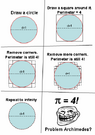
I did a quick google search and it seems this "proof" is erroneous, but I still haven't figured out where the analogy between the staircase and the curve breaks down. The best way to understand the problem with this "proof" is that some of the points on the staircase are not on the curve This issue is not there when we approximate the curve with a polygon (all the points are on the curve), the way Archimedes and Zu Chongzhi did.Frabjous said:This is my favorite* geometric calculation of pi.
View attachment 350043
*favorite does not mean correct
Notice that this curve breaks your perimeter/diameter for circle quality construction.Agent Smith said:I did a quick google search and it seems this "proof" is erroneous, but I still haven't figured out where the analogy between the staircase and the curve breaks down. The best way to understand the problem with this "proof" is that some of the points on the staircase are not on the curve This issue is not there when we approximate the curve with a polygon (all the points are on the curve), the way Archimedes and Zu Chongzhi did.
Of course the proof is erroneous. We know that going in.Agent Smith said:I did a quick google search and it seems this "proof" is erroneous, but I still haven't figured out where the analogy between the staircase and the curve breaks down. The best way to understand the problem with this "proof" is that some of the points on the staircase are not on the curve.
Oh, that's right, visually that is, but I did stress that the critical ratio has to approximate ##\pi##.Frabjous said:Notice that this curve breaks your perimeter/diameter for circle quality construction.
The points that matter to the approximation are on the curve (the points get closer and closer as the number of sides increase).jbriggs444 said:Almost none of the points in the circumscribed/inscribed polygons are on the curve either.
Think about a sequence of stair-step approximations to a circle with more and more sides that are each tinier and tinier. That sequence of stairstep shapes approaches a limiting shape. The limiting shape is the circle, of course.Agent Smith said:@jbriggs444 , the "perimeter of the limit"?
Please stop using fuzzy language. Phrases like "matter to the approximation" are meaningless. The points on a stairstep also get closer and closer as the number of sides increase.Agent Smith said:The points that matter to the approximation are on the curve (the points get closer and closer as the number of sides increase).
In the case of a polygon circumscribing a circle, some of the points always stand outside of the circle about which they are circumscribed.Agent Smith said:In the case of the staircase, some of the points always stand outside of the curve/line being approximated.
And some of them always stand inside the curve being approximated.Agent Smith said:In the case of the staircase, some of the points always stand outside of the curve/line being approximated.
Well, what's the explanation for the error then? ##\pi \ne 4, \pi = 3.14159...##. It can only mean that the curve we're assuming is an approximation of the actual curve (the circle, etc.) isn't what we assume/think it is. We're overmeasuring or overcounting. We could investigate where the extra ##0.8584073464102067615373566167205...## is coming from. I'm sure that would be easy for you, being a science person. Can you take a look into that.jbriggs444 said:Please stop using fuzzy language. Phrases like "matter to the approximation" are meaningless. The points on a stairstep also get closer and closer as the number of sides increase.
I'm not sure this is actually true. For a polygon that is inscribed in the circle or circumscribed around the circle, the angle between the sides approaches 180 degrees as the number of sides increases without bound. In other words, the polygon approaches being a smooth curve, with no angles at all (each "angle" of 180 degrees is just a tangent line to the circle at the "angle" point).jbriggs444 said:That sequence of stairstep shapes approaches a limiting shape. The limiting shape is the circle, of course.
See my post #99 just now. If the limit of the stairsteps is not well-defined, then the limit of the perimeter is not well defined either.Agent Smith said:Well, what's the explanation for the error then?
Yes, but as the NumberOfSides(Polygon) increases, all the points are on the curve/circle. This is not true for the staircase. There are 2 sets of points with a staircase, giving us 2 lines, one connects the top edges of the stairs and the other connects the bottom corners of the stairs. Both sets can't be on the same line/curve, producing the error ##\pi = 4##.PeterDonis said:And some of them always stand inside the curve being approximated.
Only in the limit. At each finite step, the corners of the polygon are not on the circle.Agent Smith said:as the NumberOfSides(Polygon) increases, all the points are on the curve/circle.
For each finite step, this is true. But that doesn't mean it has to also be true in the limit; there is no general rule about limits that entails it.Agent Smith said:There are 2 sets of points with a staircase, giving us 2 lines, one connects the top edges of the stairs and the other connects the bottom corners of the stairs. Both sets can't be on the same line/curve
Got it!PeterDonis said:See my post #99 just now. If the limit of the stairsteps is not well-defined, then the limit of the perimeter is not well defined either.
I should've been clearer. The inscribed polygon's vertices are on the curve being approximated. Archimedes used 2 polygons (circumscribing one and the inscribed one). I have to do the math but my hunch is the inscribed polygon's perimeter more closely approximates the circle's circumference, the outer polygon having the same issue as the staircase approximation. As the number of sides of the polygon increases, the inscribed polygon basically becomes the circle.PeterDonis said:Only in the limit. At each finite step, the corners of the polygon are not on the circle.
For each finite step, this is true. But that doesn't mean it has to also be true in the limit; there is no general rule about limits that entails it.
The correct procedure is to first ask if the limit of the stairsteps is well-defined at all. If it isn't, which is what I argued for in post #99, then it is meaningless to assert any properties of the limit, since there is no well-defined limit for any such properties to apply to.
No, it doesn't. I made the difference clear in post #99.Agent Smith said:the outer polygon having the same issue as the staircase approximation
This is also true of the circumscribed polygon, as I showed in post #99.Agent Smith said:As the number of sides of the polygon increases, the inscribed polygon basically becomes the circle.
I have yet to do the math. To my knowledge, ##\frac{22}{7}## is the upper limit of the rational approximation of ##\pi## (the circumscribing polygon) correct to ##2## decimal places. I have no idea what the lower limit is and how correct it is (the inscribed polygon).PeterDonis said:No, it doesn't. I made the difference clear in post #99.
This is also true of the circumscribed polygon, as I showed in post #99.
So which regular polygon has the level of "circularity" that corresponds to the ##\pi## approximation ##22/7##?Agent Smith said:Insofar as Archimedes' and Zu Chongzhi's ##\pi## approximation is concerned, we're computing the perimeter of the circumscribing and inscribing regular polygons.
The one on the outside, yes? My hunch is the inside polygon's perimeter is more accurate.A.T. said:So which regular polygon has the level of "circularity" that corresponds to the ##\pi## approximation ##22/7##?
It's not about inside or outside. How many sides does the regular polygon have, that corresponds to the ##\pi## approximation ##22/7##?Agent Smith said:The one on the outside, yes? My hunch is the inside polygon's perimeter is more accurate.
Well, I don't know. Archimedes used a 96-gonA.T. said:It's not about inside or outside. How many sides does the regular polygon have, that corresponds to the ##\pi## approximation ##22/7##?
I gave the explanation: The limit of the perimeters is not equal to the perimeter of the limit.Agent Smith said:Well, what's the explanation for the error then?
No. It means that the limit of the perimeters is not equal to the perimeter of the limit.Agent Smith said:##\pi \ne 4, \pi = 3.14159...##. It can only mean that the curve we're assuming is an approximation of the actual curve (the circle, etc.) isn't what we assume/think it is.
We're overmeasuring or overcounting.
I already know. The error is in your expectation that the two figures should be equal.Agent Smith said:We could investigate where the extra ##0.8584073464102067615373566167205...## is coming from. I'm sure that would be easy for you, being a science person. Can you take a look into that.
The point is that not every possible approximation of ##\pi## can be represented by a regular polygon. And when you don't restrict it to regular ones, then you have many differently looking polygons for the same approximation of ##\pi##. Thus the idea that a given approximation of ##\pi## corresponds to a specific amount of "circularity" is flawed.Agent Smith said:Well, I don't know. Archimedes used a 96-gon
Before we can decide what is "actually true", we should have a definition in hand. What does it mean for a sequence of shapes to "approach a shape in the limit"?PeterDonis said:I'm not sure this is actually true. For a polygon that is inscribed in the circle or circumscribed around the circle, the angle between the sides approaches 180 degrees as the number of sides increases without bound. In other words, the polygon approaches being a smooth curve, with no angles at all (each "angle" of 180 degrees is just a tangent line to the circle at the "angle" point).
I have an improved definition. It is essentially identical to the previous one. But it applies to arbitrary topological spaces, even those for which no metric is provided.jbriggs444 said:We are working in a flat two-dimensional metric space.
See also this video:jbriggs444 said:One way of compactly stating the issue is that the limit of the perimeters is not equal to the perimeter of the limit. There is no principle of mathematics by which they should be equal. The two ideas do not "commute".
Edit: Disregard this comment per post #133.Agent Smith said:Well, what's the explanation for the error then? ##\pi \ne 4, \pi = 3.14159...##. It can only mean that the curve we're assuming is an approximation of the actual curve (the circle, etc.) isn't what we assume/think it is. We're overmeasuring or overcounting. We could investigate where the extra ##0.8584073464102067615373566167205...## is coming from. I'm sure that would be easy for you, being a science person. Can you take a look into that.
As I understand the "stairstep" construction, the shapes are not circumscribed after the initial square; there are points on the "stairstep" that are inside the circle, and only the sides that are the remnants of the original sides of the square are tangent to the circle. But I may be misunderstanding the construction.jbriggs444 said:circumscribed stairstep shapes
I don't know what you mean. The circle's perimeter is ##\pi d## always. The perimeter of the square is ##4##, and so is the perimeter of every "stairstep" construction derived from it. What "approximate perimeter of the circle" are you talking about?jack action said:the approximate perimeter of the circle
As I understand the construction, we begin with a square within which a circle is circumscribed.PeterDonis said:As I understand the "stairstep" construction, the shapes are not circumscribed after the initial square; there are points on the "stairstep" that are inside the circle, and only the sides that are the remnants of the original sides of the square are tangent to the circle. But I may be misunderstanding the construction.