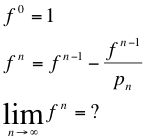
A prime limit that seems to approach a constant

Click For Summary

Discussion Overview

The discussion revolves around the limit of a function related to an infinite product involving prime numbers. Participants explore whether this limit approaches zero or some constant value, considering various mathematical approaches and reasoning. The scope includes theoretical analysis and mathematical reasoning.

Discussion Character

  • Exploratory
  • Mathematical reasoning
  • Debate/contested

Main Points Raised

  • One participant questions whether the limit approaches zero or some constant and suggests using a program to approximate it for large values of n.
  • Another participant asserts that the function is decreasing and positive, implying it must have a limit, and proposes a method to find this limit.
  • A subsequent reply agrees with the conclusion that the limit approaches zero, though it notes that the reasoning is not rigorous.
  • Another participant provides an alternative proof, stating that the infinite product converges to zero and suggests rewriting the limit in terms of the Euler product for clarity.
  • One participant introduces a probabilistic interpretation of the function, arguing that as n approaches infinity, the probability of selecting a natural number without a prime factor approaches zero.

Areas of Agreement / Disagreement

There is a general agreement among participants that the limit approaches zero, although some reasoning is noted as not being rigorous. Disagreement exists regarding the methods and proofs presented, with multiple approaches being discussed without a consensus on the best method.

Contextual Notes

Some participants note that the reasoning provided may lack rigor, and there are various interpretations of the limit involving different mathematical frameworks, such as Euler products and probabilistic reasoning.

robnybod
Messages
3
Reaction score
0
Ok here's the problem:
29288yd.png

Using wolfram the first 100 results are these
heres a plot of a couple points
As you can see it doesn't seem to be approaching exactly zero, even though its very similar to 1/x (exactly the same if you replace Pn with just n)
Is there any way to prove whether this does approach 0 or some constant, or is it possible to make a program to approximate it to some extremely large n, to see if its approaching zero or some constant.

Thanks in advance, and sorry if the answer is obvious
 
Physics news on Phys.org
welcome to pf!

hi robnybod! welcome to pf! :wink:

it's decreasing and positive, so it must have a limit

to find the limit, use the usual trick of putting fn = fn-1 :smile:
 
Thank you!
so according to that it would go to zero, correct? because than f=f(1-1/P(n)) and f goes away, so you're left with -1/P(infinity)=0, which checks
 
robnybod said:
so according to that it would go to zero, correct?

correct! :smile:

(the reaoning isn't rigorous, but the result is ok)
 
Good morning,

Your infinite product ∏(1-pi-1), over all primes, does indeed converge to zero, but no fn=fn-1 trick is close to showing why.

The standard elementary proof here is to rewrite your limit as (Ʃ1/n)-1 over the positive integers realizing that your limit is an euler product (google, wiki).

Note btw that if you add an exponent s to all your primes, your limit equals ζ(s)-1, where ζ(s) is the Riemann zeta function, known to converge for all s>1 (and giving you non-zero limit in this case).
 
Another proof would be to think of function fk as being the probability to pick a natural number that has a factor among all the prime numbers except the first k prime numbers.

f0 = 1, the probability to pick a number that has a factor among all primes is 1
f1 = f0 - f0/p1, the probability to pick a number that has a factor among all prime numbers except the first prime is 1/2

at infinity this translates into

lim [itex]_{n->\infty}[/itex]fn = 0 because f[itex]\infty[/itex] is the same as asking what is the probability to pick a natural number that doesn't have a factor among all the prime numbers. Of course all natural numbers have a prime factor or are prime numbers therefore the answer is 0.
 

Similar threads

  • · Replies 0 ·
Replies
0
Views
1K
  • · Replies 8 ·
Replies
8
Views
2K
  • · Replies 11 ·
Replies
11
Views
2K
  • · Replies 11 ·
Replies
11
Views
1K
  • · Replies 21 ·
Replies
21
Views
9K
  • · Replies 8 ·
Replies
8
Views
4K
  • · Replies 11 ·
Replies
11
Views
2K
  • · Replies 2 ·
Replies
2
Views
3K
  • · Replies 21 ·
Replies
21
Views
9K
  • · Replies 6 ·
Replies
6
Views
6K