A Question about Albert Shadowitz's Explanation of Ampere's Law

Click For Summary
SUMMARY

The forum discussion centers on Albert Shadowitz's derivation of Ampere's Law as presented in his book, "The Electromagnetic Field," specifically in Section 3-4, pages 129 to 134. The derivation begins with the Biot-Savart Law and transitions to a solid angle interpretation, ultimately equating the integral of solid angles to 4π. The discussion critiques the complexity of the derivation and emphasizes the historical context of the laws of electromagnetism, particularly highlighting Maxwell's equations and their foundational role in classical physics. Recommended textbooks for a modern understanding include Griffiths, Feynman Lectures, Landau & Lifshitz, and Jackson.

PREREQUISITES
  • Understanding of Biot-Savart Law
  • Familiarity with Maxwell's equations
  • Knowledge of solid angles and their integration
  • Basic concepts of vector calculus, particularly curl and divergence
NEXT STEPS
  • Study Griffiths's "Introduction to Electrodynamics" for undergraduate-level insights
  • Explore Feynman Lectures on Physics for a conceptual approach to electromagnetism
  • Read Landau & Lifshitz's "The Classical Theory of Fields" for advanced theoretical perspectives
  • Investigate Jackson's "Classical Electrodynamics" for comprehensive coverage of electromagnetic theory
USEFUL FOR

This discussion is beneficial for physics students, educators, and researchers interested in electromagnetism, particularly those seeking to deepen their understanding of Ampere's Law and its derivations within the context of classical physics.

bryanso
Messages
28
Reaction score
7
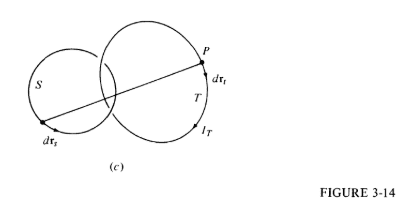
In Shadowitz's book The Electromagetic Field, Section 3-4, p. 129 to 134, there is a very interesting derivation of Ampere's Law. It is a general derivation with a circular source circuit S, and a circular test circuit T. The pages can be seen here, at least from where I post (USA):

https://books.google.com/books?id=k7XCAgAAQBAJ&pg=PA129&lpg=PA129#v=onepage&q&f=false
Screen Shot 2019-08-19 at 7.32.21 PM.png

Briefly, starting from Biot-Savart Law, the circulation Integrate(B . drt) is calculated. At one point (drs x Rst . drt) / R2 is replaced with the equivalent (drt x drs . Rst) / R2. This the author turns first into (dS . Rts) / R2 then finally he equates this with dOmega the solid angle (bottom of p. 131). I am in agreement with this algebra.

(Rst and Rts represent unit vectors)

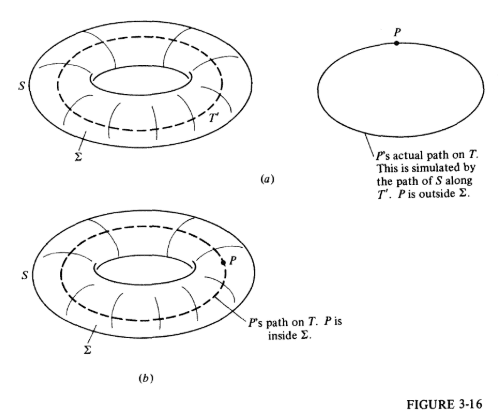
Then comes a really interesting change of point-of-view. He explains if we hold P fixed (P is a point on the test circuit T) instead of moving P around T, then effectively it is the entire circuit S moving in space. And the complete movement is a torus. Figure 3-16.
Screen Shot 2019-08-19 at 7.32.31 PM.png


If S and T are linked (kind of like the magician's linking rings :) then the point P lies within the "torus".

He then equates Integrate(dOmega) to 4pi.

Now I am not able to convince myself or prove a solid angle inside a torus sum to 4pi. All online help I can find are integration of solid angles inside a sphere or a potato :) A torus is not the same because a cone from P will eventually go out of the torus and comes back into the opposite arm of the torus.

It's funny the author writes "This is also left for the student to prove..."

Thanks
 
Physics news on Phys.org
I think this is overly and unnecessarily complicated. First of all fundamental laws cannot be "derived". They are condensed empirical wisdom. The most comprehensive wisdom about electromagnetism as far as classical physics is concerned are Maxwell's equations, of which the Ampere-Farday Law is a fundamental equation.

Maxwell's theory can a posteriory "derived" also from the information that it's an (on the fundamental level un-Higgsed) gauge theory with gauge group U(1).

Here, obviously the author uses a more historical approach (which is usually only interesting, if you are already familiar with the theory and want to learn about the history itself rather than the other way thinking it would help to understand the physics going through all the thorny paths our predecessors had to go to find out about it), i.e., he takes the Biot-Savart Law as the known law. It's of course only valid for the special case of magnetostatics (this as a warning).

Then I wouldn't formulate it with the singular form of a current through an infinitely thin wire, but just a continuous current density. Then in more comprehensible notation it reads (in Heaviside Lorentz units)
$$\vec{B}=\frac{1}{4 \pi c} \int_{\mathbb{R}^3} \mathrm{d}^3 r' \vec{j}(\vec{r}') \times \vec{\nabla} \frac{1}{|\vec{r}-\vec{r}'|}=-\frac{1}{4 \pi c} \vec{\nabla} \times \int_{\mathbb{R}^3} \mathrm{d}^3 r' \frac{\vec{j}(\vec{r}')}{|\vec{r}-\vec{r}'|}.$$
From this you get immediately Gauss's Law for the magnetic field (which is valid generally, not only in the here discussed static case)
$$\vec{\nabla} \cdot \vec{B}=0.$$
Knowing that the "source" vanishes, you now are also inclined to know the curl (at least if you familiar with Helmholtz's fundamental theorem of vector calculus). This brings you to the idea to calculate the curl:
$$\vec{\nabla} \times \vec{B} =-\frac{1}{4 \pi c} \int_{\mathbb{R}^3}
\mathrm{d}^3 r' \left [ \vec{\nabla} \left (\vec{j}(\vec{r}') \cdot \vec{\nabla}
\frac{1}{|\vec{r}-\vec{r}'|} \right) -\vec{j}(\vec{r}')
\Delta \frac{1}{|\vec{r}-\vec{r}'|} \right]. $$
The second term is well-known from electrostatics. From the Coulomb Law of a point charge you know that
$$\Delta \frac{1}{|\vec{r}-\vec{r}'|}=-4 \pi \delta^{(3)}(\vec{r}-\vec{r}').$$
For the first term we note that
$$
\int_{\mathbb{R}^3}
\mathrm{d}^3 r' \vec{\nabla} \left (\vec{j}(\vec{r}') \cdot \vec{\nabla}
\frac{1}{|\vec{r}-\vec{r}'|} \right) = -\vec{\nabla} \int_{\mathbb{R}^3} \vec{j}(\vec{r}') \cdot \vec{\nabla}' \frac{1}{|\vec{r}-\vec{r}'|}=+\vec{\nabla} \int _{\mathbb{R}^3} \mathrm{d}^3 r' \frac{1}{|\vec{r}-\vec{r}'|}\vec{\nabla}' \cdot \vec{j}(\vec{r}')=0,$$
where we have integrated by parts and then used ##\vec{\nabla} \cdot \vec{j}=0##, which holds due to charge conservation for the static case (i.e., for ##\partial_t \rho=0##).

After this cumbersome analysis finally you find Ampere's Law
$$\vec{\nabla} \times \vec{B}=\frac{1}{c} \vec{j}.$$
 
Thanks. Any recommended textbook that teaches this topic in a more modern viewpoint, as a prerequisite before tackling more advanced topics?
 
I think on the undergrad level Griffiths's book is very good. Also the Feynman lectures. On the graduate level I'd recommend Landau&Lifshitz vol. 2 (for the macroscopic theory vol. 8). Then there's of course also Jackson, which is the standard reference though to my taste bringing relativity too late.
 
Thanks a lot!
 

Similar threads

  • · Replies 9 ·
Replies
9
Views
2K
  • · Replies 7 ·
Replies
7
Views
5K
  • · Replies 1 ·
Replies
1
Views
4K
  • · Replies 1 ·
Replies
1
Views
2K
  • · Replies 5 ·
Replies
5
Views
1K
Replies
6
Views
1K
  • · Replies 9 ·
Replies
9
Views
4K
  • · Replies 14 ·
Replies
14
Views
14K
  • · Replies 3 ·
Replies
3
Views
5K
  • · Replies 1 ·
Replies
1
Views
4K