A question about operator power series

Click For Summary
SUMMARY

The discussion centers on the significance of non-convergence in operator power series as applied to wave functions in quantum mechanics, specifically referencing Shankar's 'Principles of Quantum Mechanics'. The wave function in question does not satisfy the continuity requirements of the Schrödinger equation, leading to the conclusion that it cannot represent a physically realizable state. The paradox arises from the claim that wave packets confined to finite regions must spread over time, which contradicts the behavior of the given wave function. Ultimately, the non-convergence indicates that the wave function lacks physical reality.

PREREQUISITES
  • Understanding of quantum mechanics principles, particularly the Schrödinger equation.
  • Familiarity with operator theory and power series expansions.
  • Knowledge of wave functions and their properties in quantum systems.
  • Experience with Mathematica for plotting and visualizing mathematical functions.
NEXT STEPS
  • Study the implications of wave function continuity in quantum mechanics.
  • Learn about the convergence criteria for operator series in quantum systems.
  • Explore the concept of energy eigenfunctions and their role in quantum mechanics.
  • Investigate the integral form of the time-dependent Schrödinger equation (TDSE) for handling discontinuous wave functions.
USEFUL FOR

Quantum mechanics students, physicists, and researchers interested in the mathematical foundations of quantum theory and the behavior of wave functions in confined systems.

Nitram
Messages
7
Reaction score
0
Hi All,
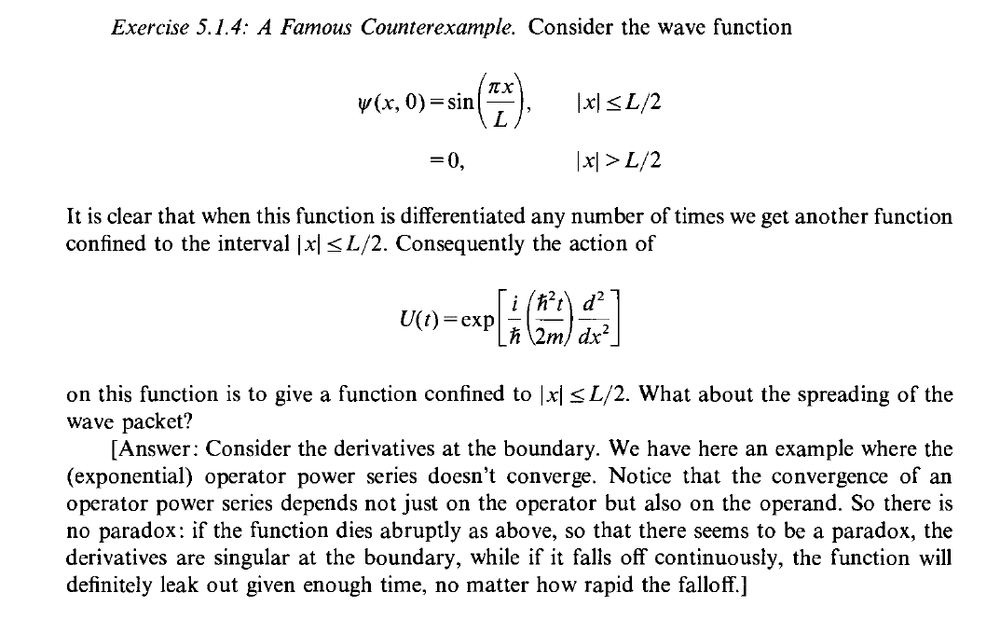
I've been going through Shankar's 'Principles of Quantum Mechanics' and I don't quite understand the point the author is trying to make in this exercise. I get that this wavefunction is not a solution to the Schrödinger equation as it is not continuous at the boundaries and neither is its first derivative. However, I don't see how this fits together with the rest of the question. What is the significance of the operator series not converging and what is the paradox that the author speaks of? An explanation in simple terms would be really appreciated!
Ex5.1.4..png
 
Physics news on Phys.org
You could write the ##U(t)## as an exponential power series

##\displaystyle\exp (x) = 1 + \frac{1}{2!}x + \frac{1}{3!}x^2 + \dots##

with ##\displaystyle x=\frac{i}{\hbar}\left(\frac{\hbar^2 t}{2m}\right)\frac{d^2}{dx^2}##,

possibly by first setting units where ##\hbar = m = 1## to make the equations simpler. Then operate with that series form operator on the function ##\psi (x,0)##, and show that the obtained power series of ##\psi (x,t)## does not converge for all combinations of ##x## and ##t##. You can also draw mathematica plots for several partial sums with an increasing number of terms to show that those don't approach the correct function.
 
hilbert2 said:
You could write the ##U(t)## as an exponential power series

##\displaystyle\exp (x) = 1 + \frac{1}{2!}x + \frac{1}{3!}x^2 + \dots##

with ##\displaystyle x=\frac{i}{\hbar}\left(\frac{\hbar^2 t}{2m}\right)\frac{d^2}{dx^2}##,

possibly by first setting units where ##\hbar = m = 1## to make the equations simpler. Then operate with that series form operator on the function ##\psi (x,0)##, and show that the obtained power series of ##\psi (x,t)## does not converge for all combinations of ##x## and ##t##. You can also draw mathematica plots for several partial sums with an increasing number of terms to show that those don't approach the correct function.
Thanks for the reply. I have tried the expansion and believe I can show that the operator series does not converge but I don't understand what the significance of this result is. Does it mean that because the series does not converge that the operator has no physical reality for that particular wavefunction? Or have I got it totally wrong?
 
Edit: sorry, there was an error in this. I will post a new one soon.
 
Last edited:
Nitram said:
What is the significance of the operator series not converging and what is the paradox that the author speaks of?

The wave function given is often claimed to describe a quantum object permanently confined to a finite region of space. However, we are also told that wave packets confined to a finite region of space must spread, i.e., the region they occupy must get wider with time. The wave function given appears to be a counterexample to that claim, hence the "paradox".

The significance of the operator series not converging is that it means the wave function given is actually not a physically possible one. So the fact that it does not "spread" with time is not a problem, since it can't be physically realized anyway. For any wave function that can be physically realized, i.e., any wave function for which the operator series does converge, the region occupied by the wave function will spread with time.
 
  • Like
Likes   Reactions: Nitram and bhobba
Ok, so it seems that even the initial state ##\psi (x,0)## in that question doesn't have the correct boundary condition of approaching ##0## when ##x\rightarrow\pm L/2##.

Forming power series of ##U(t)## up to 3rd, 10th or 100th order and operating on the ##\psi (x,0)## where I chose ##L=1##, ##\hbar = 1## and ##m=1##, the resulting ##|\psi (x,1)|^2## look like this:

3rd order:

POB_U_3rd_order.jpg

10th order:

POB_U_10th_order.jpg

100th order:

POB_U_100th_order.jpg

(the images can be expanded by clicking on them) This doesn't look like it is approaching a function with same normalization as the initial state ##\psi (x,0)##.
 
hilbert2 said:
it seems that even the initial state ##\psi (x,0)## in that question doesn't have the correct boundary condition of approaching ##0## when ##x\rightarrow\pm L/2##.

I think the textbook must have a typo there and meant to have ##\cos## instead of ##\sin##, since ##\cos## is the function that goes to zero at ##\pm \pi / 2##. Either that or they meant the interval to be ##0 \le x \le L##.
 
  • Like
Likes   Reactions: bhobba
  • Like
Likes   Reactions: vanhees71
PeterDonis said:
For any wave function that can be physically realized, i.e., any wave function for which the operator series does converge, the region occupied by the wave function will spread with time.
What about the eigenfunction of the Hydrogen atom?
 
  • #10
andresB said:
What about the eigenfunction of the Hydrogen atom?

If you make a wavepacket that describes an electron having gotten enough energy to escape the proton's electric field in an H atom, it will probably get wider with time. The question is about a free particle and one locked between hard boundaries. A wave packet in something like a harmonic oscillator potential will not spread indefinitely no matter how much energy you give it (there's no finite "escape velocity" in that potential field).
 
  • #11
andresB said:
What about the eigenfunction of the Hydrogen atom?

All of the electron orbital wave functions for the hydrogen atom already go all the way to infinity; they are not confined to a finite region of space. The probability amplitude gets very, very small once you get significantly outside the Bohr radius, but it never goes to zero.
 
  • Like
Likes   Reactions: vanhees71
  • #12
I think what the author wants to teach the students with this exercise is that the given function is not in the domain of the Hamiltonian in ##\mathrm{L}^2([-L/2,L/2])## and thus the operator time-evolution operator ##\hat{U}(t)=\exp(\mathrm{i} \hat{H} t)## cannot be naively applied.

The right procedure is that you start with a complete set of energy eigenfunctions, which are given by
$$u_{n}^{(+)}(x)=\sqrt{\frac{2}{L}} \cos[(2n-1) \pi x/L], \quad u_{n}^{(-)}=\sqrt{\frac{2}{L}} \sin(2n \pi/L).$$
Then you can expand any ##\mathrm{L}^2([-L/2,L/2])## function wrt. these eigenstates
$$\psi(x)=\sum_{n=1}^{\infty} [c_n^{(+)} u_n^{(+)}(x) + c_n^{(-)} u_n^{(-)}(x)]$$
Then the time evolution operator can be "unitarily continued" to all ##\mathrm{L}^2([-L/2,L/2])## functions via
$$\hat{U}\psi (x)=\sum_{n=1}^{\infty} [c_n^{(+)} u_n^{(+)}(x) \exp(\mathrm{i} E_n^{(+)}t)+ c_n^{(-)} u_n^{(-)}(x)\exp(\mathrm{i} E_n^{(-)t})],$$
with the energy eigenvalues
$$E_n^{(+)}=\frac{m}{2} \left (\frac{(2n-1) \pi}{L} \right)^2, \quad E_n^{(-)}=\frac{m}{2} \left (\frac{2n \pi}{L} \right)^2.$$
This operator can, however not calculated using the exponential series applied to ##\psi## since ##\psi## is not in the domain of ##\hat{H}## as a self-adjoint operator.
 
  • Like
Likes   Reactions: dextercioby
  • #13
vanhees71 said:
The right procedure is that you start with a complete set of energy eigenfunctions, which are given by
$$u_{n}^{(+)}(x)=\sqrt{\frac{2}{L}} \cos[(2n-1) \pi x/L], \quad u_{n}^{(-)}=\sqrt{\frac{2}{L}} \sin(2n \pi/L).$$
Then you can expand any ##\mathrm{L}^2([-L/2,L/2])## function wrt. these eigenstates
$$\psi(x)=\sum_{n=1}^{\infty} [c_n^{(+)} u_n^{(+)}(x) + c_n^{(-)} u_n^{(-)}(x)]$$
Then the time evolution operator can be "unitarily continued" to all ##\mathrm{L}^2([-L/2,L/2])## functions via
$$\hat{U}\psi (x)=\sum_{n=1}^{\infty} [c_n^{(+)} u_n^{(+)}(x) \exp(\mathrm{i} E_n^{(+)}t)+ c_n^{(-)} u_n^{(-)}(x)\exp(\mathrm{i} E_n^{(-)t})],$$
with the energy eigenvalues
$$E_n^{(+)}=\frac{m}{2} \left (\frac{(2n-1) \pi}{L} \right)^2, \quad E_n^{(-)}=\frac{m}{2} \left (\frac{2n \pi}{L} \right)^2.$$
This operator can, however not calculated using the exponential series applied to ##\psi## since ##\psi## is not in the domain of ##\hat{H}## as a self-adjoint operator.

Yeah, that's the same what the integral form TDSE I wrote about would predict, too. And the function ##\psi (x,0)## can then even be discontinuous on an infinite set of measure zero and still produce some result when propagated.
 
  • Like
Likes   Reactions: vanhees71
  • #14
PeterDonis said:
I think the textbook must have a typo there and meant to have ##\cos## instead of ##\sin##, since ##\cos## is the function that goes to zero at ##\pm \pi / 2##. Either that or they meant the interval to be ##0 \le x \le L##.
But then you'd have not the trouble the author wanted to display. Then it's very simple, because then it's an energy eigenfunction, and the exponential series is very easy to calculate.
 
  • #15
PeterDonis said:
The wave function given is often claimed to describe a quantum object permanently confined to a finite region of space. However, we are also told that wave packets confined to a finite region of space must spread, i.e., the region they occupy must get wider with time. The wave function given appears to be a counterexample to that claim, hence the "paradox".

The significance of the operator series not converging is that it means the wave function given is actually not a physically possible one. So the fact that it does not "spread" with time is not a problem, since it can't be physically realized anyway. For any wave function that can be physically realized, i.e., any wave function for which the operator series does converge, the region occupied by the wave function will spread with time.
This was exactly what I was looking for, thank you! Thanks to everyone who replied also, it was all very helpful.
 

Similar threads

  • · Replies 8 ·
Replies
8
Views
2K
  • · Replies 22 ·
Replies
22
Views
2K
  • · Replies 3 ·
Replies
3
Views
2K
  • · Replies 5 ·
Replies
5
Views
3K
  • · Replies 22 ·
Replies
22
Views
4K
  • · Replies 1 ·
Replies
1
Views
2K
  • · Replies 5 ·
Replies
5
Views
3K
  • · Replies 2 ·
Replies
2
Views
2K
  • · Replies 14 ·
Replies
14
Views
2K