kostoglotov
- 231
- 6
So if we have a non-simply-connected region, like this one
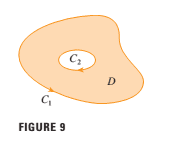
to apply Green's Theorem we must orient the C curves so that the region D is always on the left of the curve as the curve is traversed.
Why is this? I have seen some proofs of Green's Theorem for simply connected regions, and I understand why going the opposite direction along a curve gives you the negative of a line integral.
I guess what I'm asking for is a little insight into what's happening here.
Can I imagine that I'm walking along some path, circling some geometric center of a region, measuring the region to my left and summing all the areas or the function values as I go along? So then I were to traverse C2 from the above diagram, I am subtracting instead of adding? So we then need to reverse the orientation?
I can accept the rules, the conditions and can read some proofs, but I don't feel like I understand it very well.
Thanks.
edit: it has something to do with what happens when we divide the region in two doesn't it?
to apply Green's Theorem we must orient the C curves so that the region D is always on the left of the curve as the curve is traversed.
Why is this? I have seen some proofs of Green's Theorem for simply connected regions, and I understand why going the opposite direction along a curve gives you the negative of a line integral.
I guess what I'm asking for is a little insight into what's happening here.
Can I imagine that I'm walking along some path, circling some geometric center of a region, measuring the region to my left and summing all the areas or the function values as I go along? So then I were to traverse C2 from the above diagram, I am subtracting instead of adding? So we then need to reverse the orientation?
I can accept the rules, the conditions and can read some proofs, but I don't feel like I understand it very well.
Thanks.
edit: it has something to do with what happens when we divide the region in two doesn't it?
Last edited: