A question on proving countable additivity

  • Thread starter Thread starter zzzhhh
  • Start date Start date
Click For Summary
The discussion centers on a question regarding the proof of countable additivity in Lemma 9.3 of Bartle's "The Elements of Integration and Lebesgue Measure." The main concern is whether the interval constructed, denoted as {I_j}, adequately covers the left endpoint 'a' of the compact interval [a,b], as claimed in the text. One participant argues that the proof may be incorrect since the intervals {I_j} do not necessarily include 'a' if the endpoints a_i approach 'a' but do not reach it. Another contributor suggests that it is possible to select epsilon values that ensure coverage of 'a' by adjusting the intervals accordingly. The conversation highlights the nuances of the proof and the conditions necessary for establishing the desired inequalities.
zzzhhh
Messages
39
Reaction score
1
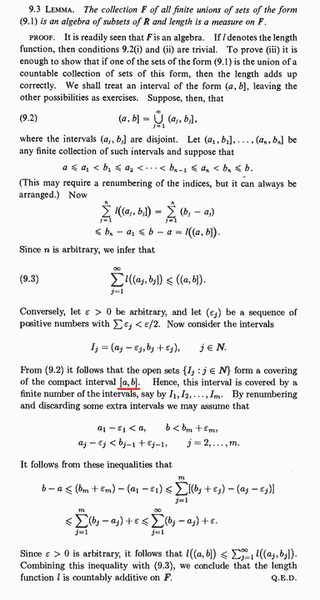
This question comes from the proof of Lemma 9.3 of Bartle's "The Elements of Integration and Lebesgue Measure" in page 97-98. This proof is shown as the image below.
684m80.png


Form (9.1) mentioned in the lemma is: (a,b], (-\infty,b], (a,+\infty), (-\infty,+\infty).

My question is: although I_j constructed in P98 is a bit fatter than (a_j,b_j], I doubt the assertion that the left endpoint a, and in turn the compact interval [a,b], is also covered by \{I_j\}, as the proof in the text claimed (I drew a red underline). Is my doubt correct (this means the text is incorrect), or point a can be proved to be covered by \{I_j\} (how)? Thanks!
PS: the establishment of the converse inequality does not need the coverage of the whole [a,b]. A small shrink, say [a+\epsilon,b], is sufficient to get the inequality.
 
Physics news on Phys.org
Definitely seems to be an error in the text. If a_i=a+\frac{1}{n} and \epsilon=\frac{1}{2} and \epsilon_i=\frac{1}{2^{i+1}} the I_j never include a

It seems true that you can pick to \epsilon_i's so that you get a covering... we know that the a_i have to get arbitrarily close to a, so you can pick one really close to a to add one of your larger values of \epsilon_i to
 
Thank you Office_Shredder!
 
zzzhhh said:
This question comes from the proof of Lemma 9.3 of Bartle's "The Elements of Integration and Lebesgue Measure" in page 97-98. This proof is shown as the image below.
684m80.png


Form (9.1) mentioned in the lemma is: (a,b], (-\infty,b], (a,+\infty), (-\infty,+\infty).

My question is: although I_j constructed in P98 is a bit fatter than (a_j,b_j], I doubt the assertion that the left endpoint a, and in turn the compact interval [a,b], is also covered by \{I_j\}, as the proof in the text claimed (I drew a red underline). Is my doubt correct (this means the text is incorrect), or point a can be proved to be covered by \{I_j\} (how)? Thanks!
PS: the establishment of the converse inequality does not need the coverage of the whole [a,b]. A small shrink, say [a+\epsilon,b], is sufficient to get the inequality.

I have not gone through the entire arguement, but the condition 9.2 and the ordering of the a's and b's assumed would require that a=a_1 and b_i=a_{i+1}.
 

Similar threads

  • · Replies 2 ·
Replies
2
Views
3K
  • · Replies 2 ·
Replies
2
Views
2K
  • · Replies 2 ·
Replies
2
Views
2K
  • · Replies 2 ·
Replies
2
Views
2K
  • · Replies 61 ·
3
Replies
61
Views
13K
Replies
1
Views
2K
Replies
11
Views
5K
  • · Replies 20 ·
Replies
20
Views
6K
Replies
2
Views
2K
  • · Replies 16 ·
Replies
16
Views
7K