A question on proving countable additivity

  • Context: Graduate 
  • Thread starter Thread starter zzzhhh
  • Start date Start date
Click For Summary

Discussion Overview

The discussion revolves around a question regarding the proof of countable additivity in the context of Lemma 9.3 from Bartle's "The Elements of Integration and Lebesgue Measure." Participants are examining the coverage of the left endpoint of a compact interval by a collection of intervals constructed in the proof.

Discussion Character

  • Technical explanation
  • Debate/contested
  • Mathematical reasoning

Main Points Raised

  • One participant questions whether the left endpoint \( a \) of the interval \( [a,b] \) is covered by the collection of intervals \( \{I_j\} \) as claimed in the proof, suggesting that the intervals \( I_j \) may not include \( a \).
  • Another participant agrees with the doubt expressed, providing a specific example where \( a_i = a + \frac{1}{n} \) and \( \epsilon = \frac{1}{2} \), indicating that under these conditions, the intervals \( I_j \) do not include \( a \).
  • Some participants propose that it is possible to select \( \epsilon_i \) values such that a covering can be achieved, noting that the sequence \( a_i \) approaches \( a \) closely enough to allow for this.
  • A later reply reiterates the initial question and adds that the ordering of the intervals \( a_i \) and \( b_i \) must satisfy certain conditions, specifically that \( a = a_1 \) and \( b_i = a_{i+1} \).

Areas of Agreement / Disagreement

Participants express disagreement regarding the correctness of the text's assertion about the coverage of the left endpoint \( a \). Multiple competing views are presented about whether the intervals \( \{I_j\} \) can indeed cover \( a \), and the discussion remains unresolved.

Contextual Notes

The discussion highlights potential limitations in the proof, particularly concerning the assumptions about the intervals and their coverage of the endpoints. Specific mathematical conditions and the ordering of the intervals are noted as relevant factors that may influence the argument.

zzzhhh
Messages
39
Reaction score
1
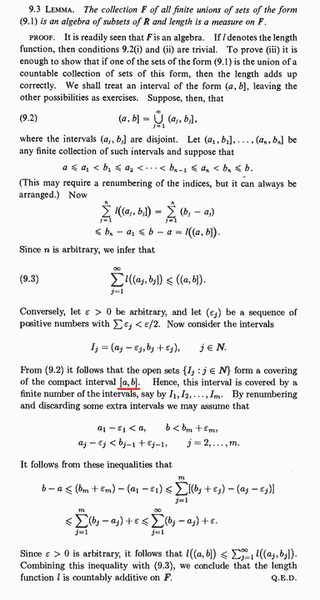
This question comes from the proof of Lemma 9.3 of Bartle's "The Elements of Integration and Lebesgue Measure" in page 97-98. This proof is shown as the image below.
684m80.png


Form (9.1) mentioned in the lemma is: [tex](a,b], (-\infty,b], (a,+\infty), (-\infty,+\infty)[/tex].

My question is: although [tex]I_j[/tex] constructed in P98 is a bit fatter than [tex](a_j,b_j][/tex], I doubt the assertion that the left endpoint a, and in turn the compact interval [a,b], is also covered by [tex]\{I_j\}[/tex], as the proof in the text claimed (I drew a red underline). Is my doubt correct (this means the text is incorrect), or point a can be proved to be covered by [tex]\{I_j\}[/tex] (how)? Thanks!
PS: the establishment of the converse inequality does not need the coverage of the whole [a,b]. A small shrink, say [tex][a+\epsilon,b][/tex], is sufficient to get the inequality.
 
Physics news on Phys.org
Definitely seems to be an error in the text. If [tex]a_i=a+\frac{1}{n}[/tex] and [tex]\epsilon=\frac{1}{2}[/tex] and [tex]\epsilon_i=\frac{1}{2^{i+1}}[/tex] the [tex]I_j[/tex] never include [tex]a[/tex]

It seems true that you can pick to [tex]\epsilon_i[/tex]'s so that you get a covering... we know that the [tex]a_i[/tex] have to get arbitrarily close to [tex]a[/tex], so you can pick one really close to [tex]a[/tex] to add one of your larger values of [tex]\epsilon_i[/tex] to
 
Thank you Office_Shredder!
 
zzzhhh said:
This question comes from the proof of Lemma 9.3 of Bartle's "The Elements of Integration and Lebesgue Measure" in page 97-98. This proof is shown as the image below.
684m80.png


Form (9.1) mentioned in the lemma is: [tex](a,b], (-\infty,b], (a,+\infty), (-\infty,+\infty)[/tex].

My question is: although [tex]I_j[/tex] constructed in P98 is a bit fatter than [tex](a_j,b_j][/tex], I doubt the assertion that the left endpoint a, and in turn the compact interval [a,b], is also covered by [tex]\{I_j\}[/tex], as the proof in the text claimed (I drew a red underline). Is my doubt correct (this means the text is incorrect), or point a can be proved to be covered by [tex]\{I_j\}[/tex] (how)? Thanks!
PS: the establishment of the converse inequality does not need the coverage of the whole [a,b]. A small shrink, say [tex][a+\epsilon,b][/tex], is sufficient to get the inequality.

I have not gone through the entire argument, but the condition 9.2 and the ordering of the a's and b's assumed would require that [tex]a=a_1[/tex] and [tex]b_i=a_{i+1}[/tex].
 

Similar threads

  • · Replies 2 ·
Replies
2
Views
3K
  • · Replies 3 ·
Replies
3
Views
4K
  • · Replies 2 ·
Replies
2
Views
3K
  • · Replies 2 ·
Replies
2
Views
2K
  • · Replies 2 ·
Replies
2
Views
3K
  • · Replies 61 ·
3
Replies
61
Views
13K
Replies
1
Views
2K
Replies
11
Views
5K
  • · Replies 20 ·
Replies
20
Views
7K
Replies
2
Views
3K