A question on the geometry of black holes

  • Context: High School 
  • Thread starter Thread starter Parthib Roy
  • Start date Start date
Parthib Roy
Messages
8
Reaction score
1
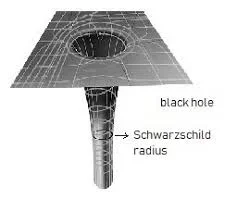
So i always saw those graphical diagrams of blackholes where we can an opening at the top and the cannal goes deeper into the space time fabric revealing its untra massive core
1779696747254.webp

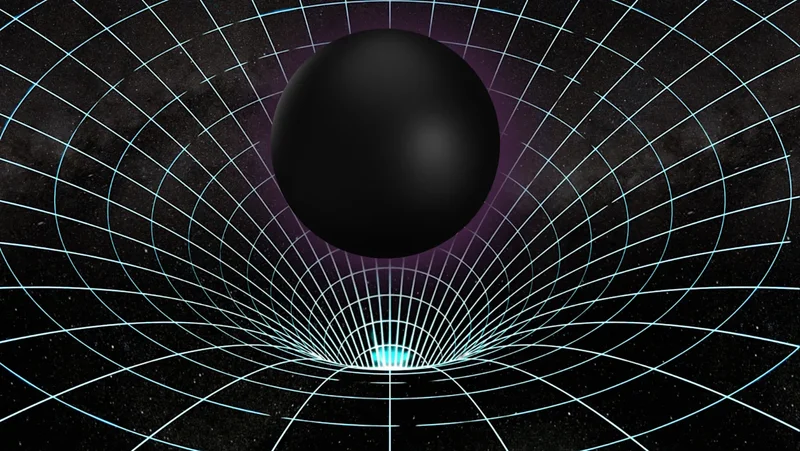
but this is a 2d depiction of a 3d model ,Black holes are not circular holes in space time fabric, they are spherical ,so my question is in a 2D model we can see the end of the hole but where does the end of the hole exist in a 3d sphere ,it cant be at there geometric center right(as black holes are smaller than there parent stars)?? or it exist in some other plain or dimention ??
1779697222025.webp
 
Space news on Phys.org
Parthib Roy said:
So i always saw those graphical diagrams of blackholes where we can an opening at the top and the cannal goes deeper into the space time fabric revealing its untra massive corebut this is a 2d depiction of a 3d model ,Black holes are not circular holes in space time fabric, they are spherical ,so my question is in a 2D model we can see the end of the hole but where does the end of the hole exist in a 3d sphere ,it cant be at there geometric center right(as black holes are smaller than there parent stars)?? or it exist in some other plain or dimention ??
What do you mean by "at there geometric center"?

That's indeed a 2D representation and you need to extrapolate it to more dimensions, but you also have to remember that this 2D surface is spacetime, not just space. The center isn't just a point in space.
 
  • Like
Likes   Reactions: Parthib Roy
You can't extend that kind of picture to a black hole interior, unfortunately. Assumptions made during the drawing fail at the event horizon, so they only work outside.

The interiors of black holes are rather odd places. They are actually infinite in extent and they do not have a center. All matter falling into one ends up at the singularity, but that isn't at the center - it is more like a moment in time, a finite time ahead of when you cross the horizon. That's one way of looking at why you can't avoid it - you can't avoid tomorrow morning either.

You can draw maps of the interior of black holes, although they are all rather abstract and are extremely distorted because of the problems of drawing extremely curved spacetime on a flat piece of paper. I can dig one out later and attempt to explain its features if you like.

Also, note that this is what General Relativity says. We have reason to believe that GR stops being an accurate picture of reality somewhere inside a black hole, but unfortunately we don't have a better theory yet.
 
  • Like
Likes   Reactions: PeterDonis, javisot, PeroK and 1 other person
Ibix said:
You can't extend that kind of picture to a black hole interior, unfortunately. Assumptions made during the drawing fail at the event horizon, so they only work outside.

The interiors of black holes are rather odd places. They are actually infinite in extent and they do not have a center. All matter falling into one ends up at the singularity, but that isn't at the center - it is more like a moment in time, a finite time ahead of when you cross the horizon. That's one way of looking at why you can't avoid it - you can't avoid tomorrow morning either.

You can draw maps of the interior of black holes, although they are all rather abstract and are extremely distorted because of the problems of drawing extremely curved spacetime on a flat piece of paper. I can dig one out later and attempt to explain its features if you like.

Also, note that this is what General Relativity says. We have reason to believe that GR stops being an accurate picture of reality somewhere inside a black hole, but unfortunately we don't have a better theory yet.
Ahh thats a even better explanation than i expected .At first i would like to thank you for your explanation it really makes the idea a lot clearer for me .also i would like to ask you one more thing ,could you clarify by what u mean as "it is more like a moment in time, a finite time ahead of when you cross the horizon. That's one way of looking at why you can't avoid it - you can't avoid tomorrow morning either." do you mean that beyond the event horizon the object falling down into a black hole slows down to such an extent that time practically freezes for them and it feels like the object is falling forever into until it is completely disintegrated ??
 
Last edited by a moderator:
Parthib Roy said:
Ahh thats a even better explanation than i expected .At first i would like to thank you for your explanation it really makes the idea a lot clearer for me .also i would like to ask you one more thing ,could you clarify by what u mean as "it is more like a moment in time, a finite time ahead of when you cross the horizon. That's one way of looking at why you can't avoid it - you can't avoid tomorrow morning either." do you mean that beyond the event horizon the object falling down into a black hole slows down to such an extent that time practically freezes for them and it feels like the object is falling forever into until it is completely disintegrated ??
It's not like that. A singularity is when a mathematical model breaks down. It's not a physical thing. Once you cross the event horizon, you only have a finite amount of time before the mathematical model breaks down.

Most physicists expect that a theory of quantum gravity will explain what really happens below the event horizon.
 
  • Like
Likes   Reactions: Parthib Roy
Parthib Roy said:
do you mean that beyond the event horizon the object falling down into a black hole slows down to such an extent that time practically freezes for them and it feels like the object is falling forever into until it is completely disintegrated ??
No. If you fell into a black hole the mass of the Sun (and if GR were correct which it probably isn't!) you would reach the singularity about fifteen microseconds after crossing the event horizon by your watch. For a billion sun mass super massive black hole, it would take about twenty five minutes.

However, the singularity isn't a place in space. It is not a point of infinite density or anything like that.

Remember that GR isn't a theory about space, it's a theory about spacetime. If you draw a map of spacetime on a piece of paper you might say left on the map is to the left in the world, right is to the right, but up and down on the map correspond to moving into the future or the past. A horizontal line on the map is all of space (or at least all of space that happens to be on one straight line) at one time, and a horizontal line just above it is the same but of space a little bit later.

GR says that if you fall into a black hole, the map has an edge at the top that isn't just "got bored of drawing". That's the singularity - an edge to the map at the top, in the future. You can reach it in finite time and then GR won't tell you anything more - you fell off the edge of the only map we know how to draw. Well, tidal forces would shred you first, but your remains would fall off the edge of the map.

That's basically why we suspect GR isn't quite right - we suspect that a physical theory that describes something you can do but then says "eh, I dunno" part way through isn't quite the truth.
 
  • Like
Likes   Reactions: Parthib Roy, PeterDonis, javisot and 1 other person
Ibix said:
the singularity isn't a place in space. It is not a point of infinite density or anything like that.
It's worth noting, though, that even though the interior of a black hole is vacuum, the spacetime curvature does increase without bound as the singularity is approached. So a person who falls through the horizon will find their body becoming increasingly deformed, and ultimately torn apart, in the finite time by their clock before they reach the singularity. Even if GR breaks down before the singularity is actually reached, and some other physics like quantum gravity takes over, it's still highly likely that the person's body would be destroyed before that point is reached.
 
  • Like
Likes   Reactions: javisot, Parthib Roy and Ibix
Also, it should be noted that spherically symmetric nonrotating collapse to a BH per general relativity does predict unbounded density for the original matter falling in. This is because, while the singularity can be thought of being the limit of a collapsing hypercylinder, all the original matter approaches one limiting point of the singularity. This is not true for later infalling matter.
 
  • Like
  • Informative
Likes   Reactions: PeroK and Ibix
PAllen said:
Also, it should be noted that spherically symmetric nonrotating collapse to a BH per general relativity does predict unbounded density for the original matter falling in. This is because, while the singularity can be thought of being the limit of a collapsing hypercylinder, all the original matter approaches one limiting point of the singularity. This is not true for later infalling matter.
could you elaborate a little more?
 
  • #10
Parthib Roy said:
could you elaborate a little more?
Like I said, the singularity is the edge of the map. In the case @PAllen is talking about all the matter of the star exits the map at one point, and its density increases without limit as it approaches that point. Where the density would go to infinity is where the matter falls off the edge. Matter falling in later, or even just leaving the surface of the star after it's formed the black hole but before it collapsed completely, will leave the map at other points on the singularity.

So there isn't a point of infinite density, but there is a region with any arbitrarily high finite density you like. But that isn't the same thing as the singularity, and if you fall in you will hit the singularity, not necessarily the collapsed star matter. In fact, unless you fall in very shortly after the collapse you won't even be able to reach it before you hit the singularity even if you had an arbitrarily powerful rocket.
 
  • Like
Likes   Reactions: Parthib Roy
  • #11
Ibix said:
Like I said, the singularity is the edge of the map. In the case @PAllen is talking about all the matter of the star exits the map at one point, and its density increases without limit as it approaches that point. Where the density would go to infinity is where the matter falls off the edge. Matter falling in later, or even just leaving the surface of the star after it's formed the black hole but before it collapsed completely, will leave the map at other points on the singularity.

So there isn't a point of infinite density, but there is a region with any arbitrarily high finite density you like. But that isn't the same thing as the singularity, and if you fall in you will hit the singularity, not necessarily the collapsed star matter. In fact, unless you fall in very shortly after the collapse you won't even be able to reach it before you hit the singularity even if you had an arbitrarily powerful rocket.
got it thanks👍
 
  • #12
This thread is fascinating.

But reading it has moved me to ask a question which, I hope won't be considered too off-topic. If it is, I apologise and would politely request that a new thread be spun off this one.

The comments made describing a black hole singularity as more like a moment in time than something with a location in space (spacetime?) have made me wonder.

Is that notion also applicable to the singularity that is posited to be associated with the Big Bang?

I realise that a black hole singularity and the initial singularity are not the same things, but was curious to see if the latter could be thought of, not as a location but as a time.

Thank you for any help given.

Cerenkov.
 
  • #13
Cerenkov said:
Is that notion also applicable to the singularity that is posited to be associated with the Big Bang?
Yes. The Big Bang singularity is a moment of time that is to the past of every event in the universe.
 
  • Like
Likes   Reactions: javisot and Ibix
  • #14
Cerenkov said:
I realise that a black hole singularity and the initial singularity are not the same things, but was curious to see if the latter could be thought of, not as a location but as a time.
Yes. Spacelike surfaces are moments in time, so the big bang singularity was not a place - apart from anything else it's in the past of everywhere, so it was everywhere.

The only reservation about calling the black hole and big bang singularities "moments" is that they actually lie outside the spacetime manifold (they're the boundary, but aren't strictly part of it). But you can consider the limit of appropriately symmetric surfaces as they approach (which is what PAllen mentioned in his post).

You can have timelike singularities that would be "places". There are some in the interior of the maximally extended Reissner-Nordstrom (electrically charged) black hole. Again, they're almost certainly the theory going wrong.
 
Last edited:
  • Like
Likes   Reactions: javisot and PeterDonis
  • #15
Cerenkov said:
This thread is fascinating.

But reading it has moved me to ask a question which, I hope won't be considered too off-topic. If it is, I apologise and would politely request that a new thread be spun off this one.

The comments made describing a black hole singularity as more like a moment in time than something with a location in space (spacetime?) have made me wonder.

Is that notion also applicable to the singularity that is posited to be associated with the Big Bang?

I realise that a black hole singularity and the initial singularity are not the same things, but was curious to see if the latter could be thought of, not as a location but as a time.

Thank you for any help given.

Cerenkov.
well since we are talking about big bang singularities and with the fascinating explanations given by @Ibix and @PeterDonis i would also like to raise a question which might be a little dumb 😅
So my question is why do we even consider big bang to be starting from a singularity ? As i hv learnt that In the tiniest fraction of a second after the Big Bang, the universe was smaller than a subatomic particle. Just like empty space today, it was filled with microscopic quantum fluctuations(tiny, random ripples of energy).Again i am still in high school so i don't know much about it but from what i have heard there was a stretch in the space time fabric which made the tiny space between the ripples of energy expand in a astronomical rate(faster than the speed of light,which separated this ripples across light years,Eventually, the intense energy field driving this rapid expansion decayed and Eventually, all the energy stored in those frozen, stretched-out quantum fluctuations flooded the newly created space. That energy transformed into a hot, dense soup of real particles: quarks, gluons, electrons, and eventually matter ,and this is what happened during the Big Bang. Again so my question is "why do we say the universe started from a singularity?" i might be wrong at my explanation about the big bang and i would like to know what you guys think about it🙂
 
Last edited:
  • #16
Parthib Roy said:
why do we even consider big bang to be starting from a singularity ?
Because when we construct a model of the universe using GR, under the assumption that it is dominated by matter and radiation at early times, the singularity theorems of Hawking and Penrose require that there is an initial singularity in the model. Note, though, that there are models, such as "eternal inflation", which violate the assumptions of those theorems (in particular, the "dominated by matter and radiation at early times"--in more technical language, they violate what are called "energy conditions" that are assumed in order to prove the singularity theorems), and in such models there is not necessarily an initial singularity. Our best current model of our universe does not commit itself one way or the other about whether there actually is an initial singularity.

However, the term "Big Bang", while it is sometimes used to refer to the initial singularity in the models that have it, is also sometimes used to refer to something else. See further comments below.

Parthib Roy said:
the tiniest fraction of a second after the Big Bang, the universe was smaller than a subatomic particle.
The observable universe was. But in our best current model, the universe as a whole is spatially infinite.

Parthib Roy said:
from what i have heard there was a stretch in the space time fabric which made the tiny space between the ripples of energy expand in a astronomical rate(faster than the speed of light,which separated this ripples across light years,Eventually, the intense energy field driving this rapid expansion decayed and Eventually, all the energy stored in those frozen, stretched-out quantum fluctuations flooded the newly created space. That energy transformed into a hot, dense soup of real particles: quarks, gluons, electrons, and eventually matter ,and this is what happened during the Big Bang.
What you are describing is the inflation model and the end of inflation. Yes, that's part of our best current model, and the term "Big Bang" is often used to describe the hot, dense, rapidly expanding state of the universe just after the end of inflation. Which of course is very confusing since the term "Big Bang" is also used, as I noted above, to refer to the initial singularity. They're not the same thing. Unfortunately, we're stuck now with this dual use of the term "Big Bang", and you have to do your best to figure out which meaning is intended from the context.
 
  • Informative
  • Like
Likes   Reactions: Ibix, Parthib Roy and PeroK
  • #17
My thanks to Peter Donis and Ibix for their help.

The following diagram seems to show that the universe originated from a point-like singularity.

1779833636490.webp


But if the initial singularity wasn't a point-like entity and more of a moment in time, perhaps this modification that I created using photoshop would do more justice to the concept?

1779833828272.webp


The arrow of time still moves from left to right, but now the lighter coloured area represents only the observable universe and not the entire universe. That is considered to continue beyond the upper and lower edges of the image. The various eras are now experienced not just by the volume of space inside the observable universe but everywhere else beyond that horizon.

But perhaps most relevant to this thread is the change that has taken place to the funnel-shaped region that represented the initial singularity. It has ceased to be localised and has enlarged to become another phase in the evolution of the universe that is experienced everywhere.

Please note that I am in no way proposing or advocating a personal theory here.

It's just that those of us who cannot do the math are sometimes obliged to use other ways to envisage what is being discussed. Diagrams are a very helpful way of doing this.

I submit this line of thought and the modified diagram in the hope that the experts here will understand what I'm trying to visualise and in the further hope that it's not too far off target.

Thank you,

Cerenkov.
 
  • #18
Cerenkov said:
The following diagram
Is not intended to be a precise representation of the actual model. You can sort of make heuristic sense of it by thinking of what it's showing as just the observable universe, not the entire universe (which, as I've noted, is spatially infinite in our best current model). In models with an initial singularity, as you approach the singularity, the size of our observable universe does shrink to a point in the limit. But that point is not all of the singularity, because it's only representing our observable universe. The entire singularity is a spacelike line--i.e., a moment of time--not a single point.

Your modified image does capture at least part of this. But see below.

Cerenkov said:
the funnel-shaped region that represented the initial singularity...has ceased to be localised and has enlarged to become another phase in the evolution of the universe that is experienced everywhere.
No, that's not correct. If the funnel-shaped region represents our observable universe, then as above, it does shrink to a point at the initial singularity.
 
  • Like
Likes   Reactions: Ibix
  • #19
Cerenkov said:
The following diagram seems to show that the universe originated from a point-like singularity.
Interpreting it charitably, it's only showing the observable universe, which is a finite patch of space at any given time and therefore was a point at the singularity (assuming there was a singularity at all, etc). Figure 1 in David and Lineweaver is a better rendering (the uppermost graph has the simplest-to-interpret scales). The dashed line labelled "particle horizon' is the equivalent of the funnel in your diagram.
 
  • Like
Likes   Reactions: PeterDonis
  • #20
Ibix said:
The dashed line labelled "particle horizon' is the equivalent of the funnel in your diagram.
I'm not sure that's quite true: the particle horizon is lightlike, but I think the "funnel" boundary is intended to be timelike. I think that boundary is intended to more or less correspond with the worldline of a comoving observer who is at our particle horizon "today". In the top diagram of Figure 1 in Davis & Lineweaver, that would be the dotted "comoving observer" line that crosses the particle horizon on the "now" line.

It's also worth noting that the "funnel" significantly stretches out the part where the expansion is decelerating, and exaggerates the deceleration (so that it seems like the size of the observable universe is roughly constant for a significant period--which is not even close to being the case in our best current model), as compared to the Davis & Lineweaver diagram in terms of proper time.
 
  • #21
PeterDonis said:
I think that boundary is intended to more or less correspond with the worldline of a comoving observer who is at our particle horizon "today".
That's an interpretation that hadn't occurred to me. The lack of labelling makes it hard to tell.

This is why you should always label your axes, folks!
 
  • #22
PeterDonis said:
Is not intended to be a precise representation of the actual model. You can sort of make heuristic sense of it by thinking of what it's showing as just the observable universe, not the entire universe (which, as I've noted, is spatially infinite in our best current model). In models with an initial singularity, as you approach the singularity, the size of our observable universe does shrink to a point in the limit. But that point is not all of the singularity, because it's only representing our observable universe. The entire singularity is a spacelike line--i.e., a moment of time--not a single point.

Your modified image does capture at least part of this. But see below.


No, that's not correct. If the funnel-shaped region represents our observable universe, then as above, it does shrink to a point at the initial singularity.

Thank you Peter,

Let me see if I'm following you about our observable universe having a point-like singularity.

An observer in another region of the universe beyond the boundary of our observable universe would possess their own observable universe centred upon them. Logically then, their observable universe would also possess its own point-like singularity. Which would seem to suggest that there are as many point-like singularities as there are observers. Leading possibly to a multitude of point-like singularities.

First, I find that hard to envisage and second I suspect that's not what you meant. So, how do we get around this conundrum - assuming that I've correctly extrapolated the principle of each observer having their own observable universe centred upon themselves?

Thank you,

Cerenkov.
 
  • #23
Cerenkov said:
Logically then, their observable universe would also possess its own point-like singularity.
No, there's one singularity. Any finite region tracks back to a point or a finite region on the singularity (depending on how you project backwards). In the Davis and Lineweaver diagram I recommended, the entire lower edge is the singularity, but our observable universe traces back to a point (following the particle horizon) or a finite patch of it (following the fine grey dotted lines of co-moving observers). Any other observer's observable universe traces back to a different (possibly overlapping) patch or point.
 
  • #24
Cerenkov said:
Let me see if I'm following you about our observable universe having a point-like singularity.
No, that's not what I said. What I said is that our observable universe, in the limit as you go to the initial singularity, shrinks to a point. So does any finite-sized region of our universe.

I did not say that that point is somehow a "different" singularity from the initial singularity, or that each different finite region of our universe has its own singularity. Neither of those things are true. There is one initial singularity, and any finite-sized region will shrink to a point as that one initial singularity is approached.

Since the initial singularity is a spacelike line, it can of course also be considered as a continuum of points. If you want a heuristic for what those points "correspond" to in the universe proper, each such point represents a different comoving observer. But that doesn't mean each comoving observer has their own point-sized singularity: it means that each comoving observer corresponds to a point on the one spacelike line that is the one initial singularity.
 
  • #25
PeterDonis said:
Is not intended to be a precise representation of the actual model. You can sort of make heuristic sense of it by thinking of what it's showing as just the observable universe, not the entire universe (which, as I've noted, is spatially infinite in our best current model). In models with an initial singularity, as you approach the singularity, the size of our observable universe does shrink to a point in the limit. But that point is not all of the singularity, because it's only representing our observable universe. The entire singularity is a spacelike line--i.e., a moment of time--not a single point.

Your modified image does capture at least part of this. But see below.


No, that's not correct. If the funnel-shaped region represents our observable universe, then as above, it does shrink to a point at the initial singularity.

Yes, I tried to capture what you've since said Peter by converting the point like singularity of the original diagram into a spacelike line on the extreme left that runs the full height of the diagram, extending outside of the boundary of the observable universe.

But how can a spacelike line which spans the entire (possibly infinite) extent of the universe also be a point-like singularity? A dot isn't a line. Yes, the singularity will appear as a dot to a given observer, but isn't that just an observer-based effect? Or am I confusing the heuristic purpose of the diagram in some way?

Thank you,

Cerenkov.
 
  • #26
Ibix said:
In the Davis and Lineweaver diagram I recommended, the entire lower edge is the singularity, but our observable universe traces back to a point (following the particle horizon) or a finite patch of it (following the fine grey dotted lines of co-moving observers.
The initial singularity can't really be properly represented on a diagram whose horizontal axis is proper distance. In terms of proper distance, the grey dotted lines also shrink to a point at the initial singularity (since the proper distance between any pair of comoving obsevers that you pick goes to zero). To really see the correspondence between comoving observers and different points on the initial singularity, you need to use comoving distance as the horizontal axis of the diagram, as the middle and bottom diagrams in Figure 1 of Davis & Lineweaver do.
 
  • #27
Cerenkov said:
how can a spacelike line which spans the entire (possibly infinite) extent of the universe also be a point-like singularity?
It isn't, and I never said it was. Go back and read what I said, carefully.
 
  • #28
Cerenkov said:
Yes, the singularity will appear as a dot to a given observer,
Better said, any observer can only see a point on the singularity, not the whole extent of it. (Note: it's only possible to see any of the singularity in principle - the universeis opaque that far back.)
 
  • #29
Ibix said:
any observer can only see a point on the singularity, not the whole extent of it.
No, that's not correct, as the bottom diagram of Figure 1 of Davis & Lineweaver shows. Our past light cone "now" covers a finite extent of the singularity line at the bottom of the diagram.
 
  • Like
Likes   Reactions: Ibix
  • #30
Cerenkov said:
am I confusing the heuristic purpose of the diagram in some way?
You might be conflating proper distance and comoving distance. I tried to disentangle at least some of that in post #26 in response to @Ibix. The best distance measure to use to see how the initial singularity is a spacelike line is comoving distance, because that gives you a measure along the spacelike line that doesn't collapse to zero, so to speak, as proper distance does. But the initial singularity remains a spacelike line even if you want to use proper distance--you just can't use proper distance along the singularity to see how it consists of a spacelike line's worth of points instead of just a single point.
 

Similar threads

  • · Replies 7 ·
Replies
7
Views
1K
  • · Replies 0 ·
Replies
0
Views
3K
  • · Replies 41 ·
2
Replies
41
Views
6K
  • · Replies 6 ·
Replies
6
Views
3K
  • · Replies 7 ·
Replies
7
Views
3K
  • · Replies 53 ·
2
Replies
53
Views
7K
  • · Replies 29 ·
Replies
29
Views
4K
  • · Replies 4 ·
Replies
4
Views
1K
  • · Replies 15 ·
Replies
15
Views
3K
Replies
10
Views
2K