Homework Help Overview
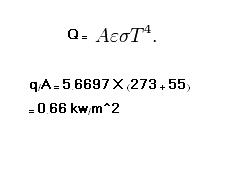
The discussion revolves around a problem related to thermal radiation emitted by a radiator in a domestic heating system, specifically focusing on the application of the Stefan-Boltzmann Law to determine the rate of radiant heat emission per unit area for a black body at a given surface temperature.
Discussion Character
- Conceptual clarification, Assumption checking
Approaches and Questions Raised
- Participants are questioning why the temperature is not raised to the fourth power in the calculations, with references to the Stefan-Boltzmann Law. There is also discussion about the correct application of the law and the significance of the Stefan-Boltzmann constant.
Discussion Status
The discussion is active, with participants exploring the reasoning behind the application of the Stefan-Boltzmann Law. Some guidance has been provided regarding the proportionality of radiation to the fourth power of absolute temperature, but there remains some confusion about the details and calculations involved.
Contextual Notes
There are indications of potential typographical errors in the original problem statement, particularly concerning the order of magnitude for the Stefan-Boltzmann constant. Participants are also navigating the implications of using absolute temperature in their calculations.