A rope, a pole, and some tension

  • Thread starter Thread starter Quantum Psi Inverted
  • Start date Start date
  • Tags Tags
    Pole Rope Tension
Click For Summary
SUMMARY

The discussion centers on the mechanics of a rope wrapped around a pole and the forces involved, specifically focusing on the tension T0 applied by a person and the static friction coefficient µ. The key takeaway is that the tension in a massless rope remains constant along its length, while the interaction with the pole introduces complexities due to friction. The concept of a capstan is also introduced, illustrating how a fixed cylinder can amplify the force exerted on a large object, such as a boat, by allowing a person to apply a smaller force effectively.

PREREQUISITES
  • Understanding of Newton's laws of motion
  • Familiarity with static friction and its coefficient (µ)
  • Knowledge of tension in ropes and cables
  • Basic concepts of rotational mechanics and fixed cylinders
NEXT STEPS
  • Study the Capstan equation and its applications in mechanical systems
  • Explore the principles of static friction in detail
  • Learn about the mechanics of fixed cylinders and their role in force multiplication
  • Investigate real-world applications of capstans in maritime and construction settings
USEFUL FOR

Physics students, mechanical engineers, and anyone interested in understanding the principles of tension and friction in mechanical systems.

Quantum Psi Inverted
Messages
7
Reaction score
1
Thread moved from the technical forums to the schoolwork forums
A rope wraps an angle θ around a pole. You grab one end and pull with a tension T0. The other end is attached to a large object, say, a boat. If the coefficient of static friction between the rope and the pole is µ, what is the largest force the rope can exert on the boat, if the rope is not to slip around the pole?

I'm struggling to understand the diagram depicted here:
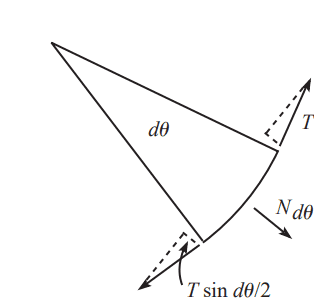
1704165521776.png

Could someone explain why this diagram would help us? This is the David Morin Classical Mechanics book if that helps whatsoever.
 
Physics news on Phys.org
Welcome to PF.

Is this homework?

Consider a rope that passes one turn around a fixed cylinder. Then consider two turns.

The force that pulls the rope onto the friction cylinder surface, is determined by the tension you apply to the "free" end of the rope, that you are holding.

How does the tension vary along the rope?
 
  • Like
Likes   Reactions: Quantum Psi Inverted
Ah! When you put it that way, everything makes sense now. Thank you very much.
 
Baluncore said:
How does the tension vary along the rope?
If the rope is taken to be massless the tension is the same everywhere!
 
Delta2 said:
If the rope is taken to be massless the tension is the same everywhere!
No, no! Please withdraw that.
 
ok tell me where is the mistake, we take a portion dx of the rope at position x, if the rope is massless from newtons 2nd T(x+dx)-T(x)=dma=rdxa, r=0 so unless we have infinite acceleration T(x+dx)-T(x)=0 hence T constant everywhere.
 
Delta2 said:
ok tell me where is the mistake, we take a portion dx of the rope at position x, if the rope is massless from newtons 2nd T(x+dx)-T(x)=dma=rdxa, r=0 so unless we have infinite acceleration T(x+dx)-T(x)=0 hence T constant everywhere.
There is a normal force from the pole, as shown, and friction parallel to the rope.
Follow the link in post #4.
 
Hm. Ok so it is the same along each segment of the rope, but between the two segments it is different?
 
  • #10
Capstans btw is for different situation, rope multiple tied around a pole with dimensions, here the rope just does a single tie around a dimensionless pole.
 
  • #11
Delta2 said:
Capstans btw is for different situation, rope multiple tied around a pole with dimensions, here the rope just does a single tie around a dimensionless pole.
The pole is not point-like. It has a finite size. Although the diameter of the pole is unknown, that diameter will turn out to be irrelevant. The diagram is a strong hint that this is the intent.

The text indicates that there are two forces. One unknown force from the boat and one known force from you (the person holding the other end of the rope).

I've cinched up more than a few ropes wrapped around trees. And tied off mooring ropes to a fair number of cleats. I assure you that the scheme is viable.
 
  • Informative
  • Like
Likes   Reactions: BvU and Delta2
  • #12
Delta2 said:
Capstans btw is for different situation, rope multiple tied around a pole with dimensions, here the rope just does a single tie around a dimensionless pole.
The fixed cylinder, or bollard, is used to hold a large tension force, by multiplying the small tension force that can be applied by a person. The person cannot pull the object providing the large force nearer, but by reducing the hand tension, can hold or control it as it moves away.

A capstan is a rotating cylinder. The capstan obeys the same physics and mathematics as the bollard. The difference with the capstan is that the person can provide a high force to move a heavy object, by pulling gently with a hand on the end of the rope. The work is then being done by the capstan motor.
 
  • Informative
  • Like
Likes   Reactions: jbriggs444 and Delta2

Similar threads

  • · Replies 8 ·
Replies
8
Views
5K
  • · Replies 1 ·
Replies
1
Views
2K
  • · Replies 4 ·
Replies
4
Views
7K
Replies
6
Views
4K
  • · Replies 32 ·
2
Replies
32
Views
5K
  • · Replies 18 ·
Replies
18
Views
2K
Replies
18
Views
2K
  • · Replies 3 ·
Replies
3
Views
2K
Replies
4
Views
5K
  • · Replies 2 ·
Replies
2
Views
2K