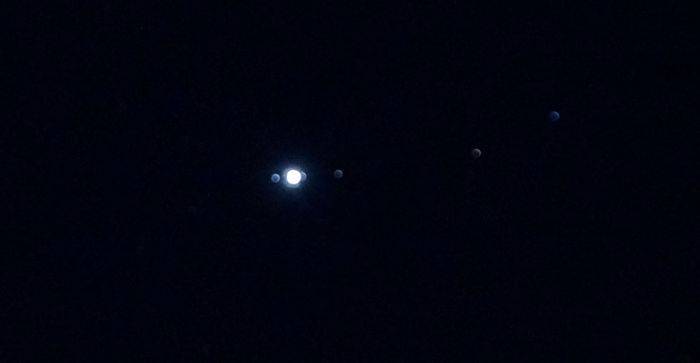
A shot I got of Jupiter & moons last night

Click For Summary

Discussion Overview

The discussion revolves around astrophotography, specifically capturing images of Jupiter and its moons. Participants share their experiences, techniques, and challenges encountered while photographing celestial objects using various camera equipment. The scope includes technical aspects of photography, observational astronomy, and equipment recommendations.

Discussion Character

  • Exploratory
  • Technical explanation
  • Debate/contested
  • Experimental/applied

Main Points Raised

  • One participant successfully captured images of Jupiter and its moons using a handheld camera and later with a tripod, noting the unexpected size and shape of the moons in the images.
  • Another participant questions the identification of the moons based on a tracker map, expressing uncertainty about their positions and sizes in the photograph.
  • There is speculation about the reasons for the moons appearing larger than expected, with suggestions including lens distortion, flare, or camera shake.
  • Some participants discuss the timing of the photograph and its correlation with the tracker map, attempting to identify the moons based on their positions.
  • A participant emphasizes that the moons would typically appear as points of light rather than disks in a properly focused image, suggesting that the observed effect is due to out-of-focus conditions.
  • Suggestions are made for improving astrophotography techniques, including focusing methods and image processing tips, such as combining exposures to enhance visibility of both Jupiter and its moons.
  • One participant mentions their experience using binoculars to observe Jupiter's moons, contrasting it with the camera's output.
  • Discussion includes interest in new camera technology, specifically a new Pentax model with features beneficial for astrophotography.
  • A later post mentions acquiring a telescope, indicating a shift towards more serious astronomical observation.

Areas of Agreement / Disagreement

Participants express differing views on the appearance of the moons in the images, with some agreeing that they should appear as points of light, while others appreciate the aesthetic of the captured image despite its technical inaccuracies. The discussion remains unresolved regarding the exact identification of the moons and the reasons for their appearance.

Contextual Notes

There are limitations in the discussion regarding the assumptions made about the moons' positions and the effects of camera settings on image quality. The identification of celestial objects relies on the accuracy of the tracker map and the timing of the photograph, which are not fully reconciled.

Who May Find This Useful

Astronomy enthusiasts, amateur astrophotographers, and individuals interested in photography techniques related to celestial imaging may find this discussion valuable.

Glenstr
Messages
77
Reaction score
34
I was trying to get a couple of quick handheld shots of the waxing crescent moon with Venus with my Nex-5N last night, when just for fun I thought I'd snap Jupiter and see if the moons showed up with the Sony 200mm zoom. Much to my surprise I was able to see a couple of the moons with just a hand held shot, so I went in and got my tripod to try a couple of more.

The Nex camera doesn't fit on the tripod the best and I'm not familiar enough with it to play with manual shutter speeds, plus I don't like composing with the LCD for pictures like this so I switched it with my wifes Pentax Kx & 250 mm Sigma lens. I did a couple of shots at several seconds exposure & was pleasantly surprised with the results for a quick spur of the moment image.

I'm not sure if it's from lens flare, diffraction, or just a bit of jiggle, but it made the moons look way bigger & retained their spherical shape. I'm not sure where the moons are right now, but it looks like I got 4 of them in this image.

Here is the best shot, cropped quite a bit to make it bigger.
jupiter2.jpg
 
  • Like
Likes   Reactions: Monsterboy, jim mcnamara, Drakkith and 5 others
Astronomy news on Phys.org
I downloaded the attached tracker map from this site. I don't know when you took the image, but I'm having trouble reconciling it with the tracker map. Presumably the one on the far right is Callisto, but then it seems like the one on the left should be Ganymede, and it looks too close to Jupiter. Also the second furthest one on the right looks too far away to be Io or Europa. I don't know why the moons look like round balls, they should be points of light, and I actually see five of the round balls (not counting Jupiter) in your image. Can you tell us when you took it and try to reconcile it with the tracker map?
 

Attachments

I took it last night between 10:15 & 10:30 MDT (UTC-6)

I assumed the 4 round balls closest were the moons, the one furthest to the right wasn't. If you look closely there is one that looks like it's behind Jupiter's disk on the right side - the one on the far right & up a bit I assumed was a distant star.

I don't know why the moons look so big, and attributed it to lens distortion or flare, jiggle or maybe a combination? At first I thought it may be specs of dust on the lens lit up from ambient light but the same spheres showed up on my Sony camera too. In hindsight I should have taken a look with my binoculars & compared - I may try it again tonight.

I tried to link the uncropped image but it didn't show up - if you click on this link it may work
 
So if I have the time right, that would be about 04:00 UT on 4/21. Do you agree? That seems to match the tracker map pretty well if you assume that the far right object is a star. Then the four moons would be (left to right) Ganymede, Europa, Io, Callisto.
 
wow insanely cool
 
phyzguy said:
So if I have the time right, that would be about 04:00 UT on 4/21. Do you agree? That seems to match the tracker map pretty well if you assume that the far right object is a star. Then the four moons would be (left to right) Ganymede, Europa, Io, Callisto.

Sounds about right, the tracker shows Europa just about to either go behind or come out from behind at about 4:18 UT, is this correct? In that if the tracker shows it going behind (or transiting) on the left side we see it here on the right?

I looked at the details on the pic and it says it was taken at 9:18 - so I'm assuming my wifes camera still has its time set to MST, I'll have to check it when I get home.
 
glenstr said:
I was trying to get a couple of quick handheld shots of the waxing crescent moon with Venus with my Nex-5N last night, when just for fun I thought I'd snap Jupiter and see if the moons showed up with the Sony 200mm zoom. Much to my surprise I was able to see a couple of the moons with just a hand held shot, so I went in and got my tripod to try a couple of more.

The Nex camera doesn't fit on the tripod the best and I'm not familiar enough with it to play with manual shutter speeds, plus I don't like composing with the LCD for pictures like this so I switched it with my wifes Pentax Kx & 250 mm Sigma lens. I did a couple of shots at several seconds exposure & was pleasantly surprised with the results for a quick spur of the moment image.

I'm not sure if it's from lens flare, diffraction, or just a bit of jiggle, but it made the moons look way bigger & retained their spherical shape. I'm not sure where the moons are right now, but it looks like I got 4 of them in this image.
just keep in mind that you pic is well out of focus and you wouldn't see the moons of Jupiter as anything more than bright points of
light in a telescope or telephoto lens at home

That is you are NOT seeing the moons as disks, you are seeing them as out of focus blobs OK ?

Dave
 
davenn said:
just keep in mind that you pic is well out of focus and you wouldn't see the moons of Jupiter as anything more than bright points of
light in a telescope or telephoto lens at home

That is you are NOT seeing the moons as disks, you are seeing them as out of focus blobs OK ?

Dave

Yes I know that that's not how they look, I just thought that regardless of what caused them to look like that (disks), be it out of focus, lens flare etc. the end result looked pretty cool for a quick spur of the moment tripod shot.

Those would have to be pretty humongous moons to see them as disks like that.. :-)

I've been watching Jupiter for the last 7 weeks or so with some 10X30 Canon IS binoculars, which shows the moons as small points light quite nicely.

I just never thought of seeing if I could get them with just a camera on its own with an 18-250mm zoom lens.
 
  • Like
Likes   Reactions: davenn
cool :) was just checking

that's a great start ... fo good focussing pick on a really bright star and focus as sharply as you can on that
then move to what you want to photo taking care not to bump the focus

I don't know if you have photoshop ? if so you can try something else ...

take 2 pics one where Jupiter is overexposed but the moons show up
Then take a second pic where Jupiter is correctly exposed and you may see a band or 2 but you won't see any of the moons

then combine the 2 images as separate layers in PS into one layer and replace the overexposed Jupiter with the good exposure
so you have Jupiter and moons nicely visible

cheers
Dave
 
  • Like
Likes   Reactions: Glenstr
  • #10
I'll try that - I didn't think 250mm was enough to show Jupiter's bands though - cool if it does.

I use PSP ProX5 & Gimp, which should be just as capable for what you described.
 
  • #11
Like this:

jupiter_2-2_zpsdzdlqe9d.jpg


And after you've taken a bunch of them all summer, stack them together like this;

jupiter_2_3_zps6fwl8avk.jpg
 
  • Like
Likes   Reactions: davenn, Drakkith and Glenstr
  • #12
Jupiter is a great target for aspiring astrophotographers. Nice shot.
 
  • #13
thanks - on another note I just was reading some info on the new Pentax K3 II coming out soon - it has a built in astrotracer function that looks interesting.

I almost pulled the trigger on a K3 in the fall but other things came up I'm glad I waited because the K3 II has some pretty neat features at a reasonable price.
 
  • #14
update - my decision got made for me, got a Celestron Sky Prodigy 130 for my birthday yesterday, started a new thread here
 

Similar threads

  • · Replies 10 ·
Replies
10
Views
3K
  • · Replies 17 ·
Replies
17
Views
6K
  • · Replies 20 ·
Replies
20
Views
6K
  • · Replies 6 ·
Replies
6
Views
3K
  • · Replies 152 ·
6
Replies
152
Views
11K