JHUK
- 5
- 0
I do not have physics education pass A-levels, yet. So what I've been thinking of should be very simple to follow. It's just so fascinating that I'm wondering if any experts could either point a logic flaw, or direct me to material that has already mused over this for me.
I understand that the answer to "what is at the edge of the universe" is something we can't know, due to the limited distance that light has traveled since the big bang. But that it's speculated that the universe is like a 3D version of a balloon's surface, that if you were to travel far enough in one direction, you'd end up back where you begin.
This brings up the very interesting and fun question, to imagine a universe like this being only the size of a small room. You're floating, what do you see? (we can assume there's light, air, etc for our convenience) Naturally you'd see the back of yourself. Now twist forward (shrink the universe a bit for this) and grab hold of "his" leg, you'd feel the same hand wrap around your own leg. There's a lot of funny things you could do here.
But on further reflection, if the universe "repeats" itself in front of you, it should also do it upwards. But likewise it should also "repeat" in any direction, which begins creating an absurd and confusing scenario, so to simplify it, imagine just a sphere.
Place this imagined sphere inside this empty and small universe. Wherever it is, we can picture that as the "center" (e.g. like placing a dot onto a balloon containing no other drawings). For our convenience, this sphere is also able to see, and emit light.
I'm going to get a sphere picture from google images, and express the rest using a crude MSpaint diagram.
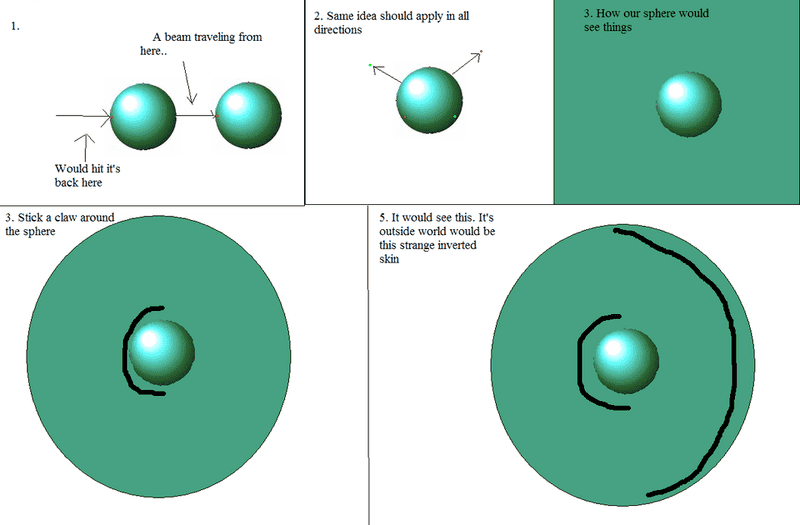
You get a similar result if you picture a point on an empty sphere. If you imagine light travels over the surface like everything else, instead of flying off into space, light emitted from the point would fly around the planet and hit it's back. The point would therefore see a circle around him. Made of him.
I understand that the answer to "what is at the edge of the universe" is something we can't know, due to the limited distance that light has traveled since the big bang. But that it's speculated that the universe is like a 3D version of a balloon's surface, that if you were to travel far enough in one direction, you'd end up back where you begin.
This brings up the very interesting and fun question, to imagine a universe like this being only the size of a small room. You're floating, what do you see? (we can assume there's light, air, etc for our convenience) Naturally you'd see the back of yourself. Now twist forward (shrink the universe a bit for this) and grab hold of "his" leg, you'd feel the same hand wrap around your own leg. There's a lot of funny things you could do here.
But on further reflection, if the universe "repeats" itself in front of you, it should also do it upwards. But likewise it should also "repeat" in any direction, which begins creating an absurd and confusing scenario, so to simplify it, imagine just a sphere.
Place this imagined sphere inside this empty and small universe. Wherever it is, we can picture that as the "center" (e.g. like placing a dot onto a balloon containing no other drawings). For our convenience, this sphere is also able to see, and emit light.
I'm going to get a sphere picture from google images, and express the rest using a crude MSpaint diagram.
You get a similar result if you picture a point on an empty sphere. If you imagine light travels over the surface like everything else, instead of flying off into space, light emitted from the point would fly around the planet and hit it's back. The point would therefore see a circle around him. Made of him.