How Does Voltage Affect Diode Behavior in a Circuit?

  • Thread starter Thread starter Sigurdsson
  • Start date Start date
  • Tags Tags
    Diodes
Click For Summary
SUMMARY

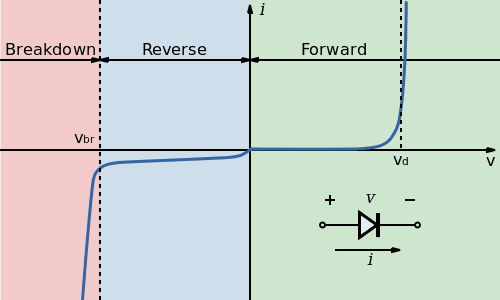
The discussion centers on the behavior of a p-n junction diode in a circuit, specifically regarding its built-in potential of 0.6 volts. To forward bias the diode, this potential must be exceeded, as illustrated by the current/voltage graph. When a +5V battery is connected, Kirchhoff's voltage law applies, yielding a voltage drop of 0.6V across the diode, resulting in 4.4V across the resistor. If the battery voltage is only +0.5V, the diode remains off, allowing minimal forward current to flow.

PREREQUISITES
  • Understanding of p-n junction diodes
  • Familiarity with Kirchhoff's voltage law
  • Basic knowledge of current/voltage graphs
  • Experience with circuit analysis
NEXT STEPS
  • Study the characteristics of p-n junction diodes
  • Learn about Kirchhoff's laws in electrical circuits
  • Explore the impact of varying voltage on diode behavior
  • Investigate the concept of forward and reverse bias in diodes
USEFUL FOR

Electrical engineers, electronics students, and anyone interested in understanding diode behavior in circuits.

Sigurdsson
Messages
24
Reaction score
1
The following picture represents the current/voltage graph through a basic p-n junction diode.
500px-Diode-IV-Curve.svg.png


Diodes have a built in potential 0.6 volts. One must overcome this potential to make the diode work. This 0.6V are the nearly flat line in the forward region. Am I right?

My question is:
If you connect a diode in a closed circuit with resistance and a battery (+5V), then would Kirchoff work this way?

0 = 5V - 0.6V - 4.4V

Is the diode simply -0.6V?

And one more thing, what happens if the battery is only +0.5V?
 
Physics news on Phys.org
Sigurdsson said:
The following picture represents the current/voltage graph through a basic p-n junction diode.

500px-Diode-IV-Curve.svg.png


Diodes have a built in potential 0.6 volts. One must overcome this potential to make the diode work. This 0.6V are the nearly flat line in the forward region. Am I right?

My question is:
If you connect a diode in a closed circuit with resistance and a battery (+5V), then would Kirchoff work this way?

0 = 5V - 0.6V - 4.4V

Is the diode simply -0.6V?

And one more thing, what happens if the battery is only +0.5V?

You are correct. And if the battery is only supplying 0.5V, then you are still on the right side of the plot before Vd, so very little forward current flows.
 

Similar threads

  • · Replies 15 ·
Replies
15
Views
7K
  • · Replies 19 ·
Replies
19
Views
5K
Replies
9
Views
2K
Replies
3
Views
1K
  • · Replies 22 ·
Replies
22
Views
16K
  • · Replies 9 ·
Replies
9
Views
6K
  • · Replies 6 ·
Replies
6
Views
6K
Replies
6
Views
2K
  • · Replies 8 ·
Replies
8
Views
5K
  • · Replies 8 ·
Replies
8
Views
3K