A Spring pushing an object up a 25 cm slope

  • Thread starter Thread starter Zero
  • Start date Start date
  • Tags Tags
    Slope Spring
Click For Summary

Homework Help Overview

The discussion revolves around a physics problem involving a spring pushing an object up a slope, specifically focusing on energy conservation principles and the relationship between potential and kinetic energy.

Discussion Character

  • Exploratory, Conceptual clarification, Mathematical reasoning, Assumption checking

Approaches and Questions Raised

  • Participants explore the application of conservation of energy, questioning the setup and calculations related to potential and kinetic energy. There are attempts to derive relationships between the speeds at different points and the energies involved.

Discussion Status

Participants are actively engaging with the problem, with some expressing confusion over negative results in their calculations. There is acknowledgment of potential errors in reasoning, and a correction is offered regarding the energy equations. The discussion reflects a mix of interpretations and attempts to clarify the relationships between the variables involved.

Contextual Notes

Some participants mention neglecting friction and express concerns about the feasibility of reaching the final point based on their calculations. There is an indication of frustration over the complexity of the problem and the implications of negative results.

Zero
Messages
17
Reaction score
4
Homework Statement
A box is initially at rest in the following system. The box is placed next to the spring and the spring (along with the box) is compressed 30.0 cm. The spring constant of the spring is 150 N/m, and the mass of the box is 540 grams.
a. Calculate the speed of the box at position B (assume energy has not been lost due to friction).
Relevant Equations
Since I know energy is lost due to friction would I use the formula ff= U (Fn) where Fn= 5.292 since that would be the gravity action on the object and normal for and gravity have to be equal. If I use the same logic would Ff= -Ek or no???
f= kx
= 150 n/m (.3m)
= 45n

Ug= 1/2 kx^2
= 1/2 (150) (.3)^2
= 75 (.09)
= 6.75 j

Ek= 1/2mv^2
6.75= 1/2 (.54) (v^2)
6.75= .27 (v^2)
25= v^2
5= v1
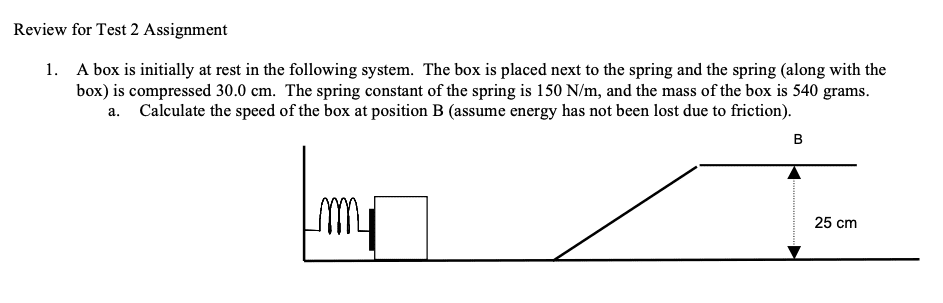
Screen Shot 2020-04-16 at 10.55.46 AM.png
 
Physics news on Phys.org
Dear Zero,

I understand, you can neglect the energy lost due to friction. Thus, to solve the problem you can use the law law of conservation of energy.

You need to know the speed of the box when the spring pushes it. Then, the different of potential and kinetic energy will give you the speed in the top (point B).

It means the final kinetic energy will be ##T = 1/2mv_B^2 = mgh-1/2mv_A²##. Now you need the speed at A. That's easy, the potential energy of the spring will be the kinetic energy of the box. In other words

$$1/2kx^2 = 1/2mv_A^2$$

Now, you only have to substitute ##v_A## in the previous equation to solve the speed at B
 
jonbovi said:
Dear Zero,

I understand, you can neglect the energy lost due to friction. Thus, to solve the problem you can use the law law of conservation of energy.

You need to know the speed of the box when the spring pushes it. Then, the different of potential and kinetic energy will give you the speed in the top (point B).

It means the final kinetic energy will be ##T = 1/2mv_B^2 = mgh-1/2mv_A²##. Now you need the speed at A. That's easy, the potential energy of the spring will be the kinetic energy of the box. In other words

$$1/2kx^2 = 1/2mv_A^2$$

Now, you only have to substitute ##v_A## in the previous equation to solve the speed at B
I don't know if I'm doing something wrong but I keep getting a negative number when I am left with v^2 which I can't square root. 1/2mv^2= .27 v^2 and mgh-1/2mv^2= -5.427 so therefore i get v^2=-20.1 which i can't square root. Can i just switch which one comes first then the answer would be positive and i can square root from there?
 
That's true, it is negative. That means that is not possible to reach the B point
 
jonbovi said:
That's true, it is negative. That means that is not possible to reach the B point
So what your saying is that its a trap, if so then I wasted hours on nothing. Thanx man really appreciate the help.
 
Oh, No sorry, I realize I messed up!

The right difference of energy is ## 1/2mv_B^2=1/2mv_A^2-mgh##

And this changes the sign. Sorry, my fault!
 
jonbovi said:
Oh, No sorry, I realize I messed up!

The right difference of energy is ## 1/2mv_B^2=1/2mv_A^2-mgh##

And this changes the sign. Sorry, my fault!
its all good man i should have also picked up on this too. Thank you I got the answer.
 

Similar threads

  • · Replies 21 ·
Replies
21
Views
2K
Replies
8
Views
3K
  • · Replies 9 ·
Replies
9
Views
2K
  • · Replies 3 ·
Replies
3
Views
2K
  • · Replies 8 ·
Replies
8
Views
4K
  • · Replies 3 ·
Replies
3
Views
2K
  • · Replies 38 ·
2
Replies
38
Views
5K
  • · Replies 3 ·
Replies
3
Views
2K
  • · Replies 8 ·
Replies
8
Views
3K