A subset of R^(2) that is a nontrivial subspace of R^(2)

  • Context: MHB 
  • Thread starter Thread starter Zoey93
  • Start date Start date
  • Tags Tags
    Subspace
Click For Summary

Discussion Overview

The discussion revolves around identifying a nontrivial subspace of $\Bbb R^2$. Participants explore definitions, examples, and properties of subspaces in the context of vector spaces, with a focus on closure under addition and scalar multiplication.

Discussion Character

  • Exploratory
  • Technical explanation
  • Homework-related
  • Debate/contested

Main Points Raised

  • One participant requests an example of a nontrivial subspace of $\Bbb R^2$.
  • Another participant suggests the set $\{(x,y) \in \Bbb R^2: y = ax, a \in \Bbb R - \{0\}\}$ as a potential example.
  • Several participants discuss the definition of a nontrivial subspace, emphasizing the need for at least one non-zero vector and closure under addition and scalar multiplication.
  • There is a contention regarding whether the suggested set is indeed a subspace, with one participant arguing it is not a proper subspace of $\Bbb R^2$.
  • Clarifications are made regarding the formatting of the suggested set, with some participants indicating that the exclusion of $a=0$ was intended to avoid triviality.
  • A participant presents their own example using the equation $y = (4/3)x$, detailing checks for containing the zero vector and closure properties.
  • Feedback is provided on the example, highlighting that closure must be demonstrated for any two points in the subspace, not just specific cases.
  • Concerns are raised about the clarity of the professor's remarks regarding non-triviality and the need to show that the line is not all of $\Bbb R^2$.

Areas of Agreement / Disagreement

Participants express differing views on the validity of the suggested subspace examples and the requirements for demonstrating closure properties. There is no consensus on a single example that meets all criteria for a nontrivial subspace.

Contextual Notes

Some participants note that the closure properties were not sufficiently demonstrated, and there is ambiguity regarding the definition of non-triviality as it relates to the examples provided.
Zoey93
Messages
15
Reaction score
0
Hey,

I need help coming up an example of a subset of $\Bbb R^2$ that is a nontrivial subspace of $\Bbb R^2$. Thank you!
 
Last edited by a moderator:
Physics news on Phys.org
Try:

$\{(x,y) \in \Bbb R^2: y = ax, a \in \Bbb R - \{0\}\}$
 
Hi Zoey93! (Smile)

I'm assuming we're talking about vector spaces yes? (Wondering)

If that's the case, any non-trivial sub space has at least one non-zero vector in it.
Any such vector spans a 1-dimensional sub space - you can choose any vector you like.
It will result in a line through the origin.

If we add a second independent vector, we get all of $\mathbb R^2$, so then it won't be a true sub space.

Erm... Deveno's suggestion is not a sub space - it's all of $\mathbb R^2$ without one specific line, which is just not a sub space. (Worried)
 
I like Serena said:
Hi Zoey93! (Smile)

I'm assuming we're talking about vector spaces yes? (Wondering)

If that's the case, any non-trivial sub space has at least one non-zero vector in it.
Any such vector spans a 1-dimensional sub space - you can choose any vector you like.
It will result in a line through the origin.

If we add a second independent vector, we get all of $\mathbb R^2$, so then it won't be a true sub space.

Erm... Deveno's suggestion is not a sub space - it's all of $\mathbb R^2$ without one specific line, which is just not a sub space. (Worried)

Uh...are you sure?
 
I think the confusion here might be with Deveno's formatting -- I believe he meant to write

$$\{(x,y)\in \Bbb R^2: y = ax\}\quad (a\in \Bbb R-\{0\})$$
 
Euge said:
I think the confusion here might be with Deveno's formatting -- I believe he meant to write

$$\{(x,y)\in \Bbb R^2: y = ax\}\quad (a\in \Bbb R-\{0\})$$

Indeed, I just wanted to exclude the case $a = 0$, not that all such $a$ should be considered simultaneously. In other words, $a$ is a constant. Come to think of it, I don't even know why I excluded that particular case, but, *sigh*, oh well.
 
Deveno said:
Come to think of it, I don't even know why I excluded that particular case, but, *sigh*, oh well.

I thought you did that to exclude the trivial subspace, which is what Zoey93 wanted excluded.
 
Euge said:
I thought you did that to exclude the trivial subspace, which is what Zoey93 wanted excluded.

Erm... it doesn't? (Thinking)
 
I like Serena said:
Erm... it doesn't? (Thinking)

No reason to think too hard ILS, it was an error on my part. (Bigsmile)
 
  • #10
Euge said:
No reason to think too hard ILS, it was an error on my part. (Bigsmile)

Great minds think alike.
(Not sure what our excuse is, though)
 
  • #11
Deveno said:
Great minds think alike.

(Not sure what our excuse is, though)

Heh. I'm quite willing to conceed that both of your minds are greater than mine where algebra is concerned.
Still, it's nice that where basic definition issues are at stake, I'm not completely left out. ;)
 
  • #12
I like Serena said:
Heh. I'm quite willing to conceed that both of your minds are greater than mine where algebra is concerned.
Still, it's nice that where basic definitions issues are at stake, I'm not completely left out. ;)

No, no...you're quite right to point out any mistakes or ambiguities you see. Just to be clear what I meant to say (and kinda flubbed up, my bad) is:

"Consider the set:

$\{(x,y) \in \Bbb R^2: y = ax\}$, where $a$ is some non-zero real number."

Of course, the $x$-axis works as well (the $a = 0$ example), and it probably a more "intuitive" example of a non-trivial proper subspace.

In my mind, I was thinking of the pairs as $(x,ax)$ where $x$ might be any real number, and $a$ is fixed.

I hope the original poster hasn't been scared away...
 
  • #13
Deveno said:
No, no...you're quite right to point out any mistakes or ambiguities you see. Just to be clear what I meant to say (and kinda flubbed up, my bad) is:

I hope the original poster hasn't been scared away...

No worries.
I'm quite aware that my primary skills are in applied mathematics.
I'm only dabbling in algebra, where I usually can only help out with the definitions.
 
  • #14
To make a distinction here, $\Bbb R^2$ is a non-trivial subspace of itself, but it is not a proper subspace of itself.
 
  • #15
Hey guys! Thank you all for your help. I came up with this example:

My definition of a non-trivial subspace: A non-trivial subspace of vector space, V, contains the zero vector and at least one non-zero vector, and is closed under addition and scalar multiplication. I used the equation y = (4/3)x

1.0 is in R2:
The equation goes through the origin and the point (3, 4)
so 4 = (4/3)*3 = 4
and 0 = (4/3)*0 = 0
2. closed under addition: <3, 4> + <0, 0> = <3, 4>
3. closed under scalar multiplication
If I make my scalar multiple = 2, then the result is:
2<3, 4> = <6, 8>
8 = (4/3)*6 = 8

My professor said that "An appropriate subset of R2 is provided. The zero vector is shown to lie in the set, and a nonzero vector is shown to lie in the set. The proofs of closure are not sufficient. Furthermore, not all nontriviality properties are identified."

I need help correcting my mistakes.
 
  • #16
Zoey93 said:
Hey guys! Thank you all for your help. I came up with this example:

My definition of a non-trivial subspace: A non-trivial subspace of vector space, V, contains the zero vector and at least one non-zero vector, and is closed under addition and scalar multiplication. I used the equation y = (4/3)x

1.0 is in R2:
The equation goes through the origin and the point (3, 4)
so 4 = (4/3)*3 = 4
and 0 = (4/3)*0 = 0
2. closed under addition: <3, 4> + <0, 0> = <3, 4>
3. closed under scalar multiplication
If I make my scalar multiple = 2, then the result is:
2<3, 4> = <6, 8>
8 = (4/3)*6 = 8

My professor said that "An appropriate subset of R2 is provided. The zero vector is shown to lie in the set, and a nonzero vector is shown to lie in the set. The proofs of closure are not sufficient. Furthermore, not all nontriviality properties are identified."

I need help correcting my mistakes.

Hey again Zoey93,

Closure under addition means that the sum of any 2 elements of the subspace are in the subspace.
Lets pick the generic elements $(x_1, \frac 4 3 x_1)$ and $(x_2, \frac 4 3 x_2)$.
Their sum is $(x_1 + x_2, \frac 4 3 (x_1 + x_2))$, which satisfies the equation $y=\frac 43 x$, so indeed we have closure under addition.

We need something similar for closure under multiplication.

As for the missing property, how about showing that we have 'at least one non-zero vector'?
 
  • #17
Zoey93 said:
Hey guys! Thank you all for your help. I came up with this example:

My definition of a non-trivial subspace: A non-trivial subspace of vector space, V, contains the zero vector and at least one non-zero vector, and is closed under addition and scalar multiplication. I used the equation y = (4/3)x

1.0 is in R2:
The equation goes through the origin and the point (3, 4)
so 4 = (4/3)*3 = 4
and 0 = (4/3)*0 = 0
2. closed under addition: <3, 4> + <0, 0> = <3, 4>
3. closed under scalar multiplication
If I make my scalar multiple = 2, then the result is:
2<3, 4> = <6, 8>
8 = (4/3)*6 = 8

My professor said that "An appropriate subset of R2 is provided. The zero vector is shown to lie in the set, and a nonzero vector is shown to lie in the set. The proofs of closure are not sufficient. Furthermore, not all nontriviality properties are identified."

I need help correcting my mistakes.

To amplify what your professor remarked:

You only showed closure for ONE SUM. You have to show it for ANY TWO POINTS on the line. Similarly, just showing one scalar multiple of a point on the line, is again on the line is not enough. You have to show that if:

$y = \frac{4}{3}x$

and $r$ is ANY real number, that

$ry = \frac{4}{3}(rx)$.

that is, any scalar multiple of any point on the line, is again on the line. One example is not enough.

Your instructor's remarks on "non-triviality" are unclear-perhaps they want to underscore the fact you have not yet shown said line is not all of $\Bbb R^2$, its clearly not the 0-subspace.
 
  • #18
Hey guys,

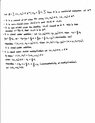
I came up with this example. My professor said, "The subset S is shown to contain the zero vector. Not all nontriviality properties are identified. One additional property needs to be shown in order for S to be proven nontrivial." I am not sure what additional property he is talking about?
 

Attachments

  • Part B LA -1.jpg
    Part B LA -1.jpg
    132.5 KB · Views: 137
  • #19
The only thing that occurs to me (as I have suggested before), is that you have not shown your set $S$ is *not* all of $\Bbb R^2$.
 

Similar threads

  • · Replies 6 ·
Replies
6
Views
4K
Replies
6
Views
2K
Replies
48
Views
5K
  • · Replies 15 ·
Replies
15
Views
5K
  • · Replies 1 ·
Replies
1
Views
2K
  • · Replies 3 ·
Replies
3
Views
3K
  • · Replies 16 ·
Replies
16
Views
2K
  • · Replies 10 ·
Replies
10
Views
2K
  • · Replies 2 ·
Replies
2
Views
2K
  • · Replies 1 ·
Replies
1
Views
2K