A train dragging coal while more coal is added into it....

Join the discussion
Ask a follow-up here, or get your own question answered by working scientists, mathematicians and engineers — people, not an autocomplete.
Real named experts · corrections over time · the nuance an AI answer skips
3 replies · 2K views
elkaka7
Messages
1
Reaction score
0
New user has been reminded to show their work in their OP. Please use the hint by @DoItForYourself toi show us your work...

Homework Statement


A locomotive is dragging empty freight cars, while coal is being dropped into them. It’s falling down into those freight cars with an efficiency (μ). Overall mass of the whole empty train is M.

a) Calculate v(t) (velocity with respect to time), assuming that the force of train engine and the force of friction are constant.

b) Calculate v(t), assuming that at the moment the coal started dropping, the train engine was stopped. Assume that to drag the empty train a power (P) is needed, and the resultant force of friction remains constant. After what time (ts) will the train stop?

c) What additional force (Fc) needs to be used so that during the coal dropping the velocity of train doesn’t change and equals v0?

Homework Equations


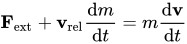
After searching for few hours i found this Variable-mass system equation:
0df34827efe7c73ea10627901b570e285a9d3eea


The Attempt at a Solution


I still have no idea how to tackle it.
 
on Phys.org
Hello,

Firstly, let us see the first question.

If the train has an initial mass M (with empty freight cars) and the efficiency (μ) expresses the added mass per second, then from Newton's second law:

## a=\frac {F} {m} = \frac {F} {M+μt} ##

If you substitute the acceleration a with dv/dt, bring dt from the other side and integrate this equation (considering a velocity v0 at t=0), you can get the function v(t).
 
DoItForYourself said:
Hello,

Firstly, let us see the first question.

If the train has an initial mass M (with empty freight cars) and the efficiency (μ) expresses the added mass per second, then from Newton's second law:

## a=\frac {F} {m} = \frac {F} {M+μt} ##

If you substitute the acceleration a with dv/dt, bring dt from the other side and integrate this equation (considering a velocity v0 at t=0), you can get the function v(t).
Unfortunately that does not work. You are overlooking the work needed to bring each added lump of coal up to the current speed.
 
elkaka7 said:
this Variable-mass system equation:
Yes, that's the equation you need, but the next step is to figure out how the variables in it relate to your problem.
(Of course, it would be much better to derive the equation yourself instead of pulling something from the net. When you have found the answer, I'd like to help you understand why the equation is right.)

The reference to "efficiency" threw me, but as DIY figured out it means the rate at which coal mass is added. Where do you think that fits in your equation?
What about vrel? What relative velocity do you think that is, and what sign should it have?
 
Last edited: