A triangle problem: Prove that |AC|+|AB|=|PR|+|PQ| given some constraints

Click For Summary

Discussion Overview

The discussion revolves around a geometric problem involving two triangles, ABC and PQR, with specific constraints regarding their vertices and angle bisectors. Participants are tasked with proving the relationship |AC| + |AB| = |PR| + |PQ|, exploring various methods and approaches, including vector algebra, geometric constructions, and theorems related to circles and angles.

Discussion Character

  • Exploratory
  • Technical explanation
  • Debate/contested
  • Mathematical reasoning

Main Points Raised

  • One participant expresses uncertainty about the appropriate level of the problem, suggesting it may be high school level.
  • Another participant suggests creating a diagram as a first step to aid understanding.
  • Some participants reference the Angle Bisector Theorem as a potential tool for the proof.
  • There are discussions about the existence of circles that could relate the points of the triangles, with one participant suggesting a circle through points A, B, C, P, Q, and R.
  • Another participant proposes constructing an example where triangles ABC and PQR are distinct, exploring the implications of such a construction.
  • Some participants mention the use of Ptolemy's Theorem and express challenges in applying it to the problem.
  • There are references to the law of sines and algebraic expressions derived from it, with some participants noting that symmetry in the expressions does not lead to a straightforward solution.
  • One participant discusses the geometric construction involving perpendicular bisectors and angle bisectors, suggesting a connection between these elements and the circles involved.
  • Another participant reflects on the complexity of the problem, noting that while some constructions make sense, they do not lead to a clean solution.

Areas of Agreement / Disagreement

Participants express a range of ideas and approaches, with no clear consensus on a solution or method. There are competing views on the applicability of various theorems and geometric constructions, and the discussion remains unresolved.

Contextual Notes

Some participants note the importance of assumptions, such as the non-parallel nature of certain lines, and the complexity of deriving clean algebraic expressions from the geometric configurations.

wrobel
Science Advisor
Insights Author
Messages
1,274
Reaction score
1,066
I actually do not understand where to place this thread. Hope that it is a high school level problem.

There are two triangles ABC and PQR. The vertex A is a middle of the side QR. The vertex P is a middle of the side BC. The line QR is a bisector of the angle BAC. The line BC is a bisector of the angle QPR. Prove that |AC|+|AB|=|PR|+|PQ|.

Using vector algebra methods and huge symbolic calculations in Maple I proved this fact in an additional assumption:
there are no parallel lines among AC, AB, PR, PQ.

I am sure that my method is not adequate and there must be an elementary high-school-level solution but I do not see it.

Please comment.
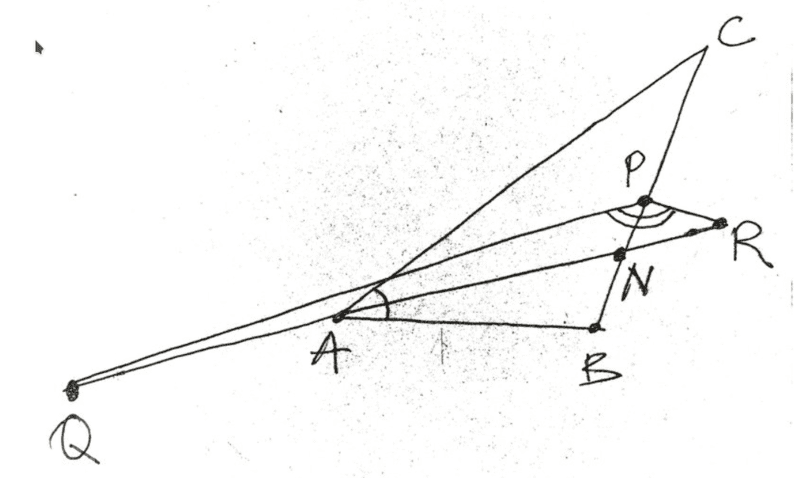
Screenshot_20230622_124841.png
 
Last edited by a moderator:
Mathematics news on Phys.org
wrobel said:
There are two triangles ABC and PQR. The vertex A is a middle of the side QR. The vertex P is a middle of the side BC. The line QR is a bisector of the angle BAC. The line BC is a bisector of the angle QPR. Prove that |AC|+|AB|=|PR|+|PQ|.
The first step could be to produce a diagram. Can you do that and post it here?

Apologies - didn't see diagram till just now.
 
Last edited:
wrobel said:
....there must be an elementary high-school-level solution but I do not see it.
Please comment.
Could this be an easier way?:
https://en.m.wikipedia.org/wiki/Angle_bisector_theorem

I have reached the following point:

QA = AR

BP = PC

CN / BN = AC / AB

RN / QN = PR / PQ
 
Assuming that CB is not parallel to QR, there has to be a circle that goes through all four points of those points. Maybe drawing in that circle leads somewhere.
 
  • Like
Likes   Reactions: Lnewqban
Looking at this a little more, there should also be a single circle centered on N that's tangent to QP, PR, AB, and AC.

Can you construct an example of this geometry where ABC and PQR are different?
 
  • Like
Likes   Reactions: Lnewqban
We know that there's an "outer circle" that goes through QBRC, and we know that there's an "inner circle" that is tangent to AB, AC, PQ, and PR. The "inner circle" is centered at N, and the outer circle is centered

WOLOG, we can assume that the radius of the outer circle is 1. And, let's say that we start by picking some lengths BN and NP that we want to generate a diagram for.

Then we have ##\overline{\rm{OP}} = \sqrt{1-\overline{\rm{BP}}^2}##.

And, I don't have clean formula for it to hand, but that leaves only one possible angle for PQR that makes the segment QR go through N. That, in turn, fixes the location of A, but we don't have any guarantee that QR bisects BAC yet. Ensuring that it is will probably "use up" one more degree of freedom.
 
  • Like
Likes   Reactions: Lnewqban
Throwaway_for_June said:
Assuming that CB is not parallel to QR, there has to be a circle that goes through all four points of those points. Maybe drawing in that circle leads somewhere.
why?
Throwaway_for_June said:
Then we have OP―=1−BP―2.
a vector is equal to a number hm

my bad solution: UPDATED the critical case with parallel lines is added
 

Attachments

Last edited:
  • Like
Likes   Reactions: Lnewqban
wrobel said:
why?

Ugh. I guess I'm too used to thinking about triangles where there are shared vertices. So there's no shared inner or outer circle, but concentric pairs of circles instead.
 
So, if ##\delta=\angle QPN##, ##\gamma = \angle CAN ## and ##\alpha=\angle ANP## then I think we have

##\left| \bar{QP }\right| + \left|\bar{PR}\right| =2 \frac{\sin \alpha}{\sin \delta} \left| \bar{AN} \right| + 2 \frac{sin \alpha}{\sin \left(\alpha - \delta \right)} \left| \bar{NP} \right|##
and
##\left| \bar{AB }\right| + \left|\bar{AC}\right| =2 \frac{\sin \alpha}{\sin \gamma} \left| \bar{NP} \right| + 2 \frac{sin \alpha}{\sin \left(\alpha - \gamma \right)} \left| \bar{AN} \right|##

from the law of sines and some algebra.

Those are symmetric, so ##\alpha = \delta + \gamma## would give the desired result, but, unfortunately, that doesn't seem to hold in general.

If I try to construct the two triangles starting with some ##A##, ##N## and ##P## I end up with a big quadratic that doesn't simplify in any ways that are obvious to me, so I'm not sure that there is any answer that's cleaner than what maple came up with.
 
  • #10
I do so want to use Ptolemy's Theorem on this but unfortunately I can't even get close.
 
  • #11
hutchphd said:
I do so want to use Ptolemy's Theorem on this but unfortunately I can't even get close.

I was looking for cross ratio stuff, but I don't think that's there either.
 
  • Like
Likes   Reactions: hutchphd
  • #12
hutchphd said:
I do so want to use Ptolemy's Theorem on this but unfortunately I can't even get close.
triangle_problem.png


I didn't realize that CQBR really are all on the same circle. Ptolemy's should work for showing that, but ...

For Ptolemy's theorem we want ##\left| QC \right| \left| BR \right| + \left| QB \right| \left| RC \right| = \left| QR \right| \left| CB \right|##.

I imagine it's possible to use the law of cosines to find expressions for the outer edges of the quadrilateral, rewrite all the lengths in terms of ##\left| AN \right|, \left| NR \right|, \left| PN \right| , ## and ## \left| NR \right| ## but that's going to work out to doing algebra with something like 64 terms which is doable in princple, but seems less than ideal.

It also doesn't readily get to the originally desired identity.
 
Last edited:
  • Like
Likes   Reactions: hutchphd
  • #13
This smacks of "coffin problem."

Let's say that we start with ##\bigtriangleup ABC##. Then it's easy to find the the perpendicular bisector of ##BC##, the bisector of ##\angle CAB## , the perpendicular to that bisector ##OA## and then the circle centered at ##O## that goes through ##B## (or ##C##).

Now we can extend ##QP## and ##RP## through the point ##P## to make points ##R'## and ##Q'## respectively. ##PQR## and ##PQ'R'## are obviously congruent (though I don't 100% have the justifcation for that). That will then give that ##CB## bisects ##\angle QPR## thanks to all of the vertical angles at ##P##. ##\bigtriangleup QPR## is determined by ##\bigtriangleup ABC##, so our construction of an example with ##QBRC## all on a circle shows that ##QBRC## is all on a circle.

Then we can imagine extending ##QP## past ##P## to make a chord of the circle with length ##\left| QP \right| + \left| PR \right|##. There's an analogous chord for ##\left| CA \right| + \left| AB \right|##.... Maybe there's a way to show that ##AC## and ##QP## are both the same distance from ##O##.

Thanks for sharing the question. It's interesting.
 
Last edited:
  • #14
triangles.png


OK, this is still a little ugly, but at least it all makes sense. ##O## - the place where the perpendicular bisectors meet - is also a the place where the circumcircles meet and there's also a connection between the angle bisectors, and the perpendicular bisectors as marked by the points ##T## and ##E##.

With this diagram in hand it's not so hard to work out that ##\left| OR \right|^2 = \left| OB \right|^2 = - \frac{ \left| OA \right| \left| OP \right| } { \cos{ \angle ANP } } ##, so ##QBRC## are all on a circle centered at ##O##.

The expression is symmetric with respect to ##\left| OA \right|## and ##\left| OP \right| ##, so it's sufficient to show that it works for one side.

##\left| OT \right| = - \frac { \left| OP \right| } {\cos{ \angle ANP } } ## from basic trig. Then since ##OT## is a diameter we can use Pythagoras' theorem:

## \left| OR \right|^2 = \left( \frac{ \left| OT \right| } {2} \right)^2 - \left( \frac{ \left| OT \right| } {2} - \left| OA \right| \right)^2 + \left| OA \right|^2 = 2 \frac{ \left| OT \right| } {2} \left| OA \right| = - \frac{ \left| OA \right| \left| OP \right| } { \cos{ \angle ANP } } ##
 

Similar threads

  • · Replies 2 ·
Replies
2
Views
2K
  • · Replies 1 ·
Replies
1
Views
2K
  • · Replies 4 ·
Replies
4
Views
1K
  • · Replies 1 ·
Replies
1
Views
1K
Replies
3
Views
2K
Replies
2
Views
1K
  • · Replies 1 ·
Replies
1
Views
1K
Replies
1
Views
2K
  • · Replies 2 ·
Replies
2
Views
1K
  • · Replies 2 ·
Replies
2
Views
2K