A Very Gentle Approach to Thinking About Hyperspheres

  • Context: Undergrad 
  • Thread starter Thread starter bob012345
  • Start date Start date
bob012345
Gold Member
Messages
2,351
Reaction score
1,079
TL;DR
A 2D problem is extended to 3D and beyond. Perhaps even to infinite dimensions!
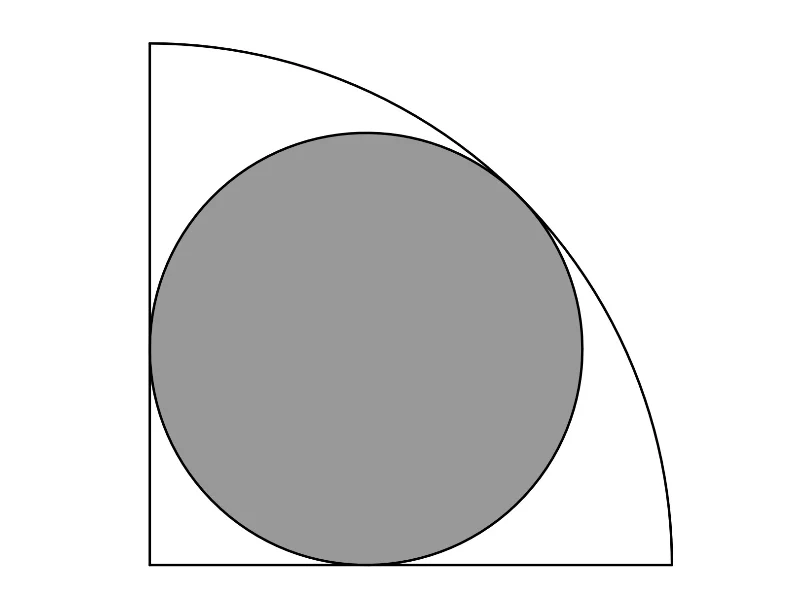
Here is an interesting geometry problem given for general interest. In the figure, compute the fraction that is shaded. Then extend that to a sphere snugly packed in an octant of a larger sphere. That means the smaller sphere is tangent to each plane and to the larger sphere in the most compact way possible. Those who are brave can extend that further to four dimensions or higher and make some interesting observations about how things change at higher dimensions. Have fun!
IMG_5586.webp
 
Mathematics news on Phys.org
Here is the first part;

Let the center to center distance be ##d## and ##r## the smaller circle radius and ##R## the larger circle radius so ##d+r=R##. We know ##d^2=r^2+r^2## or ##d=\sqrt{2}r##. Solving for ##r## in terms of ##R## we get $$r=\frac{R}{\sqrt{2}+1}$$ therefore the fraction that is shaded is $$\frac{\pi r^2}{\frac{1}{4}\pi R^2}= 4(\frac{r}{R})^2= \frac{4}{(\sqrt{2}+1)^2}\approx 0.686$$

In the 3D case, ##d=\sqrt{3}r## giving $$r=\frac{R}{\sqrt{3}+1}$$ now we have the fraction of volume of a sphere to an octant which is $$\frac{\frac{4}{3} \pi r^3}{\frac{1}{8}\frac{4}{3}\pi R^3}= 8(\frac{r}{R})^3= \frac{8}{(\sqrt{3}+1)^3}\approx0.392$$
 
Last edited:
Here is the next part;


In the case of 4D, ##d=\sqrt{4}r=2r## then ##r=\frac{R}{3}##. In the general case ##d=\sqrt{n}r## and the ratio $$\frac{r}{R}=\frac{1}{\sqrt{n}+1}$$


The general equation for hypersphere volume is

$$V_n(R) = \frac{\pi^{n/2}}{\Gamma\!\left(\frac{n}{2} + 1\right)} \, R^n$$


Note that in higher dimensions the number of orthants (quadrants in 2D and octant in 3D) goes as ##2^n##

Thus the fraction of the hypersphere of dimension ##n## to its orthant is $$\frac{2^n}{(\sqrt{n}+1)^n}$$

As ##n## gets larger, this fraction tends towards zero as does the ratio of ##r## to ##R## and a hyper cube volume in general.
 
Last edited:
  • Like
Likes   Reactions: Ibix
I got the same as #3.
The values drop quite quickly with dimension. Here's a plot of the values from ##n=2## to ##n=8##. The latter is the first time the ratio is less than 1%, and also the first time it's less than 1% of the ##n=2## value.
InShot_20260505_192456816.webp
 
  • Like
Likes   Reactions: bob012345
Looking at a projection of the 3D case we can see how the ball is smaller for the same ##R##.
IMG_5601.webp
 
Last edited:
  • Like
Likes   Reactions: robphy and Ibix
bob012345 said:
$$\frac{4}{(\sqrt{2}+1)^2}=0.686$$

I think that should be ##\approx##

bob012345 said:
In the 3D case, ##d=\sqrt{3}r##

Why?

bob012345 said:
Looking at a projection of the 3D case we can see how the ball is smaller for the same ##R##.
View attachment 371412

I don't see how this diagram helps visualize how the smaller sphere touches the face of the octant.
 
Suppose any two volumes with one properly contained within the other. As the number of dimensions increases the relative volume of the smaller shape goes to zero. This is because with high dimensions almost all of the volume is at the surface.
 
Consider a sphere and cube with the same center and volume. As the number of dimensions increases the volume of their intersection goes to zero.
 
  • Like
Likes   Reactions: bob012345
  • #10
pbuk said:
I think that should be ##\approx##


Why?


I don't see how this diagram helps visualize how the smaller sphere touches the face of the octant.

At the time I couldn’t figure out how to make Latex to do ##\approx##. Now I do and I edited the above post. Thanks.

Regarding ##d=\sqrt{3}r##, the vector from the origin to the center of the small sphere has x,y,z components each equal to ##r##.

Regarding the graph, it just visualizes the smaller size.
 
Last edited:
  • Like
Likes   Reactions: pbuk
  • #12
bob012345 said:
Regarding ##d=\sqrt{3}r##, the vector from the origin to the center of the small sphere has x,y,z components each equal to ##r##.

Ah yes, of course - obvious once you point it out.
 

Similar threads

  • · Replies 1 ·
Replies
1
Views
2K
  • · Replies 6 ·
Replies
6
Views
3K
  • · Replies 5 ·
Replies
5
Views
3K
Replies
18
Views
4K
  • · Replies 2 ·
Replies
2
Views
2K
  • · Replies 4 ·
Replies
4
Views
2K
  • · Replies 21 ·
Replies
21
Views
2K
  • · Replies 9 ·
Replies
9
Views
2K
  • · Replies 28 ·
Replies
28
Views
7K
  • · Replies 2 ·
Replies
2
Views
2K