A very simple moments question

  • Thread starter Thread starter physicals
  • Start date Start date
  • #91
anuttarasammyak said:
I observe different results between us on Fy, vertical component of the force from the wall to the rod.
Yes, different constructs result in different forces. That two constructs agree on Fx, doesn't imply they must agree on Fy as well.

The rigid joint in the inverted L-shape transmits a torque by inhomogeneous forces acting within the joint, purely internally.

In the hinges-only-version this torque transmission is accomplished by inhomogeneous forces from the wall and the diagonal rod, which is not purely internal, and thus can result in different forces at the wall.
 
Last edited:
Physics news on Phys.org
  • #92
anuttarasammyak said:
And the issue above said is the fracture of the rod itself, not the (y-component of ) fixing force to the wall, Fy. In my understanding, Fy does not depend on 𝜃. The rod may bend down, but it will remain attached to the wall.
Please explain what you mean by ##\theta## when you have a Γ - shaped construction. It's the angle between what two lines?

It seems to me that you replace the original situation in post #1, which has a well-defined angle ##\theta##, with a different situation shown in post #6, where ##\theta## is meaningless, and then discover the obvious conclusion that ##F_y## does not depend on ##\theta## in this different situation!
 
  • Like
Likes   Reactions: A.T.
  • #93
kuruman said:
It seems to me that you replace the original situation in post #1, which has a well-defined angle ##\theta##, with a different situation shown in post #6, where ##\theta## is meaningless,
I would say that the original diagram in post #1 is ambiguous on aspects, that do not affect Fx, which the question is about.

There are different plausible interpretations of the original diagram in post #1. For some Fy does depend on ##\theta##, for some it doesn't. But since Fy is not asked for, that's OK.
 
Last edited:
  • #94
kuruman said:
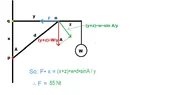
Please explain what you mean by ##\theta## when you have a Γ - shaped construction. It's the angle between what two lines?
The small angle between the wall and the diagonal rod, blue line, in the figure of my #90 you quoted. We can make it infinitesimal.
 
  • #95
anuttarasammyak said:
The small angle between the wall and the diagonal rod, blue line, in the figure of my #90 you quoted.
No. That angle is not equivalent to the angle ##\theta## in any mechanically relevant way.

For the rigid Γ the equivalent of the angle ##\theta## would be an internal angle, not an angle with the wall. Making ##\theta## very small is equivalent to making the rigid joint of the Γ very small, so the internal inhomogeneous forces in the joint transmitting the torque become very large.
 
Last edited:

Similar threads

  • · Replies 12 ·
Replies
12
Views
2K
  • · Replies 7 ·
Replies
7
Views
1K
  • · Replies 7 ·
Replies
7
Views
2K
Replies
11
Views
2K
  • · Replies 8 ·
Replies
8
Views
3K
  • · Replies 2 ·
Replies
2
Views
2K
  • · Replies 2 ·
Replies
2
Views
1K
  • · Replies 1 ·
Replies
1
Views
5K
  • · Replies 21 ·
Replies
21
Views
5K
  • · Replies 15 ·
Replies
15
Views
4K