A2 chemistry - how do i know there's an OH in the products?

Click For Summary
SUMMARY

The discussion focuses on determining the presence of hydroxide ions (OH-) in the products of a redox reaction, specifically in the context of A2 chemistry. The user initially attempted to calculate molar mass by dividing gas concentration by 24, which was incorrect. The correct approach involves recognizing that balancing the reaction requires either H+ or OH- ions, a common requirement in aqueous redox reactions. The conversation highlights the importance of understanding gas behavior at room temperature and pressure (RTP) and the relationship between volume and molar mass.

PREREQUISITES
  • Understanding of redox reactions in aqueous solutions
  • Knowledge of gas laws, particularly at room temperature and pressure (RTP)
  • Familiarity with molar mass calculations
  • Basic concepts of chemical balancing involving ions
NEXT STEPS
  • Study the principles of balancing redox reactions in aqueous solutions
  • Learn about gas behavior and calculations at room temperature and pressure (RTP)
  • Explore the concept of molar mass and its applications in chemical reactions
  • Investigate the role of hydroxide ions (OH-) in various chemical equilibria
USEFUL FOR

A2 chemistry students, educators, and anyone preparing for chemistry exams who seeks to understand the role of hydroxide ions in redox reactions and the calculations involved in determining molar mass and gas behavior.

1832vin
Messages
58
Reaction score
1
This is the question and the answer, the problem is i don't know how to get to the answer
top is question and bottom is answer
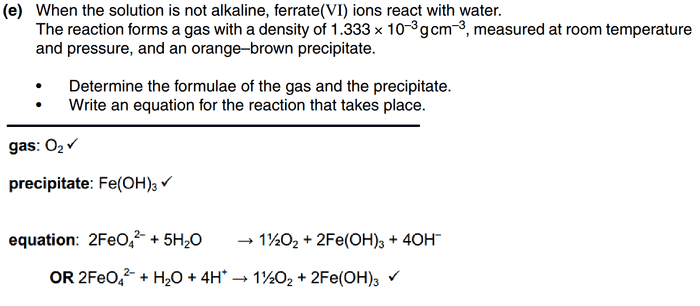
PCbyMXO.png


I attempted to divide the gas concentration by 24 to get molar mass, but that didn't work
and how am i suppose to know that OH- is one of the products? i guessed that there is fe(OH)3, but that's all i got right...

it's the very last question from this A level paper

please help, my exams are close, and i have no clue at all...
 
Physics news on Phys.org
1832vin said:
I attempted to divide the gas concentration by 24 to get molar mass

I see no concentration in the question.

And why do you divide? You have mass of 1 mL, right? Assuming there is one mole of a gas at RTP, what volume does it occupy? What is its mass (given the density as listed)?

It is not that there is OH- between products, however, you won't be able to balance the reaction without either H+ of OH-. That's a quite common situation when it comes to redox reactions in water.
 
1.3333 × 22 = very close to 32 so that part works well.
 

Similar threads

  • · Replies 8 ·
Replies
8
Views
2K
  • · Replies 6 ·
Replies
6
Views
4K
  • · Replies 28 ·
Replies
28
Views
5K
  • · Replies 4 ·
Replies
4
Views
2K
  • · Replies 9 ·
Replies
9
Views
2K
  • · Replies 4 ·
Replies
4
Views
3K
  • · Replies 7 ·
Replies
7
Views
2K
Replies
3
Views
2K
Replies
7
Views
2K