About critical damping resistance of a ballistic galvanometer

Click For Summary

Homework Help Overview

The discussion revolves around the critical damping resistance of a ballistic galvanometer, focusing on the relationship between resistance and the damping coefficient as represented in a graph. Participants are exploring how to derive the asymptote of the graph based on observed data without an explicit function.

Discussion Character

  • Exploratory, Assumption checking, Problem interpretation

Approaches and Questions Raised

  • Participants are attempting to understand the implications of critical damping and the significance of the moment of inertia in the context of the galvanometer. Questions are raised about the meaning of variables in the equations and the complexity of fitting data to derive relationships.

Discussion Status

Some participants have provided guidance on using spreadsheet tools for linear regression to analyze data, while others express concern about the complexity of deriving the relationship between the variables involved. There is an ongoing exploration of how to approach the fitting process and the assumptions that need to be made.

Contextual Notes

Participants mention the challenge of working with observed data and the lack of an explicit relationship between the variables, which adds to the complexity of the problem. There is also a reference to the potential need for assumptions regarding certain parameters in the analysis.

phymath7
Messages
48
Reaction score
4
Homework Statement
In my physics lab experiment,I need to find out the critical damping resistance of a ballistic galvanometer (The associated circuit is given in the attempt section) by drawing ##\lambda## vs. ##R_2## graph where ##\lambda## is the logarithmic decrement of deflection of galvanometer .
Relevant Equations
$$\omega=\sqrt{\omega_0{}^2 -\frac{\gamma^2}{4}}$$
where ##\omega## is the damped angular frequency and ##\omega_0## is the undamped angular frequency
The differential equation of the motion of the galvanometer(wrt time):
$$\ddot \theta+\gamma\dot \theta +k^2\theta=0$$
Relation between ##\lambda## and ##\gamma ## is:
$$\lambda=\frac{\gamma T}{4}$$
Where
$$\gamma =\frac{\beta +\frac {a} {R_2 +G}}{I}$$
##\beta## and 'a' are constant,G is the galvanometer resistance and T is the time period.
At critical condition, ##\omega=0## so time period will be infinite and so will be ##\lambda##.Therefore, the critical resistance will be the corresponding resistance(plus galvanometer resistance)of the asymptote of ##\lambda## vs. ##R_2## graph(the graph is a rectangular hyperbola).
But here's where I'm stuck.How am I supposed to find the asymptote of the graph only having the observed data and not the explicit function?
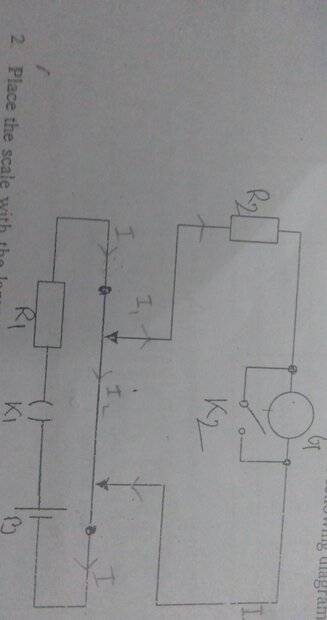
20230826_165720.jpg
 
Last edited:
Physics news on Phys.org
phymath7 said:
Where
$$\gamma =\frac{\beta +\frac {a} {R_2 +G}}{I}$$
What is I? At first I thought it was a typo for T but that doesn't seem to make sense.
 
haruspex said:
What is I? At first I thought it was a typo for T but that doesn't seem to make sense.
The denominator "I" is the moment of inertia of the coil of galvanometer.
 
phymath7 said:
The denominator "I" is the moment of inertia of the coil of galvanometer.
If you fit the ##(R_2,\lambda)## data to that equation, can you deduce ##\beta/I, a/I, G##?
 
haruspex said:
If you fit the ##(R_2,\lambda)## data to that equation, can you deduce ##\beta/I, a/I, G##?
Did you write the explicit relation between ##\lambda## and ##R_2## ?Do you see how complex this one? I am afraid that it's beyond my (and even for those who are more advanced) capability to do the fitting.
 
phymath7 said:
Did you write the explicit relation between ##\lambda## and ##R_2## ?Do you see how complex this one? I am afraid that it's beyond my (and even for those who are more advanced) capability to do the fitting.
Assuming you have some idea of the value of G, put that in a spreadsheet and set up columns of values of ##1/\gamma, 1/(R_2+G)##.
Have the spreadsheet produce a linear regression, showing the goodness of fit.
Tweak G to maximise the fit.
 
haruspex said:
Assuming you have some idea of the value of G, put that in a spreadsheet and set up columns of values of ##1/\gamma, 1/(R_2+G)##.
Have the spreadsheet produce a linear regression, showing the goodness of fit.
Tweak G to maximise the fit.
I need the relationship between ##\lambda## and ##R_2## which represents a hyperbola.How am I supposed to get that?
 

Similar threads

  • · Replies 14 ·
Replies
14
Views
2K
  • · Replies 3 ·
Replies
3
Views
2K
  • · Replies 1 ·
Replies
1
Views
2K
  • · Replies 1 ·
Replies
1
Views
2K
  • · Replies 75 ·
3
Replies
75
Views
7K
Replies
12
Views
4K
Replies
24
Views
8K
  • · Replies 2 ·
Replies
2
Views
2K
  • · Replies 5 ·
Replies
5
Views
7K
  • · Replies 2 ·
Replies
2
Views
3K