Acidity of substituted benzoic acids

  • Thread starter Thread starter CrimpJiggler
  • Start date Start date
  • Tags Tags
    Acids
Click For Summary
SUMMARY

The discussion centers on the acidity of substituted benzoic acids, specifically comparing meta methoxy benzoic acid and para methoxy benzoic acid. Meta methoxy benzoic acid exhibits stronger acidity due to the inductive withdrawing effects of the methoxy group, while the para isomer's resonance donation stabilizes the carboxylate ion, making it less acidic. The resonance structures for the deprotonated forms reveal that the para isomer allows for charge delocalization to the methoxy group, which is not possible in the meta isomer. This difference in resonance structures is crucial for understanding the acidity variations between these compounds.

PREREQUISITES
  • Understanding of organic chemistry concepts, particularly acidity and resonance.
  • Familiarity with the structure and properties of benzoic acids.
  • Knowledge of inductive and mesomeric effects in organic compounds.
  • Ability to draw and interpret resonance structures.
NEXT STEPS
  • Study the inductive and resonance effects in substituted aromatic compounds.
  • Learn to draw and analyze resonance structures for various organic acids.
  • Explore the acidity trends of other substituted benzoic acids.
  • Investigate the role of electron-donating and electron-withdrawing groups in organic chemistry.
USEFUL FOR

Chemistry students, organic chemists, and anyone interested in the acidity of substituted aromatic compounds will benefit from this discussion.

CrimpJiggler
Messages
141
Reaction score
1
Heres meta methoxy benzoic acid:

and here's para methoxy benzoic acid:
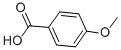
100-09-4.gif

m-methoxybenzoic acid is a stronger acid than its para substituted analogue. I'm a bit confused about why this is. From what I've read, its because at the meta position, only the methoxy groups inductive withdrawing effects apply whereas at the para position, it also acts as a mesomeric (resonance) donator. Why does the methoxy groups resonance effects only work when its at the para position? Why doesn't it act as a resonance donator when its at the meta position?
 
Last edited by a moderator:
Chemistry news on Phys.org
Draw out the resonance structures for the deprotonated form of both acids. For the para isomer, you will see that you will have more resonance structures because the negative charge can move to the methoxy group. For the meta isomer, however, you cannot draw a resonance structure that moves the negative charge to the methoxy group.
 
Last edited:
**** my organic chem is a bit rusty, I don't know how to draw this resonance structure. Heres my attempt for the meta isomer:
[PLAIN]http://img28.imageshack.us/img28/2921/resonance.png
what am I doing wrong there?
 
Last edited by a moderator:
First, I made a mistake in my post. None of the resonance structures should move the negative charge to the methoxy group. Rather, for the para-isomer, there are resonance structures that give a slight negative charge to certain positions of the ring, and this slight negative charge will destabilize the carboxylate.

As for your resonance structures, the first two are ok, but the thrid is wrong as it involves the movement of a proton. Below are some resonance structures for methoxybenzene.

resonance.png


When you draw the resonance structures for the para-isomer you should find a resonance structure that would disfavor dissociation of the proton from the carboxyl group. This resonance structure you would not be able to see with the meta-isomer.
 

Similar threads

  • · Replies 7 ·
Replies
7
Views
3K
  • · Replies 18 ·
Replies
18
Views
5K
Replies
2
Views
3K
  • · Replies 5 ·
Replies
5
Views
3K
  • · Replies 3 ·
Replies
3
Views
5K
  • · Replies 1 ·
Replies
1
Views
2K
  • · Replies 11 ·
Replies
11
Views
11K
  • · Replies 2 ·
Replies
2
Views
6K
Replies
4
Views
3K
  • · Replies 2 ·
Replies
2
Views
2K