Adding vectors algebraically to find displacement

Click For Summary

Homework Help Overview

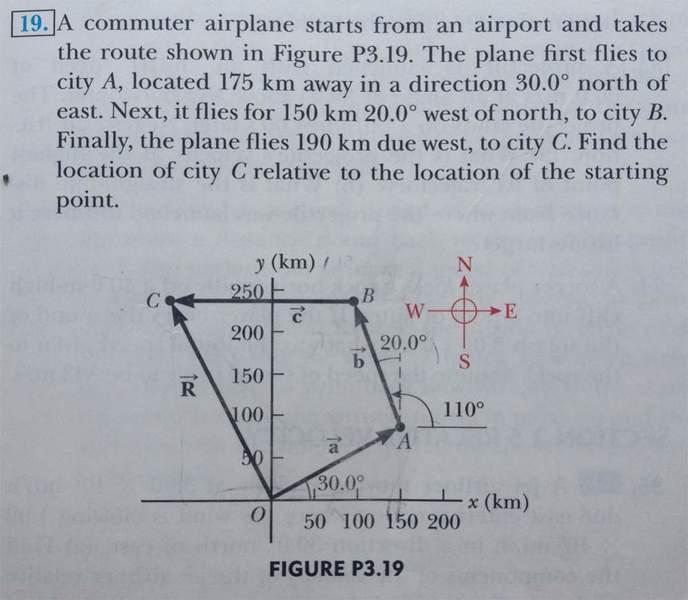
The discussion revolves around the addition of vectors to determine displacement in a physics context. The original poster expresses confusion regarding the vertical displacement when adding vectors, particularly when one vector is directed due west. The problem involves calculating the resultant vector using trigonometric components.

Discussion Character

  • Exploratory, Assumption checking, Mathematical reasoning

Approaches and Questions Raised

  • Participants discuss the vector components and their respective angles, questioning the setup and calculations. There is an exploration of how to correctly represent the vectors and their contributions to the resultant vector.

Discussion Status

Participants are actively engaging with each other's calculations and reasoning. Some have offered guidance on how to approach the vector addition, while others are clarifying the angles and components involved. There is a recognition of the need to correct certain assumptions regarding the angles of the vectors.

Contextual Notes

There is mention of a diagram that is referenced but not provided, which may contain crucial information for understanding the vector relationships. Additionally, the original poster has indicated a discrepancy between their calculated result and the expected answer from the textbook.

KevinFuerst
Messages
4
Reaction score
0
Hi everyone,
I am taking a physics course this year and I find myself already looking for help unfortunately. I think I understand the basics of adding vectors using Ax = A cosθ , Ay = A sinθ, etc. I am getting confused with the 3rd leg of the trip though. Since it is due west wouldn't that mean there is no vertical displacement? How can work that into my equation?
Homework Statement


attachment.php?attachmentid=50133&stc=1&d=1345744862.jpg

Homework Equations


Ax = A cosθ
Ay = A sinθ
...
R = √Rx2 + Ry2

The Attempt at a Solution


I have tried using the previous formulas to solve it but i get an answer of ≈320km. the back of the book says it should be 245km. could someone walk me though this? Thank you!
 

Attachments

  • Untitled-2.jpg
    Untitled-2.jpg
    37.9 KB · Views: 1,130
Physics news on Phys.org
Hey Kevin ,
In the picture I have uploaded you can see
that
(*note the symbols in bold are vectors)

r =a + b

, subsequently
R= c+r
 

Attachments

  • Untitled-2.jpg
    Untitled-2.jpg
    45.3 KB · Views: 622
What you want is [itex]\vec{R} = \vec{a} + \vec{b} + \vec{c}.[/itex]
Write out the vector equations for each of [itex]\vec{a}, \vec{b}, \vec{c}[/itex] and then add them together. This will give an eqn for [itex]\vec{R}[/itex]

Using [itex]|\vec{R}| = \sqrt{R_x^2 + R_y^2}[/itex] will give you it's length.
Can you find the angle from this?
 
thanks for the quick response but I am not quite following you guys. Still new to this.
Here is my work, maybe you can show me what i am doing wrong that way. Once i get the right distance i'll have no problem finding the angle. I under stand how to do that part.

Ax = A cos(30) = 175km (.866) = 151.55km
Ay = A sin(30) = 175 (.5) = 87.5km
Bx = B sin(20) =150km (.342) = -51.3km
By = B cos(20) = 150 (.939) = 140.96km
Cx = C cos(110) = -190km (-.342) = 64.98km
Cy = C sin(110) = 190 (.939) = 178.54km

√165.232 + 4072 = √192951.4 ≈ 439km
 
Hey kelvin ,
As the diagram and the question says , the vector C is parallel to X axis , which mean there is no change in the y component of total displacement .
On the side note , What does the figure mean by 110 degrees ? what is it .
 
Try solving
Cx as 190
and Cy as 0
 
Cx = C cos(110) = -190km (-.342) = 64.98km
Cy = C sin(110) = 190 (.939) = 178.54km

You have the components correct for vectors [itex]\vec{a}[/itex] and [itex]\vec{b},[/itex]however the angles are wrong for the components of [itex]\vec{c}[/itex]

What angle does [itex]\vec{c}[/itex] make with the positive [itex]x[/itex] direction?
There is no vertical component to [itex]\vec{c}[/itex]
 
kushan said:
Try solving
Cx as 190
and Cy as 0
thank you so much. i understand that now. it will help me on a previos one i thought i had right too.

CAF123 said:
You have the components correct for vectors [itex]\vec{a}[/itex] and [itex]\vec{b},[/itex]however the angles are wrong for the components of [itex]\vec{c}[/itex]

What angle does [itex]\vec{c}[/itex] make with the positive [itex]x[/itex] direction?
There is no vertical component to [itex]\vec{c}[/itex]

vector c is at 0 or 180 degrees isn't it?
 
180 you can call it .
 
  • #10
Vector [itex]\vec{c}[/itex] is at angle of 180o with respect to the positive [itex]x[/itex] axis. Therefore the vector eqn for [itex]\vec{c}[/itex] is,
[itex]\vec{c} = (190cos180)\hat x = -190\hat x[/itex]
 
  • #11
oh okay! that's where that 110 came from. i was trying to figure out the angle so i decided to try the interior angle of ΔABC

i had a very similar problem there i found the interior angle like that and coincidently the resultant was extremely close either way. I have now corrected both and i can't thank you two enough.
 

Similar threads

Replies
3
Views
2K
  • · Replies 4 ·
Replies
4
Views
2K
  • · Replies 19 ·
Replies
19
Views
8K
Replies
6
Views
5K
Replies
5
Views
2K
  • · Replies 11 ·
Replies
11
Views
2K
  • · Replies 2 ·
Replies
2
Views
2K
  • · Replies 3 ·
Replies
3
Views
930
  • · Replies 2 ·
Replies
2
Views
2K
  • · Replies 12 ·
Replies
12
Views
12K