Amplitude of a circular ripple at distance r from source

Click For Summary
SUMMARY

The discussion centers on the amplitude of a circular ripple generated by a point source in a fluid, specifically addressing the assumption that no energy is absorbed by the water. Participants clarify that in a 2D wave scenario, energy spreads over a circumference, leading to a decrease in energy per unit length as 1/r. In a 3D context, the energy disperses over larger spherical surfaces, decreasing as 1/r² due to the inverse square law. The conversation highlights the importance of viscosity in energy absorption, noting that while some energy is lost, water's low viscosity allows ripples to propagate effectively.

PREREQUISITES
  • Understanding of wave mechanics and energy propagation
  • Familiarity with the inverse square law in physics
  • Basic knowledge of fluid dynamics and viscosity
  • Concept of 2D and 3D wave behavior
NEXT STEPS
  • Research the mathematical derivation of energy dispersion in 2D and 3D waves
  • Study the effects of viscosity on wave propagation in different fluids
  • Explore the implications of energy absorption in wave mechanics
  • Learn about practical applications of wave theory in engineering and physics
USEFUL FOR

Students and professionals in physics, fluid dynamics researchers, and engineers interested in wave behavior and energy propagation in fluids.

member 731016
Homework Statement
Please see below
Relevant Equations
Please see below
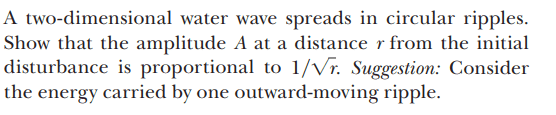
For this problem,
1675813522481.png

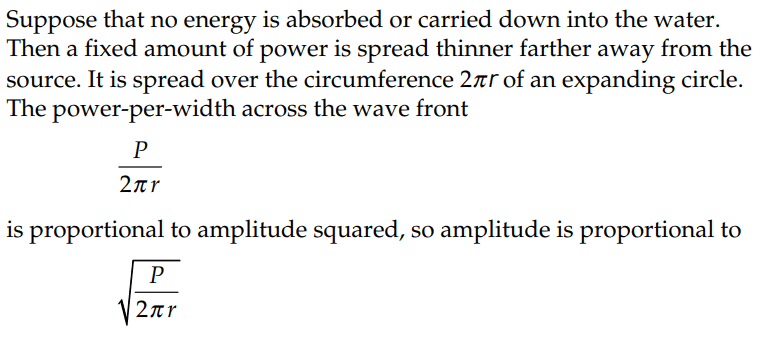
The solution is,
1675813536290.png

Does anybody please know another way to solve this problem?

EDIT: Why do they assume that no energy is absorbed by the water?

Many thanks!
 
Last edited by a moderator:
Physics news on Phys.org
What is wrong with this one?
 
  • Like
Likes   Reactions: member 731016
nasu said:
What is wrong with this one?
Thank you for your reply @nasu! I don't understand why they can assume that no energy is absorbed by the water. Do you please know why?
 
But the problem tells you to use energy.
 
  • Like
Likes   Reactions: member 731016
nasu said:
But the problem tells you to use energy.
Thank you for your reply @nasu! I guess their statement could be interpreted as energy is not absorbed. I though the problem could be a bit clearer in that manner thought.
 
No, it means that the energy is spread over larger and larger perimeters (because is a 2D wave).
In 3D the energy of a point (or spherical) source is spread over larger and larger spherical surfaces and so the energy per unit area decereases as 1/r 2(inverse square law). As the energy is proprtional to amplitude squared, the energy per unit area (in 3D) decreases as 1/r.
For the 2D case you can make a similar deduction. Here the energy is spread over a circumference so the energy over unit length of circumference decreases as 1/r.
 
  • Like
Likes   Reactions: member 731016
Callumnc1 said:
I don't understand why they can assume that no energy is absorbed by the water. Do you please know why?
Otherwise the problem is not solveable unless we know a whole lot about water.
 
  • Like
Likes   Reactions: member 731016
nasu said:
No, it means that the energy is spread over larger and larger perimeters (because is a 2D wave).
In 3D the energy of a point (or spherical) source is spread over larger and larger spherical surfaces and so the energy per unit area decereases as 1/r 2(inverse square law). As the energy is proprtional to amplitude squared, the energy per unit area (in 3D) decreases as 1/r.
For the 2D case you can make a similar deduction. Here the energy is spread over a circumference so the energy over unit length of circumference decreases as 1/r.
Thank you for your reply @nasu! Sorry for the late reply, I completely forgot about this thread!

Many thanks!
 
malawi_glenn said:
Otherwise the problem is not solveable unless we know a whole lot about water.
Thank you for your reply @malawi_glenn ! Sorry for the late reply, I completely forgot about this thread!

Many thanks!
 
  • #10
Callumnc1 said:
Why do they assume that no energy is absorbed by the water?
Some is, of course, due to viscosity, but the viscosity of water is very low, allowing waves to propagate a long way. Compare with trying to make ripples across the top of a pot of treacle.
 
  • Like
Likes   Reactions: member 731016
  • #11
haruspex said:
Some is, of course, due to viscosity, but the viscosity of water is very low, allowing waves to propagate a long way. Compare with trying to make ripples across the top of a pot of treacle.
Thank you for your reply @haruspex ! Sorry about the late reply, I forgot about this thread again.

I have never tried to seen treacle, but searching it up, it looks it has quite a high viscosity. I guess that means that the kinetic energy of the particles from a wave source is quite rapidly dissipated as friction between the layers of the liquid so the ripples won't travel far.

https://link.springer.com/referencework/10.1007/978-0-387-92897-5

Many thanks!
 

Similar threads

Replies
4
Views
3K
Replies
7
Views
1K
  • · Replies 3 ·
Replies
3
Views
3K
Replies
55
Views
3K
  • · Replies 27 ·
Replies
27
Views
2K
  • · Replies 5 ·
Replies
5
Views
728
Replies
3
Views
1K
  • · Replies 1 ·
Replies
1
Views
1K
  • · Replies 2 ·
Replies
2
Views
3K
  • · Replies 5 ·
Replies
5
Views
6K