Unraveling the Enigma: Understanding the Equation

  • Thread starter Thread starter hidemi
  • Start date Start date
  • Tags Tags
    Mystery
Click For Summary
SUMMARY

The discussion focuses on calculating the charge on a capacitor after five complete cycles using specific equations from the textbook. Participants emphasize the importance of determining the damped angular frequency, denoted as ##\omega'##, from the values of resistance (R), inductance (L), and capacitance (C). Additionally, they outline the process of calculating the period ##T'## and the charge at time ##t=5T'##, leading to the energy stored in the capacitor using the formula $$E=\frac{1}{2}\frac{q'^2}{C}$$.

PREREQUISITES
  • Understanding of RLC circuit dynamics
  • Familiarity with capacitor charge equations
  • Knowledge of angular frequency calculations
  • Basic principles of energy storage in capacitors
NEXT STEPS
  • Learn how to derive the damped angular frequency in RLC circuits
  • Study the relationship between charge, current, and time in capacitors
  • Explore energy storage calculations in capacitive systems
  • Investigate the effects of varying R, L, and C on circuit behavior
USEFUL FOR

Students and professionals in electrical engineering, physics enthusiasts, and anyone studying RLC circuits and capacitor behavior.

hidemi
Messages
206
Reaction score
36
Homework Statement
An RLC circuit has a resistance of 200 Ω, an inductance of 15 mH, and a capacitance of 34nF. At time t = 0, the charge on the capacitor is 25
μC and there is no current flowing. After five complete cycles the energy stored in the capacitor is:

A) 0.64 μJ
B) 77 μJ
C) 0.49 mJ
D) 1.8 mJ
E) 9.2 mJ

The answer is A.
Relevant Equations
(see better expression below)
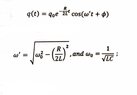
The equation is the only equation discussed in the textbook.
Is there a hint of how I could start this?
 

Attachments

  • 3.jpg
    3.jpg
    20.5 KB · Views: 245
Physics news on Phys.org
Yes well, you should find the charge on the capacitor after five complete cycles. To find it you will use the first equation you give in the attached picture.

You can calculate ##\omega'## from the given values for R L C, and also ##q_0## and ##\phi## from the initial conditions of ##q(0)=25\mu C,I(0)=0##.

Also once you find ##\omega'## find ##T'=\frac{2\pi}{\omega'}## which is the duration of one cycle. Finally put ##t=5T'## in the initial equation for ##q(t)## and find ##q'=q(5T')##. The energy stored will be $$E=\frac{1}{2}\frac{q'^2}{C}$$.
 
  • Like
Likes   Reactions: hidemi
Thanks for the hint. I got it.
 
  • Like
Likes   Reactions: Delta2

Similar threads

  • · Replies 12 ·
Replies
12
Views
1K
  • · Replies 1 ·
Replies
1
Views
856
  • · Replies 5 ·
Replies
5
Views
2K
Replies
14
Views
2K
  • · Replies 3 ·
Replies
3
Views
2K
  • · Replies 6 ·
Replies
6
Views
886
  • · Replies 61 ·
3
Replies
61
Views
5K
  • · Replies 19 ·
Replies
19
Views
2K
  • · Replies 25 ·
Replies
25
Views
2K
  • · Replies 30 ·
2
Replies
30
Views
2K