Analytic continuation of Dilogarithm

  • Context: Undergrad 
  • Thread starter Thread starter aheight
  • Start date Start date
  • Tags Tags
    Analytic continuation
Click For Summary

Discussion Overview

The discussion revolves around the analytic continuation of the Dilogarithm function, specifically focusing on its branching geometry and the parameters involved in its definition. Participants explore the implications of the theorem regarding the Dilogarithm, the role of the variables ##k_m##, and the methods for plotting the function over its Riemann surface while addressing branch cuts.

Discussion Character

  • Exploratory
  • Technical explanation
  • Debate/contested
  • Mathematical reasoning

Main Points Raised

  • One participant seeks clarification on the meaning of the variables ##k_m## in the definition of the Dilogarithm function and how to apply them for analytic continuation.
  • Another participant suggests that the ##k_m## values are arbitrary and questions if there are any constraints on them in the referenced material.
  • There is a mention of a formula for computing the ##k_m## values, but uncertainty remains about the definition of ##k## in relation to the summation.
  • A participant proposes that ##k## could represent an integer value related to differential forms, linking it to integrals of various orders.
  • Concerns are raised about discrepancies between experimental results and the expected behavior of the Dilogarithm function when crossing branch cuts, particularly regarding the increment of the logarithmic term.
  • A later post attempts to clarify the process of differential continuation of the Dilogarithm function, emphasizing the need to first continue the logarithm before applying it in the context of the Dilogarithm's initial value problem (IVP).

Areas of Agreement / Disagreement

Participants express uncertainty regarding the definitions and roles of the ##k_m## variables, with no consensus on their constraints or implications. Disagreement exists on the correct approach to incrementing the logarithmic term when crossing branch cuts, as some participants report differing results from expected outcomes.

Contextual Notes

Limitations in understanding the branching behavior and the definitions of the parameters involved may affect the clarity of the discussion. The relationship between the variables and their roles in the analytic continuation process remains unresolved.

Who May Find This Useful

This discussion may be of interest to those studying complex analysis, particularly in the context of multi-valued functions and their analytic continuations, as well as individuals exploring the properties of special functions like the Dilogarithm.

aheight
Messages
318
Reaction score
108
TL;DR
I cannot understand the notation for analytically-continuing this function as given by Lewen and was wondering if someone could help me.
I am trying to understand the branching geometry of the Dilogarithm function as described in Branching geometry of Dilogarithm. In Theorem 8.6, the following (dilogarithm) definition is given by letting ##n=2##:

$$
\text{Li}_2(z)=\text{Li}_2^{(k_0,k_1)}(z)=\text{Li}_2^{(0)}(z)+\sum_{m=0}^1 k_m\binom{1}{m}(2\pi i)^{m+1}(\text{Log}(z))^{2-m-1}
$$
but it's not clear at all what ##k_m## is and was wondering if someone would know this?

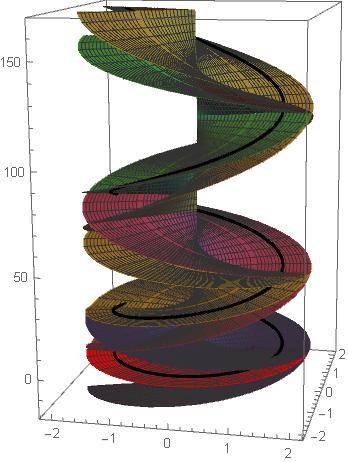
For example, suppose I wanted to plot an analytically-continuous ##6\pi## route via ##z(t)=2e^{it}## over it's Riemann surface, how would I splice-together the pieces defined above over the branch-cuts ##(-\infty,0)## and ##(1,\infty)## beginning on the principal branch ##\text{Li}_2(2)## so that the path traverses an analytically-continuous over them?

I can differentially-continue the path above over the sheets of ##f(z)=\text{Li}_2(z)## via the IVP:
$$
\frac{df}{dt}=-\frac{1}{2}\log(1-z)\frac{dz}{dt};\quad f(0)=\text{Li}_2(2)
$$
and by using MapleSoft's definition:

Start with the principal sheet ##\text{Li}_n## (implemented in mathematica as ##\text{Polylog}[n,z]##. Now, each time the branch cut ##(1,\infty)## is crossed in the counter clockwise direction, subtract from the current expression ##\frac{2\pi i\text{Log}^{n-1}(z)}{\Gamma(n)}##. Each time the branch cut ##(-\infty,0)## is crossed in the counter clockwise direction, add ##2\pi i## to the ##\text{Log}## term.

stitch the MapleSoft sheets together by trial-and-error over this path to create the (real) plot below showing the analytically-continuous route through the function along this path in black. However that's not practical and was hoping to better understand the formula for ##\text{Li}_2(z)## above to do this systematically by supplying the correct indices ##k_m## I assume.
polylog sheet.jpg
 
Last edited:
Physics news on Phys.org
Well, it looks like there are only two ##k_m## variables namely: ##k_0## and ##k_1##.

I think they are arbitrarily set values to cover a family of such surfaces.

Is there nothing that defines or limits the values of the ##k_m## in the book or theorem statement?

NOTE: ALso it looks like your Maplesoft link no longer works. It sends me to a new Google Books web page with no means to see the pages you've referenced.
 
jedishrfu said:
NOTE: ALso it looks like your Maplesoft link no longer works. It sends me to a new Google Books web page with no means to see the pages you've referenced.

Ok, I removed the link and added the description.

Is there nothing that defines or limits the values of the km in the book or theorem statement?

Not that I can see.
 
Last edited:
Okay got it. I had to press the preview button to see it.

On page 175 they mention the k values are computed as follows:

##(1+k)^0 = k_0##

##(1+k)^m = k_0 + \binom{m}{1} k_1 + ... + \binom{m}{n} k_m ##
 
jedishrfu said:
Okay got it. I had to press the preview button to see it.

On page 175 they mention the k values are computed as follows:

##(1+k)^0 = k_0##

##(1+k)^m = k_0 + \binom{m}{1} k_1 + ... + \binom{m}{n} k_m ##

I did see that but what is ##k## then in regards to the summation?
 
On page 174, they mention the integral of order k-1 and then consider the integral of k=1 so k apparently is an integer value ranging from k=1 to k=n?

This may be off-base but could it be like differential forms of order k notion?

https://en.wikipedia.org/wiki/Differential_form

A differential k-form can be integrated over an oriented k-dimensional manifold. When the k-form is defined on an n-dimensional manifold with n > k, then the k-form can be integrated over oriented k-dimensional submanifolds. If k = 0, integration over oriented 0-dimensional submanifolds is just the summation of the integrand evaluated at points, with according to the orientation of those points. Other values of k = 1, 2, 3, ... correspond to line integrals, surface integrals, volume integrals, and so on. There are several equivalent ways to formally define the integral of a differential form, all of which depend on reducing to the case of Euclidean space.
 
jedishrfu said:
On page 174, they mention the integral of order k-1 and then consider the integral of k=1 so k apparently is an integer value ranging from k=1 to k=n?

Ok thanks. It's a bit tough for me to follow and I don't know differential forms. I could try letting k=0 or 1 but still not clear to me how to systematically link the branching across the branch-cuts as shown in Figure 8.2.

The reason I'm asking is because my experimental results via the IVP above do not agree with the MapleSoft definition of incrementing by 2πi (or Lewen's apparently) each time the branch cut (−∞,0) is crossed. In the plot I showed above, I needed to increment some of the branching by just πi to obtain an analytically-continuous route through the function so I wanted to know what is causing this discrepancy.
 
Just a correction to the above:

In my initial post above I described differential-continuation of the Dilogarithm function. However, it was poorly described and I wish to better do so here so that that interested reader can understand the principle when the DE of a multi-valued function contains itself, a multi-valued function: First continue the contained multi-valued function, then use that version in the original DE. Below, first continue ##\log(1-z)##, then use it in the Dilogarithm IVP to subsequently continue Dilogarithm:

Letting ##z(t)=1.5 e^{i t}## with ##0\leq t\leq 6\pi ##, ##u(z)=\log(1-z)## and ##f(z)=\text{Li}_2(z)##, first continue ##u(z(t))## then use ##u(t)## in the IVP for the Dilogarithm. That is, in this particular example, starting on the principal-valued log sheet, numerically solve sequentially,
$$
\begin{align*}
\frac{du}{dt}&=-\frac{1}{1-z(t)}\frac{dz}{dt};\quad u(0)=\text{Log}(1-z(0)) \\

\frac{df}{dt}&=-\frac{1}{z(t)}u(t)\frac{dz}{dt};\quad f(0)=\text{Li}_2(1.5)
\end{align*}
$$

This is how the (Re) black contour along the sheets of Dilogarithm in the plot above was generated.
 
Last edited:

Similar threads

  • · Replies 7 ·
Replies
7
Views
3K
  • · Replies 1 ·
Replies
1
Views
2K
  • · Replies 4 ·
Replies
4
Views
4K
  • · Replies 5 ·
Replies
5
Views
2K
  • · Replies 7 ·
Replies
7
Views
2K
  • · Replies 2 ·
Replies
2
Views
3K
  • · Replies 4 ·
Replies
4
Views
3K
  • · Replies 6 ·
Replies
6
Views
2K
  • · Replies 3 ·
Replies
3
Views
2K
  • · Replies 15 ·
Replies
15
Views
2K