Analytical verification of FEA involving preloaded bolt

Click For Summary

Discussion Overview

The discussion revolves around the analytical verification of finite element analysis (FEA) involving a preloaded bolt in a mechanical assembly. Participants explore the relationship between the analytical calculations and FEA results, focusing on the effects of preload and external loads on the bolt and joint behavior.

Discussion Character

  • Technical explanation
  • Mathematical reasoning
  • Debate/contested

Main Points Raised

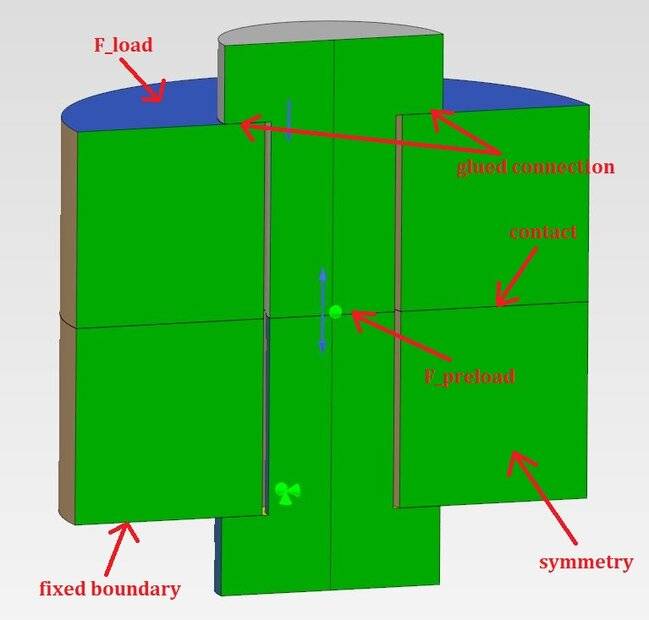
  • One participant describes their FEA setup, including the application of a preload and subsequent compressive load, and presents initial analytical calculations for stress and force in the bolt.
  • Another participant notes that the deflection of the ring under load influences the tensile load remaining in the bolt, suggesting that the change in deflections must be equal in magnitude.
  • Concerns are raised about the influence of the deformation and stiffness of the rings on the results, with a participant recalling previous models that yielded better agreement with analytical results.
  • A later reply introduces calculations based on joint and bolt stiffness, presenting various stiffness values and load factors, but questions the validity of the results compared to FEA outcomes.
  • One participant expresses difficulty in understanding the coupling of deflections in the joint and bolt, indicating confusion about the applicability of certain equations under compressive loads.
  • Another participant suggests that the equations used may be intended for tensile loads and questions their applicability when reversed for compressive scenarios, noting discrepancies in the results obtained from simulations and analytical calculations.

Areas of Agreement / Disagreement

Participants express differing views on the validity of their analytical approaches and the influence of various factors on the results. No consensus is reached regarding the correctness of the assumptions or calculations made.

Contextual Notes

Participants acknowledge limitations in their models, including assumptions about the behavior of the bolt and joint under different loading conditions, and the complexity of accurately accounting for deflections and stiffness in their calculations.

FEAnalyst
Messages
348
Reaction score
149
TL;DR
Is my approach to analytical verification of this finite element analysis correct ? What causes the difference ?
Hi,

I'm working on a simple FEA involving a preloaded bolt:
1682360626399.jpeg


The bolt is modeled as a single part (shank + head + nut), glued (perfect bonding) to both rings. Pretension force ##F_{preload}=200 \ N## is applied in the first step of the analysis while in the second, pretension force stops working and actual compressive load ##F_{load}=400 \ N## is applied to the top surface of the top ring. The bottom surface of the bottom ring is fixed in all degrees of freedom. As you can see, the model utilizes symmetry. I get some results but my goal is to verify them using simple analytical calculations. Assuming that the bolt is just a bar under tension and then compression, I get from superposition: $$\sigma=\frac{F_{preload}}{A_{bolt}}-\frac{F_{load}}{A_{ring}}$$ where: ##A_{bolt}=155.3 \ mm^{2}## - area of half of the bolt's cross-section (to which preload force is applied), ##A_{ring}=2160 \ mm^{2}## - area of the top surface of the top ring (to which actual load is applied). Thus, I get: $$\sigma=1.1026 \ MPa$$ $$F=\sigma \cdot A_{bolt}=171.24 \ N$$ while from FEA I obtain around ##188 \ N##. What can be wrong here ? Are my assumptions for the analytical calculations incorrect ? I know that I should probably use higher values but for now, it's just about figuring out the correct approach.
 
Engineering news on Phys.org
FEAnalyst said:
TL;DR Summary: Is my approach to analytical verification of this finite element analysis correct ? What causes the difference ?

Hi,

I'm working on a simple FEA involving a preloaded bolt:

View attachment 325440

The bolt is modeled as a single part (shank + head + nut), glued (perfect bonding) to both rings. Pretension force ##F_{preload}=200 \ N## is applied in the first step of the analysis while in the second, pretension force stops working and actual compressive load ##F_{load}=400 \ N## is applied to the top surface of the top ring. The bottom surface of the bottom ring is fixed in all degrees of freedom. As you can see, the model utilizes symmetry. I get some results but my goal is to verify them using simple analytical calculations. Assuming that the bolt is just a bar under tension and then compression, I get from superposition: $$\sigma=\frac{F_{preload}}{A_{bolt}}-\frac{F_{load}}{A_{ring}}$$ where: ##A_{bolt}=155.3 \ mm^{2}## - area of half of the bolt's cross-section (to which preload force is applied), ##A_{ring}=2160 \ mm^{2}## - area of the top surface of the top ring (to which actual load is applied). Thus, I get: $$\sigma=1.1026 \ MPa$$ $$F=\sigma \cdot A_{bolt}=171.24 \ N$$ while from FEA I obtain around ##188 \ N##. What can be wrong here ? Are my assumptions for the analytical calculations incorrect ? I know that I should probably use higher values but for now, it's just about figuring out the correct approach.
The deflection of the ring under ##F_l## is what determines the final tensile load remaining in the bolt, as the change in deflections of the bolt and ring must be equal in magnitude from the applied load. I think in practice it's going to be tricky to figure this out.

You can imagine as you tighten the bolt, the length of it under stress is decreasing ( i.e. the preload, and initial length are not independent). Furthermore, we need to find the initial deflection of the ring under preload because the deflections are measured from free length of each member.
 
Last edited:
erobz said:
The deflection of the ring under Fl is what determines the final tensile load remaining in the bolt, as the change in deflections of the bolt and ring must be equal in magnitude from the applied load. I think in practice it's going to be tricky to figure this out.
Right, deformation/stiffness of the rings also influences the results here. However, I thought that it could be ignored. My previous similar model gave very good agreement with analytical results obtained with the formulas from my first post. The main difference between the previous and current model is the way the bolt is connected with rings - in the first case cylinders representing the head and nut were bonded with the faces of the holes in the rings, in the second case (current model) they are bonded with the top faces of the rings. There are formulas (some quite complex) to estimate stiffnesses of all components (bolt and rings) and this way I could calculate the displacement but how can I get the final force in the bolt from that ?
 
I performed some additional calculations taking into account bolt and joint stiffness, based on this article: https://www.endeavos.com/finite-element-analysis-of-bolted-connections-part-2/ which uses equations from "An Introduction to the Design and Behavior of Bolted Joints" by J.H. Bickford. Here are my calculations (this time with values for the whole joint, not half of it due to symmetry like before):

- equivalent cylinder cross-sectional area: $$A_{c}=\frac{\pi}{4} \cdot \left( \left( D_{bolt} + \frac{L}{10} \right)^{2} - D_{hole}^{2} \right)=\frac{\pi}{4} \cdot \left( \left( 35 + \frac{60}{10} \right)^{2} - 22^{2} \right)=940.1216 \ mm^{2} $$
where: ##D_{bolt}## - diameter of contact between bolt head and joint, ##L## - height of bolt shank/joint, ##D_{hole}## - diameter of the hole in the joint

- bolt stiffness: $$K_{bolt}=\frac{E \cdot A_{bolt}}{L}=\frac{210000 \cdot 310.6}{60}=1.0871 \cdot 10^{6} \ \frac{N}{mm}$$
where: ##E## - Young's modulus, ##A_{bolt}## - cross-sectional area of the bolt

- joint stiffness: $$K_{joint}=\frac{E \cdot A_{c}}{L}=\frac{210000 \cdot 940.1216}{60}=3.2904 \cdot 10^{6} \ \frac{N}{mm}$$
- load factor: $$\Phi=\frac{K_{bolt}}{K_{bolt}+K_{joint}}=\frac{1.0871 \cdot 10^{6}}{\left(1.0871 \cdot 10^{6} \right)+ \left(3.2904 \cdot 10^{6} \right)}=0.2483$$
- bolt force: $$F_{bolt}=F_{preload}+ \Phi \cdot F_{load}=400+ 0.2483 \cdot \left(-800 \right)=201.3307 \ N$$
- joint force: $$F_{joint}=F_{preload}- \left( 1- \Phi \right) \cdot F_{load}=400- \left( 1- 0.2483 \right) \cdot \left(-800 \right)=1001.3307 \ N$$
Thus, when I calculate half of the bolt force (to compare it with FEA model), I get ##100.6653 \ N## which is nowhere near ##188 \ N## obtained from the simulation. Also, joint force seems to large. Any ideas where the mistake can be? Perhaps I should account for the fact that ##F_{load}## is compressive (not tensile like in the sources of the formulas) in a different way than just setting its value to negative but this seems to make sense.
 
I'm trying to wrap my head around the math involved in the coupling of the deflection of the joint, and negative deflection of the bolt from pre-load...so far unsuccessfully.

I feel like those equations you found are for separating a joint, I don't know how cleanly they work in reverse.
 
erobz said:
I feel like those equations you found are for separating a joint, I don't know how cleanly they work in reverse.
Indeed, they are meant for joints under tensile load (separation force is also calculated in the article). It might be possible that they won't work when the joint is under compression but I reversed the load in my calculations to make it tensile and there's still no agreement. I got around ##400 \ N## from the simulation and around ##300 \ N## as half of ##F_{bolt}## from the analytical solution. I also tried applying the external load to the top of the bolt head instead of the top surface of the top ring (like it was done in the article) but it didn't help. The simulation result was different but there was no way to account for it in the analytical calculations.
 
Last edited:
Here is what I can come up with. We start with the bolt and joint unloaded. The initial length of the joint is ##l_j##:

1682546488066.png


Next apply the load ##P## (pre-load) by tightening the bolt. The joint compresses and the section of the bolt between the nut and the head stretches. Let ##l_p## be the final length of the joint and shank after the application of ##P##:

1682546772478.png


Let ##l_b## be the initial unstretched length of the shank between the head and the nut. It follows that:

$$ l_j + \delta l_j = l_p= l_b + \delta l_b $$

$$ l_j - \frac{P l_j}{A_j E_j} = l_b + \frac{P l_b}{A_b E_b} $$

$$\implies l_b = l_j \frac{ \left( 1 - \frac{P}{A_j E_j} \right) }{ \left( 1+ \frac{P}{A_b E_b} \right) } \tag{1} $$

Next apply compressive load ##F## to the joint, observing deflection ##x##. The load ##P## will diminish as a function of ##x##:

1682558389003.png


$$ P(x) = \left( (l_p - x) - l_b\right)\frac{A_b E_b}{l_b} \tag{2} $$

The internal forces in the joint are from static equilibrium:

$$ F + P(x) = P + \frac{A_j E_j}{l_j}x \tag{3}$$

Substitute (2) into (3) and solve for the deflection ##x##:$$ F + \cancel{ \overbrace{\left( l_p -l_b \right) \frac{A_b E_b}{l_b}}^{P}} - x \frac{A_b E_b}{l_b} = \cancel{P} + \frac{A_j E_j}{l_j}x $$

$$ \implies x = \frac{F}{ \frac{A_j E_j}{l_j}+\frac{A_b E_b}{l_b} } \tag{4}$$

Then sub (4) and (1) into (2) to find the remaining tension ##P_r## in the bolt:

$$ P_r = \left( l_j - \frac{P l_j}{A_j E_j} - \frac{F}{ \frac{A_j E_j}{l_j}+\frac{A_b E_b}{ l_j \frac{ \left( 1 - \frac{P}{A_j E_j} \right) }{ \left( 1+ \frac{P}{A_b E_b} \right) }} } -l_j \frac{ \left( 1 - \frac{P}{A_j E_j} \right) }{ \left( 1+ \frac{P}{A_b E_b} \right) }\right)\frac{A_b E_b}{ l_j \frac{ \left( 1 - \frac{P}{A_j E_j} \right) }{ \left( 1+ \frac{P}{A_b E_b} \right) }} \tag{2} $$I have no idea if this works out or I bungled something(s). Probably best just to test it numerically.
 
Last edited:
erobz said:
Here is what I can come up with. We start with the bolt and joint unloaded. The initial length of the joint is ##l_j##:
...
I have no idea if this works out or I bungled something(s). Probably best just to test it numerically.
Thank you very much for this derivation. I got ##351.8068 \ N## for my full model (and thus ##175.9034 \ N## for half model) from this equation which is close to what I got with the first approach described in my initial post but unfortunately far from that advanced approach with an equivalent cylinder. I also checked FEA with a full model to avoid confusion caused by symmetry and it gave me ##376.769 \ N## so the first result from FEA for half model (##188 \ N##) should be correct. But so large differences between the advanced approach and simulation shouldn't be happening. I'm probably making some silly mistake somewhere here.
 
FEAnalyst said:
Thank you very much for this derivation. I got ##351.8068 \ N## for my full model (and thus ##175.9034 \ N## for half model) from this equation which is close to what I got with the first approach described in my initial post but unfortunately far from that advanced approach with an equivalent cylinder. I also checked FEA with a full model to avoid confusion caused by symmetry and it gave me ##376.769 \ N## so the first result from FEA for half model (##188 \ N##) should be correct. But so large differences between the advanced approach and simulation shouldn't be happening. I'm probably making some silly mistake somewhere here.
Well thanks for checking it.

If you change the parameters, making bolt and joint material different, initial joint length, etc... how well does the simple subtraction of stresses (in your OP) perform? I don't think it should perform well against what I've shown. It seems like too much of a "shortcut" to be robust, but I'm curious that they are in relative agreement at all?
 
  • #10
Problem solved, thank you for your help. I got very good agreement when I changed the formula for the joint stiffness to one based on a loaded elastic half-space problem, made the bolt 2 times longer and changed the load/boundary condition application regions so that they correspond to the model described in the article.
 
  • Like
Likes   Reactions: erobz and berkeman

Similar threads

  • · Replies 8 ·
Replies
8
Views
5K
  • · Replies 5 ·
Replies
5
Views
11K
  • · Replies 12 ·
Replies
12
Views
14K
Replies
8
Views
160K
  • · Replies 1 ·
Replies
1
Views
5K
  • · Replies 3 ·
Replies
3
Views
5K
  • · Replies 1 ·
Replies
1
Views
3K
Replies
2
Views
11K