Leo Liu
- 353
- 156
I am trying to determine how the addition of a counterweight affects the ##C_m-\alpha## (in longitudinal direction) graph for a model plane project, where the counterweight can be considered as the battery.
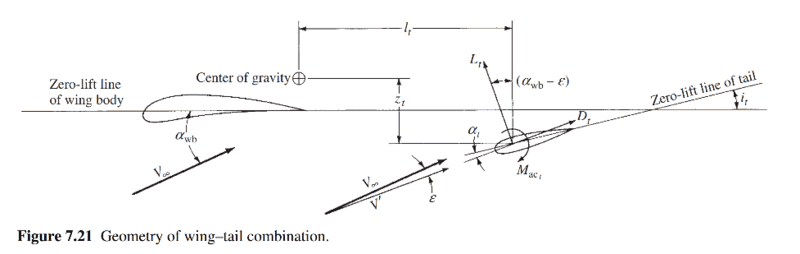
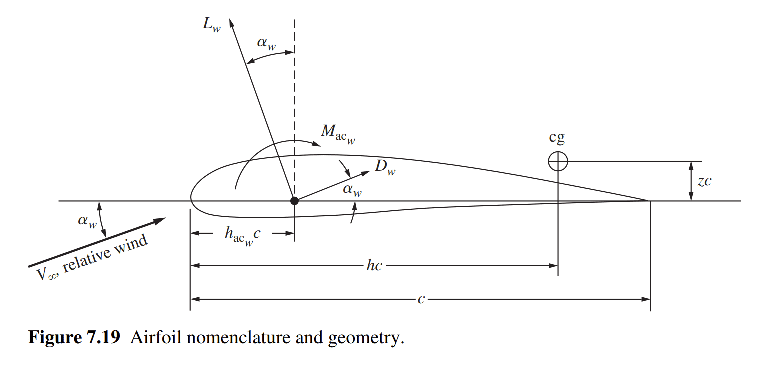
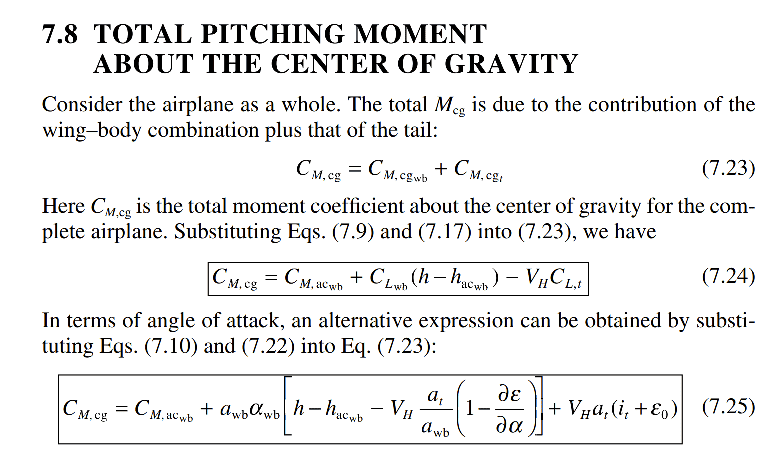
Suppose we try to place the battery at the back of the current CoM. The new CoM will be at further back, reducing ##l_t## and increasing ##hc##. According to Anderson't Intro to Flight, the equation is as follows:
this will decrease the slope of the ##C_m-\alpha## curve:

Now I am wondering if it will have a significant impact on the slope; ##h## is larger, while ##V_H## is smaller. Yet I am not sure which change is more significant to the moment slope.
From the equation (7.24) we can see that at $L_{wing}=0$, ##V_H## will become smaller due to a smaller ##l_t##, increasing the value of ##C_{m\,(L=0)}##:
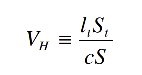
where
 .
.
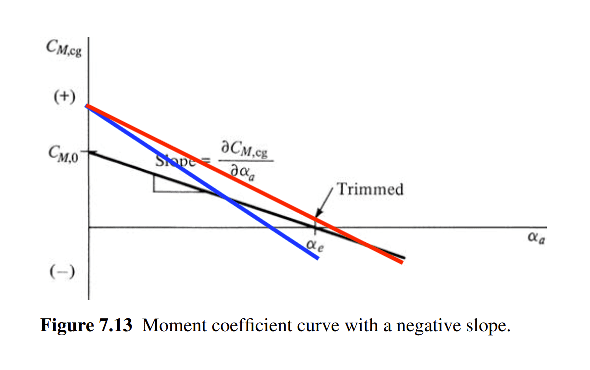
I think the graph of the line will look like either one of the added lines. The blue one will result in a lower equilibrium angle, thus providing a lower ##C_L##; yet the red line will allow a higher flight angle, thus producing more lift.
Could someone please give a bit more insight into this and tell me if my reasoning is correct?
Suppose we try to place the battery at the back of the current CoM. The new CoM will be at further back, reducing ##l_t## and increasing ##hc##. According to Anderson't Intro to Flight, the equation is as follows:
this will decrease the slope of the ##C_m-\alpha## curve:
Now I am wondering if it will have a significant impact on the slope; ##h## is larger, while ##V_H## is smaller. Yet I am not sure which change is more significant to the moment slope.
From the equation (7.24) we can see that at $L_{wing}=0$, ##V_H## will become smaller due to a smaller ##l_t##, increasing the value of ##C_{m\,(L=0)}##:
where
I think the graph of the line will look like either one of the added lines. The blue one will result in a lower equilibrium angle, thus providing a lower ##C_L##; yet the red line will allow a higher flight angle, thus producing more lift.
Could someone please give a bit more insight into this and tell me if my reasoning is correct?
Attachments
Last edited: