Anisotropic Modulus of elasticity and Poisson's ratio

Click For Summary
SUMMARY

This discussion focuses on calculating the anisotropic modulus of elasticity and Poisson's ratio for a material using experimental data. The user, Syed, seeks to determine the values of Ex, Ey, Ez, Vxy, Vyx, and Vxz based on known stress (σx, σy, σz) and strain (εx, εy, εz) values. The response provided clarifies that each modulus of elasticity can be calculated by dividing the corresponding stress by strain, while Poisson's ratios can be derived using the formula vxy = - εx/εy. The complexity of the anisotropic material's behavior is acknowledged, particularly when multiple stresses are applied simultaneously.

PREREQUISITES
  • Understanding of anisotropic materials and their mechanical properties
  • Familiarity with stress-strain relationships in materials
  • Knowledge of Young's modulus and Poisson's ratio calculations
  • Basic principles of rock mechanics and material deformation
NEXT STEPS
  • Research the calculation methods for anisotropic modulus of elasticity in materials
  • Study the derivation and application of Poisson's ratios in multi-axial stress scenarios
  • Learn about the significance of shear modulus and its calculation in anisotropic materials
  • Explore advanced topics in rock mechanics related to anisotropic behavior under stress
USEFUL FOR

Material scientists, mechanical engineers, and researchers involved in the study of anisotropic materials and their mechanical properties will benefit from this discussion.

rabbahs
Messages
16
Reaction score
0
Hi,
I have some experimental data and I am interested to use this data to calculated modulus of elasticiy (young's modulus) and Poisson's ratio. The material for which the data is given in an anisotropic material, therefore I need to calculate modulus of elasticity and poisson's ration is x,y and z direction.
the data which is have is the stress in three direction and corresponding strain three direction.

So , my problem is simple.
Knows: sigma_x, sigma_y, sigma_z, epsilon_x, epsilon_y, epsilon_y (6 knows)
Unknows: Ex, Ey, Ez, Vxy, Vyx, Vxz (6 unknows).

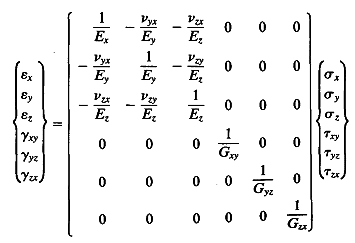
I have seen a formula in rock mechanics book (see the following image), but it will resolve into only three equation if the share stress is ignored.

Please help me out.
Thanks
Syed
upload_2014-11-4_14-29-14.png
 
Engineering news on Phys.org
Hello Rabbahs, from your post I assume you wish to find the values Ex, Ey, Ez, Vxy, Vyx, and Vxz. For each of the E values, you will need to divide the corresponding sigma value by the corresponding strain value.
In other words, if for example you would like to know Ex, Ex will be equal to σx / εx. This goes for all the E values.

For the poisson values:
Poisson's ratio vxy = - εxy

Bonus: Should you need to calculate the Shear modulus, Gxy = τxy xy.
Or Gx = taux /gammax.

I hope this helps.
 
Thanks darovmat for you reply, I really appreciate it.
The data which I have is for the deformation in x,y and z direction when sample is compressed in all three direction simultaneously. Therefore in my data the effected of anisotropy is coupled in all three strain value due to difference in poisson's ration in x,y and z direction (material is highly anisotropic).
The formula you have stated is only valid for very simple case when only axial stress is applied and strain in measured.

Please let me know you comments.
thanks
Syed
 

Similar threads

  • · Replies 1 ·
Replies
1
Views
2K
  • · Replies 1 ·
Replies
1
Views
2K
Replies
8
Views
2K
  • · Replies 1 ·
Replies
1
Views
3K
  • · Replies 1 ·
Replies
1
Views
2K
  • · Replies 5 ·
Replies
5
Views
2K
  • · Replies 3 ·
Replies
3
Views
2K
  • · Replies 1 ·
Replies
1
Views
2K
Replies
1
Views
2K
  • · Replies 4 ·
Replies
4
Views
3K