Another Water Riddle: What Will Happen & Why?

  • Thread starter Thread starter micromass
  • Start date Start date
  • Tags Tags
    Riddle Water
Click For Summary
SUMMARY

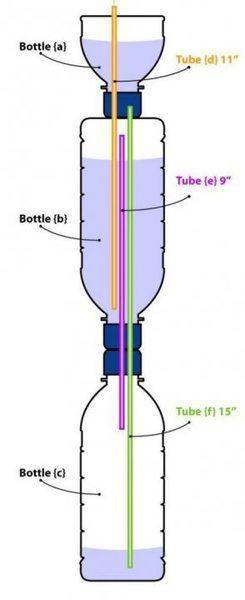
The forum discussion centers on a water riddle involving a system of interconnected bottles and tubes, specifically analyzing the behavior of water flow when pressure is applied. Participants conclude that when water is squirted down the yellow hose, it will flow into bottle "a" and subsequently affect the water levels in bottles "b" and "c". The analysis indicates that air pressure dynamics play a crucial role in determining the final water levels across the bottles, with bottle "c" ultimately filling up while bottles "a" and "b" stabilize at lower levels. The discussion emphasizes the importance of understanding air pressure and fluid dynamics in such systems.

PREREQUISITES
  • Understanding of fluid dynamics principles
  • Knowledge of air pressure effects in closed systems
  • Familiarity with manometer concepts
  • Basic grasp of interconnected systems and pressure equilibrium
NEXT STEPS
  • Research fluid dynamics and pressure in interconnected systems
  • Study the principles of manometers and their applications
  • Explore the effects of air pressure on fluid behavior in closed environments
  • Investigate practical experiments demonstrating fluid flow in connected vessels
USEFUL FOR

This discussion is beneficial for physics enthusiasts, engineering students, and anyone interested in fluid mechanics and pressure systems. It provides insights into the complexities of water behavior in interconnected environments.

micromass
Staff Emeritus
Science Advisor
Homework Helper
Insights Author
Messages
22,170
Reaction score
3,327
What will happen? And why?

aeYYo5W_460s.jpg
 
  • Like
Likes   Reactions: Charles Link
Physics news on Phys.org
micromass will get banned because discussion of perpetual motion machines is prohibited at PF?
 
  • Like
Likes   Reactions: Dembadon, mheslep, DrClaude and 1 other person
That looks an awful lot like a drawing for one of those perpetual motion thingys. :nb)
 
Borg said:
That looks an awful lot like a drawing for one of those perpetual motion thingys. :nb)

It does, but what would actually happen?
 
micromass said:
It does, but what would actually happen?
If you insist. :smile:
I'm assuming that bottle a is open at the top. Water from bottle a will move into bottle c, causing the air pressure to increase in bottle c and b. This will cause the water level in tube d to rise until it equals the level of the water in bottle a.
If a is not open, then nothing will change.
 
It would actually topple over?
 
What are we doing to the bottles?
If we squirt water down the yellow hose, water will come back up into bottle "a".
 
If you want to get technical about it: from my perspective the diagram is drawn showing the tubes outside of the bottles and are either glued to the outside of the bottle or floating without support in the front- they could have easily been drawn to appear inside the bottles, so as to indicate holes are present to connect the bottles You have to assume there are holes, but if the tubes were represented to be inside the bottles, then we still wouldn't know if tube d, e, & f are actually in two pieces or not.

There is more evidence that the tubes exist outside of the bottles than inside the bottles. Can someone point out to me why I should assume that the tubes exist inside of the bottles? All of the bottles appear closed to me, whether or not the bottles are stacked or glued, I still think it would topple over. That or some cat will come along and knock it over, the water will slowly evaporate, bottle b will burst during freezing, or the bottle will degrade over time.

256bits said:
What are we doing to the bottles?
If we squirt water down the yellow hose, water will come back up into bottle "a".

But I don't see anything representing the addition of more water. o_O
 
  • Like
Likes   Reactions: Charles Kottler
An interesting puzzle. Without doing a very detailed analysis, I think the air pressure in bottle c will build up from water dripping down through the straw from bottle a. Bottle b will have this same pressure which will easily be sufficient to cause water to flow up the 11" of tube "d" and thereby work its way down to bottle c. Bottle b will be nearly emptied, until it no longer has a connection to tube d and all the water will wind up in bottle c. Near the end though, water will flow up the 9" tube e into bottle b and into the bottom of bottle b and up tube d. I don't quite have a complete solution yet. Thank you @micromass . I will need to give it a little additional effort. The finish could be a little tricky.
 
  • #10
all the water in bottles a and b will end up in bottle c.
 
  • #11
It would be nice to have an answer for this (if there is one) or at least have micromass post his solution for it. The other water riddle wasn't resolved either. :H
 
  • #12
I think that counter-intuitively the approximately 15" height of water pressure in tube (f) will be transferred to the air at the top of bottle (b) and that will be enough to lift water up tube (d) back into the top, as suggested by @Charles Link, causing (a) to remain at an approximately constant level. The overall initial effect is then to transfer water from (b) through (a) to (c).

I think this will end soon after (c) becomes sufficiently full that the water level in (c) passes the bottom tube (e), as after that point the back pressure due to the water in tube (e) will prevent the pressure in (b) from being sufficient to lift any more water up tube (d). It will then end with (a) containing a similar amount to when it started, (b) containing a similar small amount and (c) being full up to the bottom of (e). However, that all depends on the exact relative capacities which are not clearly indicated.
 
  • Like
Likes   Reactions: Charles Link
  • #13
This may be naive, but (assuming A is open at the top) isn't it essentially a manometer with a couple of air bubbles? So the answer is that the water level in the yellow tube must reach the same height as the water in bottle A. The details would surely depend on the initial pressure of the air in B and C.
 
  • Like
Likes   Reactions: Fervent Freyja
  • #14
Ibix said:
This may be naive, but (assuming A is open at the top) isn't it essentially a manometer with a couple of air bubbles? So the answer is that the water level in the yellow tube must reach the same height as the water in bottle A. The details would surely depend on the initial pressure of the air in B and C.
The blue tube connecting the air in bottle C to the air in bottle B makes it so that things will not reach the same level in bottle A. The blue tube could be 10 ft. long and the air pressure at the top of it (bottle B)would be essentially the same as the pressure at the bottom (bottle C). This makes an extension of the system. I believe the 11" length of tube d was chosen to be less than 15" so that water in bottle B would necessarily go through it and spill over from it even if the length of the blue tube was several feet long. (Another bottle could be put in the system (call it bottle D) (similar to bottle B) that the blue tube feeds into at a height several feet above this system. The water would go up an 11" tube from this bottle (because of the 15" length of tube "f") and spill right over. Clearly the water would not be at the same level as Bottle A.)
 
Last edited:
  • #15
Assume the system is in equilibrium initially. Water added to a would go into c via the green, increasing air pressure in c. Displaced air would be transferred to b via the pink. This would exert pressure on the water in b, which would flow up and out through the yellow. What goes down must come up.
 

Similar threads

  • · Replies 3 ·
Replies
3
Views
3K
Replies
2
Views
3K
  • · Replies 10 ·
Replies
10
Views
2K
  • · Replies 9 ·
Replies
9
Views
2K
  • · Replies 3 ·
Replies
3
Views
2K
  • · Replies 16 ·
Replies
16
Views
6K
Replies
25
Views
4K
  • · Replies 27 ·
Replies
27
Views
12K
Replies
5
Views
741
  • · Replies 3 ·
Replies
3
Views
5K