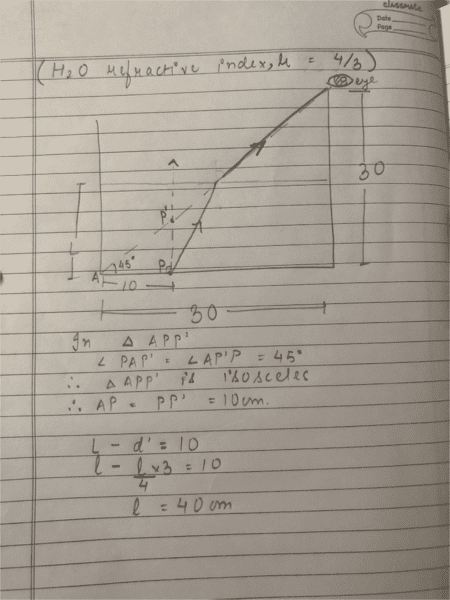
Viewing Particle P in a Cylindrical Vessel - 40 cm Height Needed

Click For Summary
SUMMARY

The discussion centers on determining the minimum height of water required in a cylindrical vessel to make a particle visible from a specific viewpoint. The vessel has a diameter and height of 30 cm, with the particle positioned 5 cm from the center. The initial approach using the formula for apparent depth was incorrect; instead, Snell's Law must be applied to account for the bending of light rays at the water's surface. The correct calculation involves understanding the geometry of light refraction and the angles involved in the observation.

PREREQUISITES
  • Understanding of Snell's Law in optics
  • Basic principles of light refraction
  • Geometry related to angles and distances
  • Concept of apparent depth in optics
NEXT STEPS
  • Study Snell's Law and its application in different mediums
  • Explore the concept of apparent depth and how it varies with angle
  • Learn about ray diagrams and their use in optics problems
  • Investigate the effects of lens shape on light behavior
USEFUL FOR

Students studying optics, physics educators, and anyone interested in understanding light behavior in different mediums, particularly in relation to refraction and apparent depth calculations.

Rightwrong
Messages
6
Reaction score
0
I1. Homework Statement
A cylindrical vessel whose diameter and height both are equal to 30 cm is placed on a horizontal surface and a small particle p is placed in it at a distance of 5 cm from the centre. An eye is placed at a position such that the edge of the bottom is in the plane of drawing. Upto what minimum height should water be filled in the vessel to make particle p visible?

Homework Equations


Apparent depth (d’) = real depth (d) / refractive index

The Attempt at a Solution


My answer is 40 cm which is wrong.

upload_2018-6-6_13-36-47.png
[/B]
 

Attachments

  • upload_2018-6-6_13-36-47.png
    upload_2018-6-6_13-36-47.png
    58.9 KB · Views: 1,254
Last edited by a moderator:
Physics news on Phys.org
Rightwrong said:
Apparent depth (d’) = real depth (d) / refractive index
That formula is for looking straight down, i.e. the line of vision is normal to the surface,
Apply Snell's Law instead.
 
haruspex said:
That formula is for looking straight down, i.e. the line of vision is normal to the surface,
Apply Snell's Law instead.

But why do the rays bend if it’s for looking straight down? Because their Sin 0 *4/3 = sin r
And r would have to be 0 so the rays wouldn’t bent then why does it appear to be raised?
 
sorry. I mean sin i *4/3 = sin 0
Sin i = 0
Could you please explain why that equation is used for when an object is viewed from straight above.
I'm having a problem with that equation in pther questions also.
 
Rightwrong said:
But why do the rays bend if it’s for looking straight down?
Your pupil has diameter. Consider, from a point object, one ray to each side of the iris. These are not quite vertical, so as they emerge will be bent just a little away from each other. Project the emerging rays back down to the point where they intersect. This will be where the object appears to be.

The calculation of apparent depth assumes these angles are small. In the problem you are given the angles are much larger.
 
These are not quite vertical, so as they emerge will be bent just a little away from each other.

But the lens in our eyes is convex and it converges the rays. So why will the rays bend away from each other?
 
Sorry I didn't get what you said earlier. The rays bend away from each otherat the surface of the liquid. Thanks for helping me out.

How do you get the answer for this question?

https://ibb.co/k0zFv8
 
Rightwrong said:
Sorry I didn't get what you said earlier. The rays bend away from each otherat the surface of the liquid. Thanks for helping me out.

How do you get the answer for this question?

https://ibb.co/k0zFv8
Draw a ray from the object that is a small angle θ above the horizontal. (You can draw it large for legibility but bear in mind that is in principle small.)
Show how it deviates at each interface before reaching the eye.
We can take the horizontal line as a second ray, not deviating.
Project back the final section of the first until it meets the horizontal one. That is where the object will appear to be.
Now use some geometry to relate the apparent distance to the other distances and the angles.
 

Similar threads

  • · Replies 8 ·
Replies
8
Views
2K
  • · Replies 7 ·
Replies
7
Views
6K
  • · Replies 4 ·
Replies
4
Views
3K
Replies
3
Views
16K
Replies
1
Views
24K
  • · Replies 1 ·
Replies
1
Views
3K
Replies
1
Views
3K
  • · Replies 6 ·
Replies
6
Views
3K
  • · Replies 15 ·
Replies
15
Views
6K
  • · Replies 2 ·
Replies
2
Views
4K