Applying 2nd Kirchhoff's Law in Electrical Circuits - Homework Practice

  • Thread starter Thread starter Jhenrique
  • Start date Start date
  • Tags Tags
    Law
Click For Summary

Homework Help Overview

The discussion revolves around applying the 2nd Kirchhoff's law in electrical circuits. Participants are examining the formulation of equations based on Kirchhoff's voltage law (KVL) and addressing the consistency of voltage direction assumptions.

Discussion Character

  • Exploratory, Assumption checking, Conceptual clarification

Approaches and Questions Raised

  • Participants discuss the necessity of choosing a consistent direction for voltage drops in their equations. There are mentions of the number of independent equations derived from the circuit and the implications of incorrect assumptions about current direction.

Discussion Status

The discussion is active, with participants providing guidance on how to properly set up KVL equations. Some participants suggest alternative methods for understanding circuit dynamics, while others highlight potential errors in the original poster's equations.

Contextual Notes

There are indications that some participants are exploring the implications of their assumptions regarding voltage and current direction, and the discussion includes references to external resources for further understanding.

Jhenrique
Messages
676
Reaction score
4

Homework Statement


Apply the 2nd Kirchhoff's law in:

attachment.php?attachmentid=70441&stc=1&d=1402248289.png


Homework Equations


The Attempt at a Solution


##V_1 = V_3 + V_5 + V_2##

##V_7 = V_4 + V_5##

##0 = V_2 + V_4 + V_6##

##V_1 + V_7 = V_3 + V_6##

All right!?
 

Attachments

  • asd.PNG
    asd.PNG
    2.5 KB · Views: 676
Physics news on Phys.org
No, not all right. You have to chose a direction for the Voltage drops V2, V3, etc. and then be consistent with that choice through out the equations. Some of the terms will inevitably end up with a minus sign attached to them.
 
Also, Application of Kirchhoff's 2nd to that circuit produces only three independent equations. You wrote down four equations. Even after fixing the signs one of those equations will be useless. Correct but useless.
 
hmm... if v1 > v7 so this scheme is correct:
attachment.php?attachmentid=70442&stc=1&d=1402253759.png


and if v1 < v7 so this scheme is valid:
attachment.php?attachmentid=70443&stc=1&d=1402253759.png
 

Attachments

  • 1.PNG
    1.PNG
    3.2 KB · Views: 517
  • 2.PNG
    2.PNG
    3.2 KB · Views: 505
OR

for v1 > v7 the correct is:
attachment.php?attachmentid=70448&stc=1&d=1402257086.png


and v1 < v7 is:
attachment.php?attachmentid=70449&stc=1&d=1402257086.png


?
 

Attachments

  • 01.PNG
    01.PNG
    3 KB · Views: 530
  • 02.PNG
    02.PNG
    3 KB · Views: 500
Don't waste time trying to guess the direction of the currents. Just chose one that seems reasonable. If you make a mistake somewhere, it is a self correcting mistake because the solution for those currents that were chosen in the wrong direction will turn out to be negative numbers indicating that the current is in the opposite direction.
 
dauto said:
Don't waste time trying to guess the direction of the currents. Just chose one that seems reasonable. If you make a mistake somewhere, it is a self correcting mistake because the solution for those currents that were chosen in the wrong direction will turn out to be negative numbers indicating that the current is in the opposite direction.

Ok... so why the my equations in the 1st post are wrong?
 
Dear Jhenrique
for writeing KVL equation at first you should define the direction of current or voltage of each element.it depends on you how you can assume the element voltage or current sign or direction.for example i set the voltage sign in this form
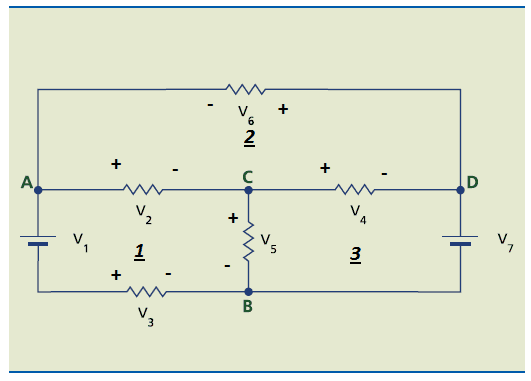
5433016700_1402290090.png

now for first loop we write KVL
-V1+V2+V5-V3=0
and for third loop we have
-V7-V4+V5=0

above equations were an example of setting voltage signs.after set the voltage sing and write KVL equation you should solve them.i assume that we find V5=2 and V3=-1 so the circuit could be same as this
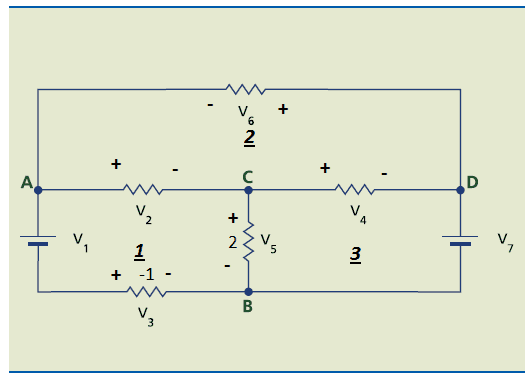
7415916400_1402290457.png

or combine the sign of voltage that specified and the sign of voltage that you obtain. redraw the circuit like this
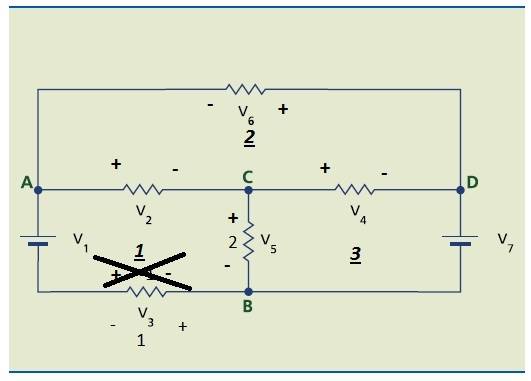
2507908400_1402290458.jpg
 
Last edited:
baby_1 said:
Dear Jhenrique
for writeing KVL equation at first you should define the direction of current or voltage of each element.it depends on you how you can assume the element voltage or current sign or direction.for example i set the voltage sign in this form
5433016700_1402290090.png

now for first loop we write KVL
-V1+V2+V5-V3=0
and for third loop we have
-V7-V4+V5=0

above equations were an example of setting voltage signs.after set the voltage sing and write KVL equation you should solve them.i assume that we find V5=2 and V3=-1 so the circuit could be same as this
7415916400_1402290457.png

or combine the sign of voltage that specified and the sign of voltage that you obtain. redraw the circuit like this
2507908400_1402290458.jpg

Your approach is very interesting!
 
  • #10
Jhenrique said:
Ok... so why the my equations in the 1st post are wrong?

I said don't waste time guessing the direction of the currents. Just chose one. Your 1st post is wrong because you didn't chose a direction
 
  • #11
dauto said:
I said don't waste time guessing the direction of the currents. Just chose one. Your 1st post is wrong because you didn't chose a direction

I found another way more easy of solve it (my ideia isn't solve the problem, is understand the dynamical of the electrical circuit)

if I apply the hydraulic analogy like this video:


and the superpostion theorem:
http://en.wikipedia.org/wiki/Superposition_theorem

together with KVL
##\oint \vec{E} \cdot d\vec{s} = 0##

in this case:
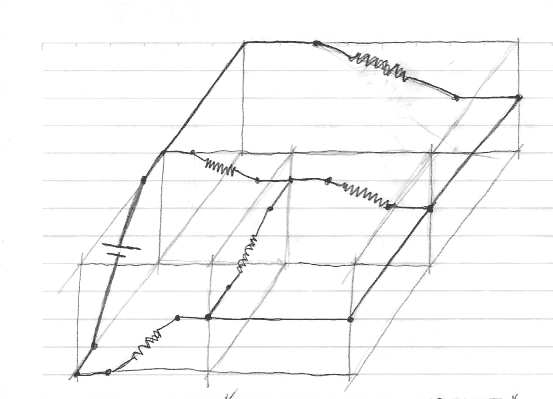
attachment.php?attachmentid=70470&stc=1&d=1402348364.png


and choose a mesh and a sense of circulation, so the "ramps" (source or resistor) would have positive voltage and the declivities correspond to negative voltage!
 
Last edited by a moderator:
  • #12
Jhenrique said:
I found another way more easy of solve it (my ideia isn't solve the problem, is understand the dynamical of the electrical circuit)

if I apply the hydraulic analogy like this video:


and the superpostion theorem:
http://en.wikipedia.org/wiki/Superposition_theorem

together with KVL
##\oint \vec{E} \cdot d\vec{s} = 0##

in this case:
attachment.php?attachmentid=70470&stc=1&d=1402348364.png


and choose a mesh and a sense of circulation, so the "ramps" (source or resistor) would have positive voltage and the declivities correspond to negative voltage!


Yes, that's the way to solve the problem. Guess what you will get out of it. Yes, you get Kirchhoffs' laws. No kidding...
 
Last edited by a moderator:
  • #13
dauto said:
Yes, that's the way to solve the problem. Guess what you will get out of it. Yes, you get Kirchhoffs' laws. No kidding...

The 2nd Kirchhoff's law is quite elaborate! I never would understand the ideia, the principle, the fundament, the dynamical of the thing if I hadn't watched the caltech's video...
 

Similar threads

  • · Replies 16 ·
Replies
16
Views
2K
  • · Replies 1 ·
Replies
1
Views
2K
Replies
2
Views
8K
  • · Replies 16 ·
Replies
16
Views
4K
  • · Replies 2 ·
Replies
2
Views
4K
  • · Replies 4 ·
Replies
4
Views
1K
  • · Replies 2 ·
Replies
2
Views
2K
  • · Replies 1 ·
Replies
1
Views
2K
  • · Replies 7 ·
Replies
7
Views
4K
  • · Replies 30 ·
2
Replies
30
Views
3K