Applying KVL: Understanding the Process and Confusions

  • Thread starter Thread starter sciman
  • Start date Start date
  • Tags Tags
    Application Kvl
Click For Summary

Homework Help Overview

The discussion revolves around applying Kirchhoff's Voltage Law (KVL) in the context of an electrical circuit consisting of two batteries and two resistors. The original poster expresses confusion about the correct process for assigning currents and polarities in the circuit loops.

Discussion Character

  • Exploratory, Assumption checking

Approaches and Questions Raised

  • The original poster presents two methods for applying KVL, questioning whether to assign currents first or polarities of resistors. They provide examples of equations derived from both methods and express confusion over discrepancies found in an external source.

Discussion Status

Participants are actively engaging with the original poster's confusion, with one member asking for clarification on the external source referenced. Another participant suggests that discrepancies may be due to a typographical error in the source material.

Contextual Notes

The original poster mentions a specific external website for reference, indicating that the discussion may involve comparing different interpretations or presentations of KVL application.

sciman
Messages
24
Reaction score
1
hello

what is the process to apply KVL exactly?

we know nothing in a loop, apart from that it consists of 2 batteries with known polarity and 2 resistors.

what do we do?

we assign arbitrarily the currents to each of the branches that compose the loop? and then we assign polarities to the resistors?

or we assign arbitrarily polarities to the resistors in the loop and apply kvl based on that and if we find negative values, we just invert the polarity?

I am a bit confused

To give you an example:
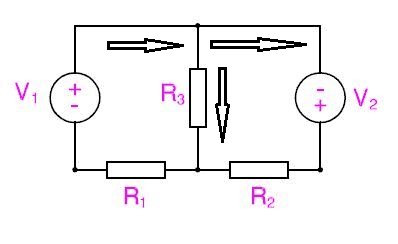
upload_2015-4-15_14-28-19.png


1) according to the first method (we take resistor polarities based on the arbitrarily taken currents)
in left loop, we have V1-Vr3-Vr1=0
in right loop, we have V2-Vr2+Vr3=0
2) according to the second method (we assign polarities of resistors arbitrarily)
in left loop, we have V1-Vr3-Vr1=0
in right loop, we have V2-Vr2+Vr3=0

which are the same, but the website of this example gives:

0cbb994040dab97570b92f9b9749960b.png

and
4321cdc46d8988dee94d4e54a0d32e97.png


WHICH IS DIFFERENT!thanks
 
Last edited:
Physics news on Phys.org
sciman said:
but the website of this example gives:

Which website?
 
sciman said:
hello

what is the process to apply KVL exactly?

we know nothing in a loop, apart from that it consists of 2 batteries with known polarity and 2 resistors.

what do we do?

we assign arbitrarily the currents to each of the branches that compose the loop? and then we assign polarities to the resistors?

or we assign arbitrarily polarities to the resistors in the loop and apply kvl based on that and if we find negative values, we just invert the polarity?

I am a bit confused

To give you an example:
View attachment 82039

1) according to the first method (we take resistor polarities based on the arbitrarily taken currents)
in left loop, we have V1-Vr3-Vr1=0
in right loop, we have V2-Vr2+Vr3=0
2) according to the second method (we assign polarities of resistors arbitrarily)
in left loop, we have V1-Vr3-Vr1=0
in right loop, we have V2-Vr2+Vr3=0

which are the same, but the website of this example gives:
0cbb994040dab97570b92f9b9749960b.png

and
4321cdc46d8988dee94d4e54a0d32e97.png


WHICH IS DIFFERENT!thanks
I think it's just a typo.

He later writes:
a94bdc8bc3c8f2088e7080f82db570a4.png


and
67ea64f45c29bdc54996286d5d07072b.png


which implies using opposite signs for VR3 .
 

Similar threads

  • · Replies 6 ·
Replies
6
Views
2K
Replies
7
Views
1K
  • · Replies 1 ·
Replies
1
Views
2K
  • · Replies 6 ·
Replies
6
Views
3K
  • · Replies 3 ·
Replies
3
Views
993
  • · Replies 3 ·
Replies
3
Views
2K
  • · Replies 12 ·
Replies
12
Views
3K
  • · Replies 7 ·
Replies
7
Views
6K
  • · Replies 9 ·
Replies
9
Views
3K
  • · Replies 11 ·
Replies
11
Views
3K
