Are Electron Orbitals Always Spherical in Shape?

Click For Summary

Discussion Overview

The discussion revolves around the shapes of electron orbitals, specifically whether they are always spherical or if they can take on different geometries, such as the dumbbell shape of the 2p_x orbital. Participants explore the implications of electron excitation, the role of coordinate systems, and the influence of external fields on orbital shapes and spin states.

Discussion Character

  • Debate/contested
  • Conceptual clarification
  • Technical explanation

Main Points Raised

  • Some participants question the characterization of the 2p_x orbital as having a dumbbell shape, suggesting that the z-axis can point in any direction, which complicates the interpretation of orbital shapes.
  • There is a discussion about the nature of spherical harmonics and their relationship to the 2p_x orbital, with some asserting that the 2p_x is a real function and not an eigenfunction of the angular momentum operator.
  • One participant mentions that while orbitals may appear spherical on average, specific conditions, such as polarization of the sample, can lead to non-spherical distributions.
  • There is an inquiry into the nature of electron spin, with some asserting that it exists in a superposition of states rather than having a definite direction, and questioning how such superpositions can be prepared.
  • Another participant states that there is always a coordinate system in which the spin can be aligned along the z-axis, but this may change in the presence of external fields due to spin precession.
  • One participant adds that the choice of which orbital gets excited is influenced by the polarization of the electromagnetic field used for excitation, indicating that the quantization axes can be chosen based on the experimental setup.

Areas of Agreement / Disagreement

Participants express differing views on the shapes of orbitals and the nature of electron spin. There is no consensus on whether orbitals can be considered spherical under all conditions, and the discussion remains unresolved regarding the implications of external fields and the preparation of superpositions.

Contextual Notes

Participants note that the interpretation of orbital shapes may depend on the specific experimental conditions and the definitions used, highlighting the complexity of the topic.

Happiness
Messages
686
Reaction score
30
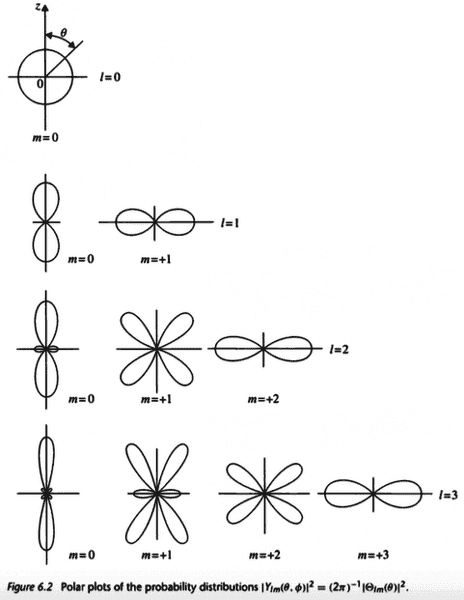
The probability distribution of the position of the electron of a hydrogen atom is related to the following polar plots
Screen Shot 2016-02-25 at 5.18.27 pm.png


Suppose the electron is excited from the ##1s## orbital to the ##2p_x## orbital. Does it make sense to talk about the ##2p_x## orbital having a dumbbell shape pointing in the ##x## direction since the ##z## axis can be pointing in any direction? Shouldn't all orbitals be spherical when we consider there is an equal probability for the ##z## axis to point in any direction?
 
Physics news on Phys.org
Happiness said:
Does it make sense to talk about the 2px2p_x orbital having a dumbbell shape pointing in the xx direction since the zz axis can be pointing in any direction?
What are shown in the picture above are actually the cross-section of ##|Y_{lm}(\theta,\phi)|^2## in the xz plane, so when viewed as a 3D distribution, the ##2p_x## orbital does not have a dumbbell shape.
 
Happiness said:
Suppose the electron is excited from the ##1s## orbital to the ##2p_x## orbital. Does it make sense to talk about the ##2p_x## orbital having a dumbbell shape pointing in the ##x## direction since the ##z## axis can be pointing in any direction?
Be careful that what you posted are pictures of the the spherical harmonics, which are complex functions, while ##p_x## is a real function, linear combination of spherical harmonics, and is not an eigenfunction of ##\hat{L}_z##.

Happiness said:
Shouldn't all orbitals be spherical when we consider there is an equal probability for the ##z## axis to point in any direction?
No, you can have a polarized sample. At equilibrium, you should have on average an isotropic distribution, but one can prepare an atomic sample in a given ##l, m_l## state. Note that the preparation aspect is going to define a laboratory z axis: the choice of axes is no longer arbitrary.
 
  • Like
Likes   Reactions: Happiness
Must the spin angular momentum of an electron have a definite direction or could it be in a superposition of being in manydifferent directions? If so, how can we prepare such a superposition?
 
Happiness said:
Must the spin angular momentum of an electron have a definite direction or could it be in a superposition of being in manydifferent directions? If so, how can we prepare such a superposition?
It is always in some superposition. If it is aligned along z in some coordinate system, it is in a superposition in any coordinate system where z' is not colinear with z.
 
  • Like
Likes   Reactions: Happiness
DrClaude said:
It is always in some superposition. If it is aligned along z in some coordinate system, it is in a superposition in any coordinate system where z' is not colinear with z.

So there must always exist exactly one coordinate system in which the spin is aligned along its z axis?
 
Happiness said:
So there must always exist exactly one coordinate system in which the spin is aligned along its z axis?
Yes. In the presence of an external field, you also have to account for spin precession, so it is possible that that coordinate system is a rotating one.
 
  • Like
Likes   Reactions: Happiness
I just want to add that which orbital gets excited depends on the polarisation of the exciting electromagnetic field. The propagation direction defines one axis and the direction of the em field fixes another one. It is convenient to chose the quantization axes accordingly.
 

Similar threads

  • · Replies 21 ·
Replies
21
Views
3K
  • · Replies 10 ·
Replies
10
Views
2K
  • · Replies 43 ·
2
Replies
43
Views
5K
  • · Replies 16 ·
Replies
16
Views
2K
  • · Replies 10 ·
Replies
10
Views
2K
  • · Replies 7 ·
Replies
7
Views
2K
  • · Replies 36 ·
2
Replies
36
Views
9K
  • · Replies 14 ·
Replies
14
Views
2K
  • · Replies 3 ·
Replies
3
Views
2K
  • · Replies 1 ·
Replies
1
Views
2K