Discussion Overview
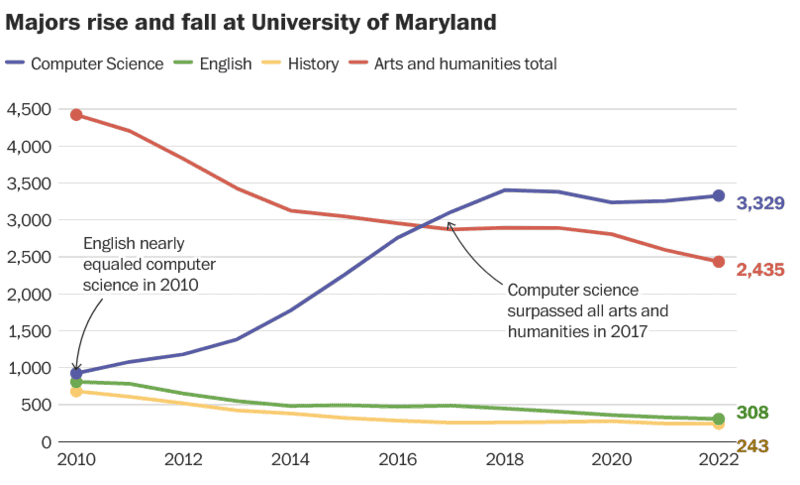
The discussion revolves around the increasing number of students pursuing degrees in Computer Science (CS) and whether this trend is beneficial or problematic. Participants explore various aspects of this trend, including job market implications, educational content, and the balance between technical and liberal arts education.
Discussion Character
- Debate/contested
- Conceptual clarification
- Exploratory
Main Points Raised
- Some participants express concern that the influx of students into CS may lead to an oversaturation of the job market, questioning how many graduates are "too many."
- Others argue that the perception of job opportunities in CS drives students to pursue these degrees, especially given the rising costs of education and the perceived lower financial return of humanities degrees.
- One participant highlights the importance of aligning educational objectives with market demands, noting that the skills of graduates may not match the needs of employers.
- Concerns are raised about the appropriateness of including non-technical subjects, such as 19th-century literature, in a technology-focused curriculum, suggesting that more relevant courses would better prepare students for the workforce.
- Some participants reflect on the value of a well-rounded education, suggesting that a narrow focus on technical skills may limit adaptability in a changing job market.
- There is a discussion about the potential for CS programs to become "impacted," indicating that local demand may exceed available resources for students.
- Participants question the effectiveness of current educational structures in providing a balanced education that prepares students for diverse career paths.
Areas of Agreement / Disagreement
Participants do not reach a consensus on whether too many students are entering CS or what the ideal number should be. Multiple competing views exist regarding the value of a rounded education versus a focused technical curriculum, and the discussion remains unresolved.
Contextual Notes
Participants express various assumptions about job market dynamics, educational content relevance, and the long-term career trajectories of graduates, which remain unexamined in detail.