Area of 'that' part of the circle ....

  • Context: MHB 
  • Thread starter Thread starter marutkpadhy
  • Start date Start date
  • Tags Tags
    Area Circle
Click For Summary

Discussion Overview

The discussion revolves around finding the area of the region of a circle defined by the equation x² + y² = 16 that lies outside the parabola defined by y² = 6x. Participants explore the setup of integrals and the process of determining limits of integration, focusing on the intersection points of the curves and the area calculation methods.

Discussion Character

  • Exploratory, Technical explanation, Homework-related, Mathematical reasoning

Main Points Raised

  • One participant suggests using integrals to find the area of the circle exterior to the parabola.
  • Another participant proposes a method involving symmetry and doubling the area calculated in one quadrant.
  • A participant expresses confusion about the topic and requests a detailed solution, indicating they are new to the subject.
  • There is a discussion about determining the limits of integration by finding the intersection points of the circle and parabola.
  • Participants identify the intersection points as x = 2 and discard x = -8 as irrelevant.
  • There is a repeated emphasis on the integration process, specifically the form f(x) - g(x) for the area between curves.
  • One participant writes down the integral for the area and proposes doubling the result, but another questions the correctness of their area calculation.
  • Participants discuss the appropriate substitution for the integral representing the area calculation.

Areas of Agreement / Disagreement

Participants generally agree on the approach to set up the integral and the need to find the intersection points. However, there is no consensus on the final area calculation or the correctness of specific values derived during the discussion.

Contextual Notes

Some participants express uncertainty about the LaTeX system and mathematical expressions on the web. There are also unresolved details regarding the specific substitution needed for the integration process.
marutkpadhy
Messages
9
Reaction score
0
Using integral find the area of that part of the circle x^2 + y^2 = 16 which is exterior to the parabola y^2 = 6x.
 
Physics news on Phys.org
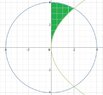
I would use the following diagram:

View attachment 2707

We know half of the circle is exterior to the parabola, which is the part to the left of the $y$-axis. We know both curves are symmetrical about the $x$-axis, so we need only find the area in green, double it, then add it to the half-circle.

Can you set up the integral to find the area in green?
 

Attachments

  • circleparabola.jpg
    circleparabola.jpg
    17.4 KB · Views: 104
No :/ I am very new to this topic, I am learning. I would appreciate if you could give the detailed solution, please. :)

Also, I am very confused with this LaTeX system, and expressing mathematics on web. :(
 
Providing a detailed solution won't help you nearly as much as guiding you through the problem, so that you are an active participant in the process.

First, let's determine our limits of integration. The left limit is easy, it is just $x=0$. For the right limit, we need to determine where the circle and parabola intersect. So, solve both equations for $y^2$, and equate the two results, and then solve for $x$, discarding any roots that do not apply. What do you find?
 
x = 2 or -8, discarding -8, we have only solution for x = 2.
now?
 
marutkpadhy said:
x = 2 or -8, discarding -8, we have only solution for x = 2.
now?

Yes, good. So, how do we find the area between two curves on a given interval?
 
By Integrating,
f(x) - g(x)
where these two functions are of the curves.
Now? Please guide me the whole solution.
 
marutkpadhy said:
By Integrating,
f(x) - g(x)
where these two functions are of the curves.
Now? Please guide me the whole solution.

Why? You already have said what it is you have to do. Write down what f(x) - g(x) is and integrate it over the given region...
 
marutkpadhy said:
By Integrating,
f(x) - g(x)
where these two functions are of the curves.
Now? Please guide me the whole solution.

Correct...can you write the integral? You know the limits of integration, and you simply need to solve for $y$ in the two curves, taking the first quadrant roots. What is the integral representing the area I shaded above in green?
 
  • #10
Integrating ( \sqrt{16-x^2} - \sqrt{6x} ),
lower limit = 0,
upper limit = 2
right?
then doubling the answer,
+ \pi r^2 / 2 = 8
 
  • #11
Yes, you have the right idea (I don't know how you got an answer of 8 though). The total area $A$ is:

$$A=\frac{1}{2}\pi\cdot4^2+2\int_0^2 \sqrt{16-x^2}-\sqrt{6x}\,dx$$

The second term in the integrand is a straightforward application of the power rule, but can you tell me what type of substitution would be appropriate for the first term?
 

Similar threads

  • · Replies 29 ·
Replies
29
Views
5K
  • · Replies 24 ·
Replies
24
Views
4K
  • · Replies 3 ·
Replies
3
Views
2K
  • · Replies 1 ·
Replies
1
Views
1K
  • · Replies 5 ·
Replies
5
Views
3K
  • · Replies 2 ·
Replies
2
Views
3K
  • · Replies 33 ·
2
Replies
33
Views
7K
  • · Replies 3 ·
Replies
3
Views
3K
  • · Replies 1 ·
Replies
1
Views
3K
  • · Replies 4 ·
Replies
4
Views
3K