Area of Triangle ABC: Find the Answer Here

  • Context: MHB 
  • Thread starter Thread starter ketanco
  • Start date Start date
  • Tags Tags
    Area Triangle
ketanco
Messages
15
Reaction score
0
what is the area of triangle ABC in the attached? answer is 18

i can not construct any similar triangles here. all i can see is area of ACD is 3 times area of ABD but how does it help me...
View attachment 8598
 

Attachments
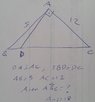
  • 06-4.jpg
    06-4.jpg
    17.1 KB · Views: 119
Mathematics news on Phys.org
ketanco said:
what is the area of triangle ABC in the attached? answer is 18

i can not construct any similar triangles here. all i can see is area of ACD is 3 times area of ABD but how does it help me...

How about extending AC to E such that ACD is similar to ECB?

[TIKZ]
\def\x{sqrt(265)/4}
\def\gamma{atan2(3,16)}
\coordinate[label=above:A] (A) at ({4*\x - 12 * cos(\gamma)},{12 * sin(\gamma)});
\coordinate[label=left:B] (B) at (0,0);
\coordinate[label=right:C] (C) at ({4*\x},0);
\coordinate[label=below:D] (D) at ({\x},0);
\coordinate[label=above:E] (E) at ({4*\x - 16 * cos(\gamma)},{16 * sin(\gamma)});

\draw[rotate={270-\gamma}] (A) +(0.4,0) -- +(0.4,0.4) -- +(0,0.4);
\draw[rotate={270-\gamma}] (E) +(0.4,0) -- +(0.4,0.4) -- +(0,0.4);

\draw (C) -- node[above] {12} (A) -- node[above left] {5} (B);
\draw (A) -- (D);
\draw (A) -- (E) -- (B);
\path (B) -- node[below] {$x$} (D) -- node[below] {$3x$} (C);
\draw[blue, ultra thick] (A) -- (B) -- (C) -- cycle;
[/TIKZ]
 
Klaas van Aarsen said:
How about extending AC to E such that ACD is similar to ECB?

[TIKZ]
\def\x{sqrt(265)/4}
\def\gamma{atan2(3,16)}
\coordinate[label=above:A] (A) at ({4*\x - 12 * cos(\gamma)},{12 * sin(\gamma)});
\coordinate[label=left:B] (B) at (0,0);
\coordinate[label=right:C] (C) at ({4*\x},0);
\coordinate[label=below:D] (D) at ({\x},0);
\coordinate[label=above:E] (E) at ({4*\x - 16 * cos(\gamma)},{16 * sin(\gamma)});

\draw[rotate={270-\gamma}] (A) +(0.4,0) -- +(0.4,0.4) -- +(0,0.4);
\draw[rotate={270-\gamma}] (E) +(0.4,0) -- +(0.4,0.4) -- +(0,0.4);

\draw (C) -- node[above] {12} (A) -- node[above left] {5} (B);
\draw (A) -- (D);
\draw (A) -- (E) -- (B);
\path (B) -- node[below] {$x$} (D) -- node[below] {$3x$} (C);
\draw[blue, ultra thick] (A) -- (B) -- (C) -- cycle;
[/TIKZ]
i see... thanks !
 

Similar threads

  • · Replies 17 ·
Replies
17
Views
3K
  • · Replies 5 ·
Replies
5
Views
2K
  • · Replies 2 ·
Replies
2
Views
2K
  • · Replies 4 ·
Replies
4
Views
2K
  • · Replies 5 ·
Replies
5
Views
3K
Replies
2
Views
2K
Replies
6
Views
2K
Replies
1
Views
2K
  • · Replies 2 ·
Replies
2
Views
5K
  • · Replies 4 ·
Replies
4
Views
2K