Arithmetic Sequence: Definition & Examples

  • Context:
  • Thread starter Thread starter Albert1
  • Start date Start date
  • Tags Tags
    Arithmetic Sequence
Join the discussion
Registration is free. Ask a follow-up in this thread, or start your own.
2 replies · 2K views
Albert1
Messages
1,221
Reaction score
0

Attachments

  • arithmetic sequence.jpg
    arithmetic sequence.jpg
    19.2 KB · Views: 153
Mathematics news on Phys.org
Re: arithmetic sequence

Here is my solution:

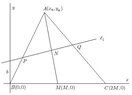
I chose to use a coordinate geometry approach. Please refer to the following diagram:

View attachment 1742

The following line segments lie along the lines:

$$\overline{AB}\implies y=\frac{y_a}{x_a}x$$

$$\overline{AM}\implies y=\frac{y_a(x-M)}{x_a-M}$$

$$\overline{AC}\implies y=\frac{y_a(x-2M)}{x_a-2M}$$

And let line $\ell_1$ be given by $$y=mx+b$$ where $$0\le b$$.

And so we find the coordinates of the following points:

$$P\implies \left(\frac{bx_a}{y_a-mx_a},\frac{by_a}{y_a-mx_a} \right)$$

$$N\implies \left(\frac{b\left(x_a-M \right)+My_a}{y_a-m\left(x_a-M \right)},\frac{y_a(b+mM)}{y_a-m\left(x_a-M \right)} \right)$$

$$Q\implies \left(\frac{b\left(x_a-2M \right)+2My_a}{y_a-m\left(x_a-2M \right)},\frac{y_a(b+2mM)}{y_a-m\left(x_a-2M \right)} \right)$$

Next, using the distance formula, we find the lengths of the following line segments:

$$\overline{AB}\implies \sqrt{x_a^2+y_a^2}$$

$$\overline{AM}\implies \sqrt{\left(x_a-M \right)^2+y_a^2}$$

$$\overline{AC}\implies \sqrt{\left(x_a-2M \right)^2+y_a^2}$$

$$\overline{AP}\implies \frac{y_a-mx_a-b}{y_a-mx_a}\sqrt{x_a^2+y_a^2}$$

$$\overline{AN}\implies \frac{y_a-mx_a-b}{y_a-m\left(x_a-M \right)}\sqrt{\left(x_a-M \right)^2+y_a^2}$$

$$\overline{AQ}\implies \frac{y_a-mx_a-b}{y_a-m\left(x_a-2M \right)}\sqrt{\left(x_a-2M \right)^2+y_a^2}$$

Now, we find the following ratios:

$$r_1=\frac{\overline{AB}}{\overline{AP}}=\frac{y_a-mx_a}{y_a-mx_a-b}$$

$$r_2=\frac{\overline{AM}}{\overline{AN}}=\frac{y_a-m\left(x_a-M \right)}{y_a-mx_a-b}$$

$$r_3=\frac{\overline{AC}}{\overline{AQ}}=\frac{y_a-m\left(x_a-2M \right)}{y_a-mx_a-b}$$

And so we find:

$$r_1-r_1=r_3-r_2=\frac{mM}{y_a-mx_a-b}$$

And so we may conclude the 3 ratios are an arithmetic progression. This follows from the $x$-coordinates of points $B$, $M$ and $C$ being an arithmetic progression.
 

Attachments

  • albert02.jpg
    albert02.jpg
    9.4 KB · Views: 137
Albert said:
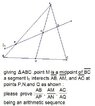
https://www.physicsforums.com/attachments/1741
[sp]This is a generalisation of the problem in http://mathhelpboards.com/geometry-11/vector-geometry-problem-8032.html, and one way to tackle it is by using vector geometry, as Pranav did in that thread.

Let $\lambda = \dfrac{{AB}}{{AP}}$, $\mu = \dfrac{{AM}}{{AN}}$, $\nu = \dfrac{{AC}}{{AQ}}$, $\mathbf{b} = \vec{AB}$ and $\mathbf{c} = \vec{AC}$. Then $$\vec{AP} = \frac1\lambda \mathbf{b},\quad \vec{AN} = \frac1{2\mu}(\mathbf{b} + \mathbf{c}), \quad \vec{AQ} = \frac1\nu\mathbf{c}.$$ The points $P,\ N,\ Q$ are collinear, so $\vec{PN} = \alpha\,\vec{QN}$ for some scalar $\alpha$. Hence $$\frac1{2\mu}(\mathbf{b} + \mathbf{c}) - \frac1\lambda \mathbf{b} = \alpha\Bigl(\frac1{2\mu}(\mathbf{b} + \mathbf{c}) - \frac1\nu\mathbf{c} \Bigr).$$ Compare coefficients of $\mathbf{b}$ and $\mathbf{c}$ to get $$\frac1{2\mu} - \frac1\lambda = \frac{\alpha}{2\mu}, \qquad \frac1{2\mu} = \frac\alpha{2\mu} - \frac{\alpha}{\nu}.$$ Thus $\dfrac1\lambda = -\dfrac{\alpha}{\nu}$ so that $\alpha = -\dfrac\nu\lambda.$ Substitute that into the previous displayed equation to get $$\frac1{2\mu} - \frac1\lambda = -\frac{\nu}{2\lambda\mu}.$$ Clearing fractions, you see that $\lambda - 2\mu + \nu = 0$, which means that $\lambda$, $\mu$ and $\nu$ are in arithmetic progression.[/sp]
 
Last edited: