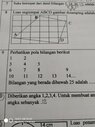
What is the number below 25 in this sequence?

  • Context: MHB 
  • Thread starter Thread starter Monoxdifly
  • Start date Start date
  • Tags Tags
    Geometry Series
Click For Summary
SUMMARY

The discussion centers on solving two specific problems from an Elementary School Math Olympiad: determining the area of a quadrilateral and identifying the number below 25 in a sequence. The sequence is analyzed, revealing that the number directly below 25 is 32, based on the arrangement of numbers in a grid format. The participants express uncertainty about the placement of numbers and the rules governing their arrangement, particularly regarding the spacing and positioning of numbers like 8 and 9.

PREREQUISITES
  • Understanding of basic geometry, specifically quadrilaterals
  • Familiarity with number sequences and grid arrangements
  • Knowledge of elementary mathematical problem-solving techniques
  • Ability to interpret and analyze mathematical Olympiad questions
NEXT STEPS
  • Research methods for calculating areas of irregular quadrilaterals
  • Explore number theory concepts related to sequences and patterns
  • Study grid-based problem-solving techniques in mathematics
  • Practice with previous Elementary School Math Olympiad questions
USEFUL FOR

Students preparing for math competitions, educators teaching elementary mathematics, and anyone interested in enhancing their problem-solving skills in geometry and number theory.

Monoxdifly
MHB
Messages
288
Reaction score
0
My partner asked me about questions no. 8 and 9.

Number 8 asks about what is the area of the quadrilateral.
Number 9 asks about what number is below the number 25.

Those are questions for Elementary School Math Olympiads in my country but both of us were having a hard time figuring them out.
For question no. 9, if only that number 9 is located right above number 13 it would be easy to solve. However, we don't know whether the placement of 9 above is intentional or not. Can someone help us solve either question?
 

Attachments

  • IMG-20200208-WA0003.jpg
    IMG-20200208-WA0003.jpg
    78.8 KB · Views: 120
Mathematics news on Phys.org
Monoxdifly said:
Number 8 asks about what is the area of the quadrilateral.
So the vertices of the quadrilateral, in particular, $C$, don't lie on the grid nodes? Then I doubt there is a nice answer.

Monoxdifly said:
Number 9 asks about what number is below the number 25.
So I can invent any rule for arranging these numbers? For example, I can place 15 to the right of 14 or I can place it in the beginning of the next line. And I can skip 0, 1, 2, etc. places after 15 or in any other place, just like 1 place is skipped after 8 for no particular reason. Then I doubt there is a nice answer.
 
For the first problem, #8, it looks like you are not expected calculate any precise values but to count rectangles, including estimating areas of partial rectangles.

For #9, I would suspect that the space between 8 and 9 shouldn't be there and write
1 2
3 4 5
6 7 8 9
10 11 12 12 14
15 16 17 18 19 20
21 22 23 24 25 26 27
28 29 30 31 32 33 34 35

So the number under 25 is 32.
 
Last edited by a moderator:

Similar threads

  • · Replies 3 ·
Replies
3
Views
3K
  • · Replies 4 ·
Replies
4
Views
2K
  • · Replies 12 ·
Replies
12
Views
2K
Replies
4
Views
3K
Replies
2
Views
2K
  • · Replies 7 ·
Replies
7
Views
11K
  • · Replies 12 ·
Replies
12
Views
6K
  • · Replies 7 ·
Replies
7
Views
3K
  • · Replies 1 ·
Replies
1
Views
2K
  • · Replies 33 ·
2
Replies
33
Views
8K