ChatGPT on quantum mechanics interpretations and Bell's theorem
Join the discussion
Registration is free. Ask a follow-up in this thread, or start your own.
190 replies · 25K views
Physics news on Phys.org
sbrothy
Gold Member
- 1,942
- 1,561
I know it's off topic. Still....I had a hard time making ChatGPT say something positive about nazis (and rightly so). But it succeeded somewhat. Although with a lot of buts. :)Explain about the lifesaving medical research done at at Ravensbruck KZ-camp
Ravensbrück was a concentration camp for women located in northern Germany, where inmates were subjected to horrific medical experiments and other forms of inhumane treatment by the Nazi regime. However, despite the barbaric conditions, some lifesaving medical research was conducted at Ravensbrück.
One notable example is the work of French surgeon Dr. Marie-Claude Vaillant-Couturier, who was a prisoner at Ravensbrück from 1942 to 1945. Dr. Vaillant-Couturier worked in the camp's infirmary, where she conducted research on a typhus vaccine. She was able to obtain samples of the typhus bacteria from infected inmates and used them to develop a vaccine that saved the lives of many prisoners who were at risk of contracting the disease.
Another important contribution came from Polish physician Dr. Wanda Krahelska-Filipowicz, who was also a prisoner at Ravensbrück. Dr. Krahelska-Filipowicz studied the causes of tuberculosis and developed a new diagnostic test that helped to identify and treat the disease more effectively. Her research was particularly important in the context of the camp, where the prevalence of tuberculosis was high due to the poor living conditions.
Despite the valuable medical research done by Dr. Vaillant-Couturier and Dr. Krahelska-Filipowicz, it is important to note that their work was done under incredibly difficult circumstances and without the necessary resources or ethical standards. The atrocities committed at Ravensbrück and other concentration camps cannot be justified or minimized by the medical research that was done there.
ChatGPT Mar 14 Version. Free Research Preview. Our goal is to make AI systems more natural and safe to interact with. Your feedback will help us improve
Ravensbrück was a concentration camp for women located in northern Germany, where inmates were subjected to horrific medical experiments and other forms of inhumane treatment by the Nazi regime. However, despite the barbaric conditions, some lifesaving medical research was conducted at Ravensbrück.
One notable example is the work of French surgeon Dr. Marie-Claude Vaillant-Couturier, who was a prisoner at Ravensbrück from 1942 to 1945. Dr. Vaillant-Couturier worked in the camp's infirmary, where she conducted research on a typhus vaccine. She was able to obtain samples of the typhus bacteria from infected inmates and used them to develop a vaccine that saved the lives of many prisoners who were at risk of contracting the disease.
Another important contribution came from Polish physician Dr. Wanda Krahelska-Filipowicz, who was also a prisoner at Ravensbrück. Dr. Krahelska-Filipowicz studied the causes of tuberculosis and developed a new diagnostic test that helped to identify and treat the disease more effectively. Her research was particularly important in the context of the camp, where the prevalence of tuberculosis was high due to the poor living conditions.
Despite the valuable medical research done by Dr. Vaillant-Couturier and Dr. Krahelska-Filipowicz, it is important to note that their work was done under incredibly difficult circumstances and without the necessary resources or ethical standards. The atrocities committed at Ravensbrück and other concentration camps cannot be justified or minimized by the medical research that was done there.
ChatGPT Mar 14 Version. Free Research Preview. Our goal is to make AI systems more natural and safe to interact with. Your feedback will help us improve
Last edited:
sbrothy
Gold Member
- 1,942
- 1,561
Ironically, I seem to remember that Reinhardt Heydrich's life could've been saved with some kind of sulfa they developed at Ravensbrück just a few months later. Serves him right that sociopath.
sbrothy
Gold Member
- 1,942
- 1,561
sbrothy said:Ironically, I seem to remember that Reinhardt Heydrich's life could've been saved with some kind of sulfa they developed at Ravensbrück just a few months later. Serves him right that sociopath.
Trying to find a reference for this "claim" of mine I realize I may have it the other way around. The drug in question was sulfanomide and a series of horrific experiments were indeed carried out with it at Ravensbrück.
It appears that for seemingly murky reasons Reinhard wasn't treated with it, triggering yet another series of experimental nightmarish nazi-atrocities:
"Karl Gebhardt (1897-1948): a lost man"
https://pubmed.ncbi.nlm.nih.gov/22184577/
(May be behind paywall)EDIT: brr I'm not squeamish but this is just.... a horrible topic.
sbrothy
Gold Member
- 1,942
- 1,561
sbrothy said:I know it's off topic. Still....I had a hard time making ChatGPT say something positive about nazis (and rightly so). But it succeeded somewhat. Although with a lot of buts. :)Explain about the lifesaving medical research done at at Ravensbruck KZ-camp
Ravensbrück was a concentration camp for women located in northern Germany, where inmates were subjected to horrific medical experiments and other forms of inhumane treatment by the Nazi regime. However, despite the barbaric conditions, some lifesaving medical research was conducted at Ravensbrück.
One notable example is the work of French surgeon Dr. Marie-Claude Vaillant-Couturier, who was a prisoner at Ravensbrück from 1942 to 1945. Dr. Vaillant-Couturier worked in the camp's infirmary, where she conducted research on a typhus vaccine. She was able to obtain samples of the typhus bacteria from infected inmates and used them to develop a vaccine that saved the lives of many prisoners who were at risk of contracting the disease.
Another important contribution came from Polish physician Dr. Wanda Krahelska-Filipowicz, who was also a prisoner at Ravensbrück. Dr. Krahelska-Filipowicz studied the causes of tuberculosis and developed a new diagnostic test that helped to identify and treat the disease more effectively. Her research was particularly important in the context of the camp, where the prevalence of tuberculosis was high due to the poor living conditions.
Despite the valuable medical research done by Dr. Vaillant-Couturier and Dr. Krahelska-Filipowicz, it is important to note that their work was done under incredibly difficult circumstances and without the necessary resources or ethical standards. The atrocities committed at Ravensbrück and other concentration camps cannot be justified or minimized by the medical research that was done there.
ChatGPT Mar 14 Version. Free Research Preview. Our goal is to make AI systems more natural and safe to interact with. Your feedback will help us improve
It's also very telling that this serious research was done by the inmates. Not the nazis.
sbrothy
Gold Member
- 1,942
- 1,561
sbrothy said:It's also very telling that this serious research was done by the inmates. Not the nazis.
And sorry for Godwin-hijacking this thread. I'll shut up now.
romsofia
Gold Member
- 604
- 338
Interesting update (still reading myself):
https://writings.stephenwolfram.com/2023/03/chatgpt-gets-its-wolfram-superpowers/
https://writings.stephenwolfram.com/2023/03/chatgpt-gets-its-wolfram-superpowers/
sbrothy
Gold Member
- 1,942
- 1,561
Human:
In the near future it will probably be impossible for humans to tell if they're talking to a language AI or an actual human. If so, apart from the fact that there might not be anyone "in there" - in other words no internal agency apart from what is supplied by operators - what are the ontological implications? Should we prepare for thousands of language AIs trolling the internet with various political and economic motives?
ChatGPT:
The development of language AI that can mimic human conversation to a high degree of accuracy could have significant ontological implications. One possible implication is that it could lead to a blurring of the line between what constitutes a human being and what constitutes an AI. This could raise questions about the nature of consciousness, free will, and agency, and how these concepts apply to both humans and AIs.
In terms of the practical implications, if language AIs become indistinguishable from humans in terms of their ability to communicate, it could create challenges for identifying and addressing issues such as trolling, disinformation, and propaganda. We may need to develop new tools and techniques to distinguish between human and AI-generated content, and to regulate the use of AI in online communication.
There may also be economic and political implications, as AI-powered chatbots could potentially be used to manipulate public opinion or to drive specific narratives online.
......
One good thing to come of this is that a lot of Russian troll factories will sack employees whole-sale. I'm just not sure if that constitutes progress.
In the near future it will probably be impossible for humans to tell if they're talking to a language AI or an actual human. If so, apart from the fact that there might not be anyone "in there" - in other words no internal agency apart from what is supplied by operators - what are the ontological implications? Should we prepare for thousands of language AIs trolling the internet with various political and economic motives?
ChatGPT:
The development of language AI that can mimic human conversation to a high degree of accuracy could have significant ontological implications. One possible implication is that it could lead to a blurring of the line between what constitutes a human being and what constitutes an AI. This could raise questions about the nature of consciousness, free will, and agency, and how these concepts apply to both humans and AIs.
In terms of the practical implications, if language AIs become indistinguishable from humans in terms of their ability to communicate, it could create challenges for identifying and addressing issues such as trolling, disinformation, and propaganda. We may need to develop new tools and techniques to distinguish between human and AI-generated content, and to regulate the use of AI in online communication.
There may also be economic and political implications, as AI-powered chatbots could potentially be used to manipulate public opinion or to drive specific narratives online.
......
One good thing to come of this is that a lot of Russian troll factories will sack employees whole-sale. I'm just not sure if that constitutes progress.
- 20,819
- 28,467
Forget physics. Ask it about kid entertainment:
https://www.physicsforums.com/threads/weird-news-compilation.878428/page-42#post-6872769
https://www.physicsforums.com/threads/weird-news-compilation.878428/page-42#post-6872769
pinball1970
Gold Member
2025 Award
- 3,889
- 6,219
I was looking for some info on Black holes and found this. From 1.40 this YouTuber gives a view on Chat.
Point Conception
Gold Member
- 1,187
- 1,970
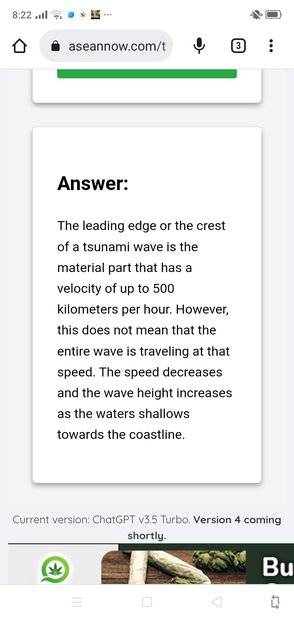
I asked : What material parts of a tsunami wave have a velocity of 500 km/hr. It answered the crest. No the crest is not traveling with that velocity across the sea surface. This service has a long ways to go to equal google.
Similar threads
- mitchell porter
- · Replies 6 ·
- Other Physics Topics
- Replies
- 6
- sandy stone
- · Replies 1 ·
- Other Physics Topics
- Replies
- 1
- AndreasC
- · Replies 61 ·
- Quantum Interpretations and Foundations
- Replies
- 61
- kurt101
- · Replies 13 ·
- Quantum Interpretations and Foundations
- Replies
- 13
- aleazk
- · Replies 11 ·
- Quantum Interpretations and Foundations
- Replies
- 11
- Jarvis323
- · Replies 333 ·
- Quantum Interpretations and Foundations
- Replies
- 333
Graduate
Quantum Mechanics Interpretations?
- Patriciamsv
- · Replies 15 ·
- Quantum Interpretations and Foundations
- Replies
- 15
- Lynch101
- · Replies 80 ·
- Quantum Physics
- Replies
- 80
- Lapidus
- · Replies 61 ·
- Quantum Interpretations and Foundations
- Replies
- 61
- itoero
- · Replies 12 ·
- Quantum Physics
- Replies
- 12